29 November 2017

Should Jolovan Wham have held a protest in a train?

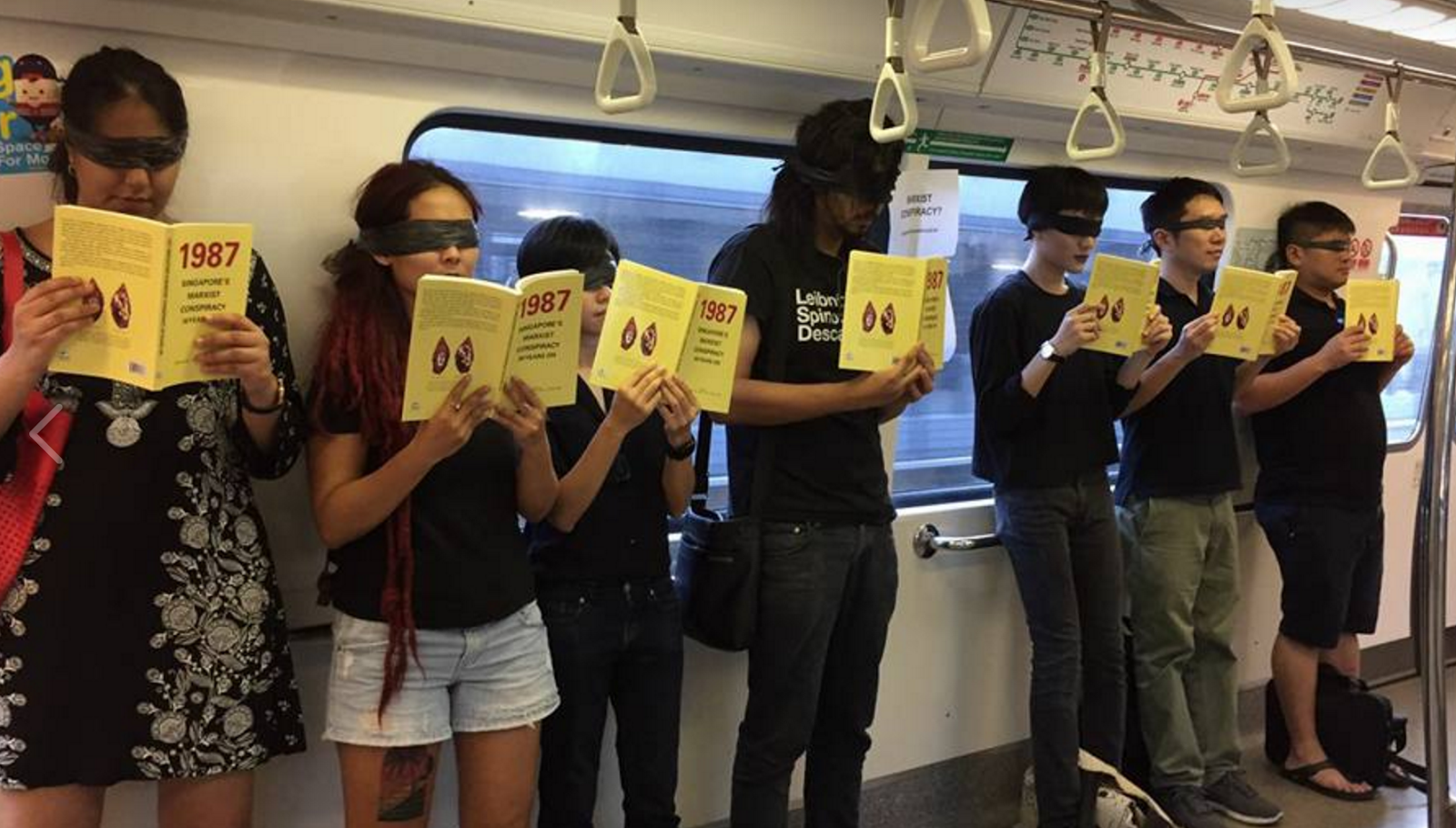
On 3 June 2017, Kirsten Han announced that her fellow activist Jolovan Wham had organised a protest in a Singapore Mass Rapid Transit train. Han reposted on her Facebook a series of photographs from Wham's personal page, showing Wham and eight others sitting blindfolded in a train carriage, holding up the recently published 1987: Singapore’s Marxist Conspiracy 30 Years On, with homemade posters stuck on the walls behind them. While Wham was tagged by Han, his collaborators and co-conspirators are instantly recognisable as activists of a certain bent in Singapore. Everyone knows who they are, but their names will not be mentioned here.


On the morning of 3 June 2017 while Kirsten Han was likely involved in the coordination of the dissemination of the news of the protest, if not the protest itself, I was attending in my personal capacity, as I note were some other members of the Community Action Network, the Singapore Heritage Society 30th anniversary lecture by Prof Kwok Kian-woon at the Singapore Management University.

I had no prior knowledge of the protest. I was not involved in its conception, deliberation, or execution. I was not invited to be part of it. If invited, I would have told them it was a stupid idea that would get them thrown in jail, whether they did it in Singapore, New York, or London.

08 November 2017

Singapore transport failure clown show: The Parliament edition

Singapore's train system has been suffering from one public embarrassment to another, breaking its own record for breakdowns every year while the Land Transport Authority (LTA) and the Ministry of Transportation double down by releasing questionable statistics to show that in some metrics they cherry-pick, Singapore's train system is doing better than ever.

You would think when senior management staff get caught falsifying systems management records for at least the past year, that the parliament sitting the next week would be a time of reckoning for the ministry, its regulatory body, their too-big-to-fail train operator Singapore Mass Rapid Transit (SMRT), and its line of incompetent bosses.

But then, this is the same august body that harboured the delusion of thinking it could proclaim the prime minister guiltless in open parliament, based solely on his testimony of events and not an independent investigation by a special counsel. Minister Khaw Boon Wan's performance yesterday is par for the course, in other words, for the national transport clown show.

03 November 2017

The realities of Singapore's online landscape

Bertha Henson and Daniel Yap have announced the impending closure of The Middle Ground (TMG), revealing that the news website had failed to meet the challenges of sustainability. Earlier last month, the trio of Dr Thum Pin Tjin, Kirsten Han, and Sonny Liew announced the setting up of "New Naratif" and rolled out their vision, accountability, and subscription model.

Bertha Henson has done a great job with TMG and will be back with Bertha Harian
These developments may fit the establishment's Wild West model of Singapore's online news media, where newcomers can rise out of nowhere to carve an empire of their own, then fall just as fast or settle into also-ran status. On a less simplistic level, the online media landscape is dominated and controlled by Singapore's regulatory framework to such an extent that no full-fledged news site can be economically viable. Where the Newspaper and Printing Presses Act empowers the government to shutter presses as it pleases and more insidiously and demand presses award shares to entities it chooses, recent Media Development Authority regulations empower the government to demand any news site it chooses to cough up hefty monetary guarantees, and to demand forfeiture of that guarantee at its discretion.

Singapore's regulatory framework is a deterrence against the setting up of online news sites, and indirectly incentivises bloggers to stay small and stay within the government's OB markers.

13 October 2017

Endgame for the 2017 presidential election

Who won the 2017 presidential election?

The big winner of the 2017 presidential election is not the PAP nor its proxy candidate, Halimah Yacob. This honour goes to the outgoing president, Dr Tony Tan.

09 October 2017

Decoding the social media narratives of the 2017 presidential election

It is significant that during the 2017 presidential campaign, the issues that the social media saw as significant to the election had very little congruence with what the candidates themselves, the People's Action Party government, and even we saw as significant and wanted to talk about. It is significant that instead of lulling the electorate to general apathy, this disconnect has served to galvanise them and stoke up their anger at the PAP.

Were these narratives part of an unofficial, yet highly coordinated campaign? Were these narratives more spin, conspiracy theory, and fake news than a reflection of the legitimate issue, that the PAP had compromised Singapore's national principles of multiracialism and meritocracy? Why does it matter if they were? Did we, the people goof up the presidential election as much as the PAP, the elections department, and the candidates themselves?

04 October 2017

Decoding the narratives of the 2017 presidential election campaign

We have established that Singapore's People's Action Party government and its proxy campaign for candidate Halimah failed to craft a winning narrative for the election that was credible. Big picture concepts like meritocracy and multiracialism were thrown up in order to manufacture a consensus around Halimah, yet the effect was to convince the populace that the PAP had become deluded, self-serving, or completely Orwellian.

But what about the semi-campaigns of the three candidates?

28 September 2017

Breaking the presidency and Singapore, straw by straw

The radical changes to the presidency that the People's Action Party mooted and enacted in 2016 have angered a public originally resigned to seeing the office incrementally remade at the whims of the PAP, for the convenience of the PAP. The old changes fooled no one into thinking they were designed to fix the problems of the presidency; the new changes fool very few as well.

In 2016 when the changes were mooted, it was expected that candidate Halimah, whose hat was thrown into the ring by class clown Chan Chun Seng, would have an easy walkover in the reserved election for a Malay president.

But it was the PAP's proxy campaign for candidate Halimah and its off-kilter messaging that convinced a large section of Singaporeans that the ruling party was intent on endangering the social fabric of Singapore itself, just to ensure a win for its candidate.

The PAP succeeded in wrecking the presidency far better than Wreck-it Ralph

25 September 2017

Before the reservation: The internal contradictions of Singapore's elected presidency

Lee Hsien Loong's People's Action Party (PAP) government began in 2016 its radical reforms to the elected presidency, a rush job of the highest order.

A case was made out for the necessity of the changes at the beginning of the year, a thoroughly respectable constitutional commission was convened, public and expert feedback was canvassed through the commission, the commission's report and recommendations pored through and discussed in cabinet, the cabinet's proposed Bill drafted as a response and debated, the Bill read twice and passed in parliament, the expected constitutional challenges and their respective appeals heard and fended off—all in an attempt to ensure the 2017 election would be run under new order rules. (Note: the exercise still ended missing a crucial deadline: Dr Tony Tan's presidency lapsed before his successor was elected.)

In justifying its shifting of the goalposts to engineer its win, Lee has forgotten what was really wrong with the office of the elected presidency to begin with, and has failed to fix it.

Bob the Builder would've done a better job fixing the elected presidency

23 September 2017

Understanding Singapore's 2017 reserved presidential election: an introduction


We extend our thanks to Dr Tony Tan for his service to the nation, and to Mdm Halimah Yacob for making history as the first female president of Singapore.

Mdm Halimah is a legitimate president, however compromised her mandate may be, however her office has been tainted by the PAP's management of the presidency and the election.

More than a week after her inauguration, the Minilee government continues to fight a PR battle to claw back the trust and public goodwill it squandered and to salvage the credibility of the presidency, while public anger at the PAP and incredulity at its error of judgement remain unabated.

The issue will not go away, nor will the public anger be truly abated or assuaged. The appropriation of #notmypresident and continued attacks on Halimah's Yishtana House are just the beginning, and not the fading scream of some sore losers. This PR battle will last beyond the tenure of Mdm Halimah, or indeed that of prime minister Lee Hsien Loong.

Because you see, the problems with the post of the elected president are written in its DNA and made worse by the PAP's continued tinkering with the office.

15 September 2017

No kiss and make-up: Sonny Liew and Singapore's National Arts Council

After Sonny Liew won several Eisner awards for the graphic novel which the National Arts Council (NAC) of Singapore has previously denounced as "potentially undermines the authority and legitimacy of the Government and its public institutions", the government agency (despite its reluctance to spell out its direct affiliation to the ministry of culture on its own website) and self-declared champion of the arts in Singapore released a congratulatory statement whose mixture of embarrassment and halfhearted conciliation did not escape notice.

It appears that this would not be the end of the matter, and it was wrong to expect a kiss and make-up between award-winning artist and the nation's arts administrators.

So we decided to interview Sonny Liew ourselves.

28 August 2017

Au revoir, Auf wiedersehen, Goodbye Huang Jing

Singapore's Ministry of Home Affairs (MHA) recently accused Prof. Huang Jing, an American IR academic and lobbyist at its Lee Kuan Yew School of Public Policy, of conniving with foreign intelligence, on behalf of foreign powers, to subvert the state and interfere with domestic politics, with the help of prominent and influential Singaporeans he enlisted.

To be fair, the MHA gave the good doctor a chance to appeal, and that appeal was eventually rejected.

Huang Jing must leave on a jet plane and never return... after an undefined grace period
But that doesn't mean that the expulsion of the professor, the accusations against him, and the prosecution of his case are credible. We've previously explained why the accusations against him are pure nonsense; we now explain how the MHA's prosecution of Huang's case completely undermines its own security narrative.

19 August 2017

Sonny Liew's Eisner win and the future of arts censorship in Singapore

When we wrote a mini-review of Sonny Liew's presentation of The Art of Charlie Chan Hock Chye almost 2 years ago, we remarked that the graphic novel telling an alternate history of Singapore appeared to be "a pastiche of various periods and styles of comic art that were popular during the 1940s to 1970s".

In the intervening year, we bought a copy of the graphic novel and were amazed at how vastly Liew had undersold himself. Sure, Liew didn't research actually existing comics made by artists in pre-independence Singapore. The Art of Charlie Chan Hock Chye isn't just a pastiche of various periods and styles of comic art; it is a love letter to giants such as Osamu Tezuka, Steve Ditko, Walt Kelly, and Jack Kirby, who have influenced Liew as an artist.

But his book isn't at all an alternate or secret history of Singapore; it is a self-critiquing narrative informed by a historian's understanding that official history is enhanced when it is tempered and even interrogated by the inclusion of multiple viewpoints and the appreciation of paths not taken. It is a masterful love letter to Singapore, warts and all, and a tribute to Singapore's big men and smallfolk alike, and all their dreams.

A post shared by Red Dot Diva (@reddotdiva) on

Photograph of Sonny Liew, reproduced with kind permission from Red Dot Diva

But let's talk about how the clown show at the National Arts Council has to deal with Liew's multiple Eisner wins.

07 August 2017

Is Track II Diplomacy Dead in Singapore?

According to industry analysts, Singapore is the worst place to be a property developer, the worst place to be a tech start-up, and the worst place to be a software programmer. Add to that growing list, the worst place to be a Track II diplomat or lobbyist.

Singapore has proscribed Dr Huang Jing, a US citizen and top professor at its Kuan Yew School of Public Policy (LKYSPP). He will be summarily expelled, his permanent resident status torn up, and his directorships in several state-linked companies dissolved if he doesn't resign from them voluntarily. The communique from the Ministry of Home Affairs (MHA) adopts a security narrative: the professor was "an agent of influence of a foreign country", engaged in subversion and interference in Singapore's domestic politics.


Now let us tell you why this narrative is a giant fail and colossal joke, and what could be actually happening.

27 July 2017

The Apothesosis of Lee Kuan Yew VI

Can we remember Lee Kuan Yew without creating a cult?

A statue of Turkmenbashi, not a statue of Lee Kuan Yew

14 July 2017

Singapore's Speak Mandarin Campaign clown show moment


A funny thing happened on the launch of the 2017 edition of the Speak Mandarin Campaign. The poster, unveiled at the official launch by a minister on 12 July, promotes the 2017 slogan for the campaign, which should translate as "Listen, speak, read, write". Except that the third character 渎 isn't the one for "read" 读. The character 渎 actually means "diss" or "disrespect".

This is what COVFEFE looks like in Chinese. This is what sheer incompetence looks like in Singapore.

23 June 2017

Why the National Archives was no Friend of the Court

Earlier last year, we commented on the case of Lee Wei Ling and Lee Hsien Yang vs Attorney-General that due to their specialist knowledge and unique mandates, the National Archives of Singapore, its fellow SARBICA member associations, or even the International Council of Archives should have submitted an amicae curiae brief to the court if they were not approached by either side to testify.

We argued that a community of archival experts could have provided their perspective on how archival institutions are mandated, given authority and institutional independence, and governed via a clear set of legal frameworks and strict operational and ethical guidelines to handle "secrets", "copyright", and "ownership".

At that time, we were confident that had the NAS or its fellow international archival bodies raised their voices on archival procedure and copyright, the case could've been settled differently, and we were perplexed on their no-show. That is, until today.

30 May 2017

Racism in Singapore comedy? Goodness gracious me!


Youtube influencer Shrey Bhargava attended an audition for the next installment in Hack Neo's "Ah Boys to Men" NSploitation comedy series. It went badly because the casting director requested Shrey to put on a funny Indian accent, and Shrey refused because it was insulting and racist.

Blogger influencer Xiaxue hit back hard, twice, at Shrey. So did his potential cast mates. All hell has broken loose.

Take it from us: This entire thing is a clown show. One that demands your attention.

And why should you listen to us? We actually have writing credits for The Noose. Made our own short films that were screened at The Substation when it was a cultural hub, as well as at the National Museum. And we've even written stand-up routines for local comedians. So let's begin, shall we?

15 May 2017

Date with High Court, Cha-cha with Cheng Bock


It was clear from Dr Tan Cheng Bock's press conference on 31 March 2017 that the good doctor would mount a challenge to the reserved presidential election to be held in Singapore before September 2017. It has been a week since Dr Tan broke the news that he had applied for "a clarification" from the High Court - an application which was accepted.

It is time for us to examine the principles that may guide the court when it makes that clarification for both Dr Tan and the Attorney-General's Chambers. We make no attempt to weigh the "correctness" of these principles or the likelihood that they will be accepted by the Court in its judgement.

24 April 2017

Beware the FAS scandal offside trap!

FIFA's 2015 reform package to improve transparency and accountability in the sport includes a call to remove government appointees from leadership of its regional and national administrative bodies. The reformation has seen a fallout in various countries, with political appointees exiting most unwillingly the national administration of their sport. In squeaky clean, corruption-free Singapore, the Football Association of Singapore (FAS) has to comply with FIFA and hold an unprecedented and contentious election for its leadership.

Following accusations of a "compulsory donation" to the FAS that was funnelled to the ASEAN Football Association (AFF), the FAS and three football clubs have been raided by Singapore's Commercial Affairs Department (CAD), the clubs' chief, the former political appointee president and his right-hand man have been called in for interviews.

Instead of reading sensationalist reportage and hack pieces attacking Bill Ng and questioning how his profitable clubs have so many jackpot machines, we invite you to try our serious analysis on the real issues surrounding this case. Clue: It has nothing to do with legalised, highly regulated, ubiquitous jackpot machines in Singapore's football clubs.

31 March 2017

Tough Questions with Tan Cheng Bock


On the morning of 31 March 2017, Dr Tan Cheng Bock held a press conference on the upcoming presidential election. During this conference, the good doctor read out the text of his media release (which is also helpfully reproduced on facebook and streamed by The Online Citizen).

As usual, we at Illusio will hold your hand and help you read between the lines.

22 March 2017

Playing politics with diasporic communities: Southeast Asia's lessons for the EU

Recep Tayyip Erdogan will make Turkey great again!
Mr Recep Erdogan has been organising, in France, the Netherlands, Germany, and Austria, an unprecedented series of campaign rallies for the upcoming Turkish national referendum to confer unprecedented powers in the presidency.

And even though the European Union has a thing for suicide pacts (yes to unlimited immigration, yes to no checks on refugees, yes to imposing debt bondage on the PIGS, yes to an illogical currency union!), European leaders are mostly not amused. Erdogan's rallies have been completely banned in Austria, cancelled in Germany, and created a victory for the right in the recent Dutch elections (which the media has spun as a loss for the far-right because Geert Wilders didn't win big).

Erdogan is not amused either. So much for EU-Turkey relations (Germany's secret deals notwithstanding), and so much for Turkey's EU membership ambitions? Not quite.

03 March 2017

Hard Talk with the Prime Minister: Singapore loses the plot

HARDTalk interviews are hardly a fireside chat

Did prime minister Lee Hsien Loong "do us proud" yesterday, or did he stutter, freeze, and turn all defensive? It is unlikely that PM Lee thought his BBC HARDTalk interview with Stephen Sackur would be a walk in the park, much less a fireside chat. His father had appeared on the same show several years ago and turned in a feisty performance.

It is far likely that Lee's media team is aware of the performative aspects of an international interview, given the pre-approved trailer showing Lee throw out a combative line: "I would not presume to tell you how your press council should operate, why would you presume to tell me my country should run?"

But if we are to judge if that's a winning line or a defensive cover, we cannot take that line out of context.

24 February 2017

We need to reconsider how Singapore remembers WW2

Yes, the Syonan Gallery has been renamed to the less offensive and traumatising "Surviving the Japanese Occupation: War and its Legacies". But have the professionals behind the formulating, marketing, chronicalising, and critiquing of Singapore history learnt from this episode? Should they seriously reconsider an approach and narrative that is not just stale, not just failed, but poisoning the Singapore identity?

Historical facts are always already mediated.
No historical narrative corresponds to the sum total of historical facts.

17 February 2017

The Syonan Gallery Clown Show


The Omnishambles so far...

On 10 February 2017, Singapore's National Library Board (NLB) unveiled the new name for the Old Ford Factory WW2 history museum. It would be called the Syonan Gallery, in memory of the name Singapore was administered as during the Japanese Occupation.

Tempers flared. According to the rising ire of detractors, the name Syonan (昭南 or "Light of the South") was an affront to survivors of the occupation. It glorified the imperialist project of the Japanese. The minister in charge of culture disagreed. Syonan is the most appropriate name to remind ourselves never again.

Of course there isn't a doubt that Syonan Gallery was a mistake. It's a mistake that hasn't been seen before in the field of cultural and historical production. To my knowledge, there isn't a Sudentenland Museum in the Czech Republic, or a Lebensraum Museum or a Heims in Reich Museum in Poland - because competent historians and curators elsewhere know better than to name a war museum using the frame of reference of the historical villains.

17 October 2016

Copyfight! What happens when copyright meets official secrets?

In his judgement, the honorable Tay Yong Kwan appears to have made a Solomonic decision: the Attorney-General gets his Official Secrets Act to apply to the interview and transcripts, and the Estate of the late Mr Lee gets its full copyright to the same interview and transcripts. That is to say, the Estate has "full copyright and literary rights", only to the extent of checking that the Government complies with the Interview Agreement.

Rafael's Judgment of Solomon


13 October 2016

Memories, Official Secrets, and the National Archives: A matter of governmental judgment or archival discretion?

In the case of Lee Wei Ling and Lee Hsien Yang vs Attorney-General, the honorable Tay Yong Kwan has ruled that the transcripts of the late Mr Lee Kuan Yew's interviews with the National Archives are:
1. covered by the Official Secrets Act;
2. copyrighted by Mr Lee's estate, but only to the extent of "ensuring the Government's compliance with the Interview Agreement"; and
3. in custody of the Cabinet Secretary [our note: till 2020, when the Government may exercise the discretion to hand them over to the National Archives then, at a later date, or never, or indefinitely delay that decision].

Both the Estate and the Attorney-General appear to have disregarded the consideration and interests of the Archives itself when they argued their cases. Neither the National Archives of Singapore, any of its fellow SARBICA member associations, or even the International Council of Archives were called by either side to submit an affidavit for the case. It thus falls on us at Illusio to illustrate how an archival institution or a community of archival experts may possibly view the case. Or at least, weigh in on whether and when archival interviews should be official secrets, and who typically has copyright, and explain why.

23 September 2016

Balled Over by the Empire

In our "Rise of the anti-intellectual, illiberal left" category, the question is:
Which of the following did not happen this week?

A. Social Justice Warriors waging war on pie. Empire Pie. I miss fafblog and its pie jokes.
B. Social Justice Warriors waging war on a museum. It put on a fundraising dinner called the Empire Ball to kick of its curated exhibition of the Tate's edgy, critical, anti-colonial take on Empire and Artists (co-branding yay or nay?). They object to the word empire, of course.
C. Social Justice Warriors waging war on Fox's Empire. The word empire is imperialist (duh) and triggering.

20 September 2016

18 July 2016

"Prosecution or persecution?" The continuing Judge Dredd tendencies of the Elections Department


As we argued last month, the principles of the exercise and distribution of power by the state and its agencies, in the event of an investigation, have been contravened in the investigation of alleged breaches of the cooling off amendments of the Parliamentary Elections Act. The police have usurped the role of the public prosecutor and attorney general in their questioning of Roy Ngerng, and more importantly, both the ELD and police have usurped the role of the courts in their joint press statement.

One month later, the separation of investigative, prosecutorial, and judicial roles of state agencies continue to be blurred. This is cause for major concern.

07 June 2016

"Prosecution or persecution?" Public law issues in the investigation of Teo Soh Lung and Roy Ngerng for Cooling Off Day violations


In the distant future of the 2000 AD comic books, Mega-City One is patrolled by a police corps empowered to arrest, convict, sentence, and execute criminals. Judge Dredd pushes the popularity of authoritarian anti-crime rhetoric in society in the 1980s to its most logical conclusion: a world where due process and separation of powers mean nothing. The gimmick is fashioning a hero for a world where these authoritarian fantasies have come true, while the twist is showing that what passes for justice in this world is hardly something we'd recognise or desire.

03 June 2016

Quo vadis? Workers Party leadership renewal crisis


Singapore's Workers Party had an election last weekend. That got them into the news because apparently in Singapore, even for an opposition party, the party leadership is a position for life and any open challenge for the post is unheard of, because this is how the cadre system works and is universally adopted by all credible parties in Singapore.

So why did Low Thia Khiang remind voters of its "leadership renewal process" in the GE2015 rallies when he presented WP's new dream team for winning the East Coast?

13 May 2016

Bukit Batok by the numbers


In our previous post, we applied the Dominant Party System model to the Bukit Batok by-elections and made some predictions of the vote, as well as initial critiques of the early campaigning by the People's Action Party and the Singapore Democratic Party. It's time we looked at the numbers, and measure the model against the competing narratives from the mainstream media's pundits as well as popular folk wisdom.


05 May 2016

Modelling the Bukit Batok 2016 by-election

How much of a swing in the electorate does Dr Chee Soon Juan and the SDP need
to win the Bukit Batok by-election?


25 April 2016

New Elected Presidency for Singapore: Is an update or rethink really needed?


Faster than a speeding bullet, or Minilee's premature constitutional contractions!

As public hearings for the constitutional commission on the changes to Singapore's Elected Presidency continue, so do our analysis to shed light and push back on what may be described as yet another hasty, ill-conceived exercise at constitutional amendment by the long-ruling People's Action Party.

Our previous post establishes the fact that despite the effort of the mainstream press, the proposed changes to the Elected Presidency are not mere updates but radical rethinks of the presidency. For the prime minister to moot the changes in parliament, convene the constitutional commission, call for feedback, let it hold public hearings, compile a report, study it, then craft the bill and allow his cabinet colleagues to sell it in parliament, have three readings of the bill all within the year, Minilee and the national press need to sell the changes as minor, perfunctory, and incremental. Otherwise, the prime minister's constitutional exercise will lose its credibility and it will be difficult to wash off the stench of unholy haste in the proceedings.

21 April 2016

New Elected Presidency for Singapore: Update, Rethink, or Clown Show?


In the matter of the changes to the elected presidency, it has taken less than 4 months from Lee Hsien Loong's proposals in his speech at the opening of the 13th parliament of Singapore for us to arrive at the constitutional commission's public hearings at the Supreme Court. And if Minilee has his way, the commission will present its findings by 2016Q3, following which the Prime Minister's Office will likely draft the changes it accepts from the commission, the bill read twice in parliament and passed "within the year", and the presidential election take place with the new rules in 2017, less than 18 months away from now.


12 January 2016

Blind men and the elephant: Chua Mui Hoong describes crony capitalism in Singapore

You've probably heard about the blind men and the elephant. In the dominant narrative, the moral of the story one should learn is the limitations to knowledge, how imperfect and incomplete information on the Truth may lead equally wise people to disagree on things. For my readers, I offer a counter narrative. The blind men and the elephant is an allegory for how things look to people who refuse to see what they're looking at.


13 November 2015

Rethinking the haze and Indonesia


Tiny and rich Singapore flails comically when it comes to Indonesia and the haze. For all its claims to being a diplomatic giant on the world stage, Singapore fumed helplessly for the last 2 months as forests and peatland burned in Borneo and Sumatra.

It's a smog that gives Peking, Shanghai, and Hong Kong a run for their money. A smog that's more lo-fi, yet more poisonous. And according to both locals and expats, a smog that has more immediate effects on health. More importantly, Singapore's credibility as a vibrant cosmopolitan city and productive financial centre withers each day the haze lingers over its skyline.

07 October 2015

18 September 2015

Modelling the 2015 general election: numbers, outcomes... and theory?


Singaporeans voted on 11 September 2015 and returned the People's Action Party to power with a supermajority and a 9.9% swing in its favour. This was despite 5 years of poor performance by the PAP, where policy and governance failures erupted in the public eye. We at Illusio conduct a postmortem to uncover, from the numbers, if what went wrong for the opposition can be best explained from the voting model we have championed.

16 September 2015

Modelling the 2015 Singapore general election: theory and outcomes


Singaporeans voted on 11 September 2015 and returned the People's Action Party to government with a supermajority and a 9.9% national swing in its favour. This was despite 5 years of poor performance by the PAP, where policy and governance failures erupted in the public eye. We at Illusio conduct a postmortem to uncover, from first principles, what broadly went wrong for the opposition.

10 September 2015

Modelling the 2015 Singapore general elections V: Rational voter choices


We at Illusio, having duly considered the facts and circumstances laid before us in the past 5 years and during the rally season, do hereby endorse for the 2015 Singapore general elections...


09 September 2015

Modelling the 2015 Singapore General Elections IV: The main opposition

I introduced last week a voting model based on the idea of a dominant party system. Here at the end of the rally season, I've decided to compare the election strategies and positioning of really existing major opposition parties in Singapore against the theoretical model. I also explain why SDP is the comeback kid, why WP can't seem to get out of the kenna hantam mode, and why SingFirst might just surprise everyone in 2 days.

Let's now turn to how the rest of Singapore's opposition parties have waged their campaigns and compare their actual strategies to the predictions in our theoretical model, which I reproduce again here for your convenience.


Singapore Democratic Party, Chee Soon Juan, the Comeback Kid

We previously wrote that the SDP "demonstrates clearly the divergent strategy. It is as liberal as the PAP is centrist or conservative. On the policy front, it challenges most of the PAP's policies". We were right, and the SG2015 Electionaire proves it.

Modelling the 2015 Singapore general elections III: The PAP campaign


As expected, the People's Action Party's campaign consisted of silly references to SG50, the Legacy of the party, and playing the LKY card as though every reverent mention of his name could resurrect the man.

And then, there was Minilee's lunchtime rally speech, quoting Papalee's House of Cards speech word for word.


It just doesn't work.

03 September 2015

Modelling the 2015 Singapore general elections II

Despite expectations, the PAP hasn't run its LKY nostalgia campaign yet.
But did you know the PAP has no viable campaign to run in 2015?

02 September 2015

Nomination day observations

PAP supporters arriving at a nomination centre via chartered bus
Picture courtesy of The Online Citizen


Up close and personal, the proceedings of Nomination Day are no less theatrical and farcical than the edited version you watch on television: all sound and fury, with candidates and their supporters behaving as though they were at a pro-wrestling event.

31 August 2015

Modelling the 2015 Singapore general election I

How much of a swing in the electorate would the opposition need
to dethrone the PAP in 2015?

In a very accessible article, Jeraldine Phneah writes about the advantages the People's Action Party has over the opposition in Singapore. Note that several of the advantages are institutional and arise from the PAP's position as the dominant party in Singapore politics.

In PolSci speak, Singapore belongs to a subset of democracies that are called dominant party states: these are countries whose political landscape are overwhelmingly dominated by a single ruling party, often for decades. As it turns out, a phenomenon like the PAP is not that unique to history or politics. And as it turns out, phenomena like the PAP do come and go.

24 August 2015

Living with Myths X: Singaporean words and images

Being a review of the final in a long, year-long series of seminars

Singapore's Literary Myths

Is a national literature a reflection of national ideology?
Is the development of a national literature a reflection of competing national ideologies?
Who gets a say?
Which question did Gwee Li Sui ask, and answer?


18 August 2015

PAP upgrades its own Upgrading Carrot

 
Uniquely Singapore inception

Minilee is expected to dissolve parliament some time after the NDRS. Nevertheless, campaign season has already begun: the opposition has resolved its coalition talks to great success, and all parties have begun unveiling their candidates.

Trust the PAP to trot out more upgrading carrots. They've already begun in Sembawang, Tanjong Pagar, Jalan Besar, and Bishan-Toa Payoh. Presumably, some MPs did not got the party memo, which upgrades the HDB upgrading carrot into the GRC master plan carrot (see media reports on Tanjong Pagar and Jalan Besar).


03 August 2015

27 July 2015

Living with Myths IX: Cultural medallions, poverty, histories

Being a review of the 9th in a year-long series of seminars


Poor people don't like oats either

Teo You Yenn is a sociologist who studies Singapore's social welfare ecosystem. What happens after the cabinet fixes a policy stand on social welfare? How does policy get enacted by ministries, semi-government bodies, and social organisation? What does social welfare look like when it is delivered to the poor?

18 May 2015

Living with myths: Singapore pastoral


Taiwan Review has published a few excerpts from Loh Kah Seng's new book, Squatters into Citizens. Followers of the Living with Myths reviews on this blog may remember the good doctor had based his presentation in Living with Myths VI on his new book.

Back then, we noted that sociologist Chua Beng Huat (an outspoken critic of the establishment for the past 30 years) took Loh to task for mythologising life in Singapore's rural kampungs and squatter settlements as ideal, free, and nobleand levelled the charge of academic irresponsibility at Loh.

Because Loh had presented a new myth: the Singapore pastoral.

Life by the River by Liu Kang

03 May 2015

The Apothesosis of Lee Kuan Yew VI

From Republic of Singapore to Republic of Nanyang

In the midst of the political purges of Singapore’s early post-independence years, the PAP government ditched its race-blind Singaporean Singapore ideals, subverted its own image of multiculturalism, appropriated key social and cultural policies of the Chinese cultural elites and absorbed them into the civil service as a form of political accommodation. This resulted in the sinification (whether intended or not) of Singapore by 1980. The mandarins and the political leaders of Singapore would then embark on even more ambitious schemes that would put the nation on the map as a Third China.

"Singapore is a Chinese country what", say just about every Chinese immigrant here

02 May 2015

The Apotheosis of Lee Kuan Yew V

To boldly go...

It is possible to typify the leadership of early Singapore and the PAP as a triumvirate consisting of Lee Kuan Yew, Goh Keng Swee, and S Rajaratnam. The first was a political man of action who wielded charisma, power, and authority to get people to comply with the national plan. The second was the technocrat who made sure every aspect of the plan was sound. The third was the ideologue, the voice of wisdom put a human touch to the plan.

Star Trek's holy trinity
In this way, the PAP early leadership serves the same archetypical functions that J Michael Straczynski sees Kirk, Spock, and Bones fulfilling in the Star Trek narrative: the Warrior, the Priest, the Doctor.


06 April 2015

Living with Myths VIII: Danger and Development

Being a review of the 8th in a year-long series of seminars

Openness and reform under the shadow of danger


An authoritarian regime often resorts to a national narrative that begins with an existential threat to the State and ends with a taboo on certain discourses. Don't tempt fate by talking about race and religion in Singapore; these topics are so sensitive, any discussion will bring down our truly great but simultaneously fragile state.

Ian Chong turns his gaze away from Singapore, where this rhetoric hasn't yet been laughed out of society, to 1987 where authoritarian regimes in Taiwan and Korea ended several long-held taboos to free up political discourse and democratic participation. It is worth noting these measures did not lead to riots in the streets or the fall of South Korea or Taiwan, or even the ruling parties governing them. Roh Tae-woo succeeded Chun, while Chiang Ching-kuo's anointed successor, Lee Teng-hui, became president.

Chong argues what had changed was a recognition at the top that society had outpaced the state's ability to regulate its politics. Society had become so complex with multitudinous identities and loyalties, that anyone at any one time could be in a minority—and that the best path forward was to let people negotiate, compromise, and negotiate their rights, recognition, roles and responsibility in a more democratic mechanism.

Chong did not provide economic and social indicators comparing the trajectories of Singapore, South Korea, and Taiwan post-1987. The trade-off might actually have paid off handsomely.

Lucius Sulla seized dictatorial powers, reformed the Roman constitution
then stepped down voluntarily.

Rethinking racial categories

Laavanya Kathiravelu recycles the keynote presentation she gave at the Singapore Heritage Society's Anatomy of a Riot seminar in September 2014. Which is resembles nothing like the writeup for Living With Myths VIII. But we'll deal with the presentation she gave, not the presentation she promised.

From her anthropological research on migrant labourers in Singapore, Kathiravelu magically takes aim at the nation-state's "CMIO model", even though their identities as migrant labourers here are shaped by both ethnicity and class. She shows powerpoint slides of recent controversies in ethnic relations (the Little India riot, STOMP complaints, etc) and presumes they are self-explanatory, and embody all that is wrong with the CMIO model, which somehow is the root of everyday racism in Singapore.

Yet listening to her speak, it is unclear if she even knows whether it is the act of classification, the inadequate description of finer, more sophisticated ethnic identities, or the very fact that master identities in Singapore are ethnically based that is her bugbear aside from her conviction that racism is bad; and it's all CMIO's fault.

Even the academic audience had fun with her unpresentation at the Q&A, where several postgraduate researchers suggested other readings of recent controversies, including the class divide, the growing disconnect between global migration and local identity, or even neocolonialism. Kathiravelu was unable to respond in a meaningful way, ironically privileging race discourse instead of rethinking it. Those interested in actually knowing about what the CMIO model really means and why it's a Bad Thing and inadequate for a modern Singapore may consult Nirmala PuruShotam's Negotiating Language, Constructing Race.

Innovation: smart nation, technology, and governance in Singapore

Arthur Chia's presentation is commendable; it is a close reading of state rhetoric from the past 3 decades on technology and innovation. He proves that it's never been about technology or innovation per se, but about attempts to define and demarcate Singapore's place in a globalising economy using the preferred frames of reference of its managerial elites on one hand, and on the other, to buttress the ruling party's technocratic, meritocratic virtues and hence right to rule.

Chia's presentation was so circumscribed to proving this point, we almost suspect the paper he's currently researching and writing on this topic has far more to say, such as correlating each attempt at reinventing technocratic discourse to earlier failed attempts at climbing the tech/innovation/productivity ladder. We wish him best of luck, and hopefully a return to the Living with Myths seminar before the end of the series.

30 March 2015

The Apotheosis of Lee Kuan Yew IV

Lee Kuan Yew, the political realist and chameleon

The pre-merger consensus in Singapore in the post-war decades was for a pan-Malayan identity. Post-merger, Lee Kuan Yew the populist democrat honoured the desires of Singapore's populace and fought the battle for a Malaysian Malaysia and lost.

Therein lies a historical problem that is tangential to our study of (if you haven't guessed by part 3) Singapore's evolving language/bilingualism/multiculturalism policy: Why did the sage and political genius of Singapore fail to recognise the MCA-UMNO political contract—the foundation of the Federation of Malaya and hence the Federation of Malaysia—was not for a Malayan Malaya, that a Malaysian Malaysia was not what the populace in the peninsula wanted, and why did he fail to politically outwit and outmanoeuvre the ruling coalition?

As it so happened, Singapore was independent—booted out or amicably divorced, depending on Lee's initial, long-term narrative or his new retelling on Goh Keng Swee's funeral. Whereupon Lee insisted on a Singaporean Singapore but somewhere along the years, became a Sinicised Singapore.

Multiculturalism in Singapore before sinification
If the Chinese elites had ultimately won the war for the soul of Singapore despite losing the battle for its political compass, it was a victory that was borne out of a significant defeat and thus could not be acknowledged as a victory. We will prove that the brand of Sinification pushed by the elites has been reactionary, essentialist, and ultimately radical, then argue further that with the passage of time, changing demographics and shifting geopolitical realities have overwritten the initial appeal of Sinification to Singapore’s Chinese population, alienating this elite and its cultural programme from not just Chinese Singaporeans but Singaporeans at large.

Take for example the idea that a Chinese Singaporean who does not speak and write fluent Mandarin is somehow un-Chinese and not worthy of respect. In the years 1959—1965, this axiomatic statement and the assumptions it makes linking language, culture, and ethnicity (in effect, the assumptions underpinning modern ‘bilingualism’ in Singapore) would not have made sense.

Pre-merger bilingualism as promoted by the PAP consisted of Malay (the national language then and still today) plus either Tamil, Mandarin, or English, depending solely on one’s medium of education. The ‘second language’ one spoke did not have any bearing on one’s ethnic identity, and was not expected to.

Parangolés, Helio Oiticica
In the late 1960s, Brasil embarked on an experiment of cultural fusion and creation
called Tropicalismo


Post-independence, Singapore multiculturalism was, under ministers Lee Koon Choy and S Rajaratnam, a matter of creating a fusion culture to create a distinctive Singaporean identity. The present-day understanding that bilingualism ‘preserves cultures’ and ties one’s identity to a ‘mother tongue’ would have been alien, if not an affront to the vision of multiculturalism and bilingualism agreed upon in the early days of Singapore. In the view of S Rajaratnam, a multicultural Singapore could not exist as a Singapore populated by hyphenated Singaporeans. A Singaporean identity could only arise out of the deliberate distancing of Singaporeans from their ‘ancestral’, ‘ethnic’ loyalties and identifications.
As a Singaporean I have no difficulty, in a single lifetime, forgetting in turn that I was a Ceylon Tamil and Sri Lankan though I was born there. I had no difficulty forgetting that I was a British subject, or the formative years as a Malayan and where most of my kith and kin are... Being a Singaporean is not a matter of ancestry. It is conviction and choice... Being Singaporean means forgetting all that stands in the way of one’s Singaporean commitment, but without in any way diminishing one’s curiosity about the triumphs and failures of one’s distant ancestors.
Witness how this radically opposite this hews from the PAP's latter-day concept of multiculturalism. It has been revisioned as an initiative of the elite, to build mini-sages and "bi-cultural elites" to trade, to enter a regressive, if profitable transaction with the now ever-present, pressingly relevant land of ancestry. It is a multiculturalism where the state prescribes and polices race and cultural identity, a multiculturalism completely at odds with Rajaratnam's race-blind Singaporean Singapore.

23 March 2015

The Apotheosis of Lee Kuan Yew

The Apotheosis of Washington, 1865
"Even from my sick bed, even if you are going to lower me into the grave and I feel something is going wrong, I will get up."
-- Lee Kuan Yew, 1988 NDRS

As the authority and competence of the People's Action Party wanes, historians are starting to point out that Singapore has no proper history, only a hagiography.

While the authoritarian leader eschewed a personality cult, it did not stop generations of Singaporeans speaking of him in hushed, deferential, even reverential tones. Neither did it stop him from making a nation in his image, from adopting the rhetoric of the enlightened despot. Leaders like him do not pass on; they apotheosize.

Lee Kuan Yew is dead. We commemorate his passing not by declaring his divinity and author of all that is good in Singapore, nor by painting him as a folk-devil responsible for all the woes of Singapore. We are guided here by a firm sense of proportion, empiricism, and grounded theory that puts the man in his proper place.