Showing posts with label utter stupidity. Show all posts

16 February 2019

Does Singapore's Ministry of Health deserve immunity for data breach?

Singapore's largest data breach happened in July 2018 when a government hospital became the target of cyber-hackers. It is believed the hackers were after the medical data of Singapore's prime minister and cabinet colleagues. There was an inquiry and the local privacy watchdog, the Personal Data Protection Commission (PDPC) fined the hospital and its technology vendor a total of S$1 million.

Proving Karl Marx's dictum about history repeating itself as a farce, Singapore's second largest data breach happened in 2016 when the ministry's very own HIV registry data was downloaded by Mikhy Farrera Brochez, the same-sex paramour of Ler Teck Siang, the head of its National Public Health Unit, but was only disclosed last week.

Why wasn't the public and the patients on the HIV registry informed in 2016? Why is the public and the patients on the HIV registry informed only now? The minister of health, Gan Kim Yong, explained in parliament the ministry made the right call because in 2016 the police thought they had deleted all copies of the HIV registry data from his devices. Since there was no evidence the data had been published, there was no need to inform those affected because informing them would cause distress and emotional harm.

Surprisingly, the minister suggested affected PLHIV could sue the ministry if they felt it made the wrong call.

Now that's a ministry of health clown show

05 November 2018

Should permanent residents and dual citizens serve national service in Singapore?

Minister of Defence Ng Eg Hen previously made nice comforting noises (otherwise known as motherhood statements) in parliament about how safety is a top priority of army training, in light of a recent escalation in fatal training incidents. But isn't 1 reported accident every 3.5 months statistically significant for an armed forces that has only 35,000 conscripts at any time? Doesn't this statistic indicate the presence of serious and pervasive systematic failings in the Singapore Armed Forces (SAF)?

Liu Kai, the victim in the latest SAF fatal training accident and possibly SAF's fatally compromised culture was a permanent resident. Kok Yuen Chin, the victim in the previous SCDF fatal training accident was also a permanent resident. Many Singapore PRs and dual citizens who are legally obligated to serve national service at the age of 16 have every right to ask to ask the question: Should they just say no to their NS obligations and give up their permanent residence or Singapore citizenship?

Soldiers are meant to die heroically in battle.
Which is why every accidental training death must be investigated.

29 November 2017

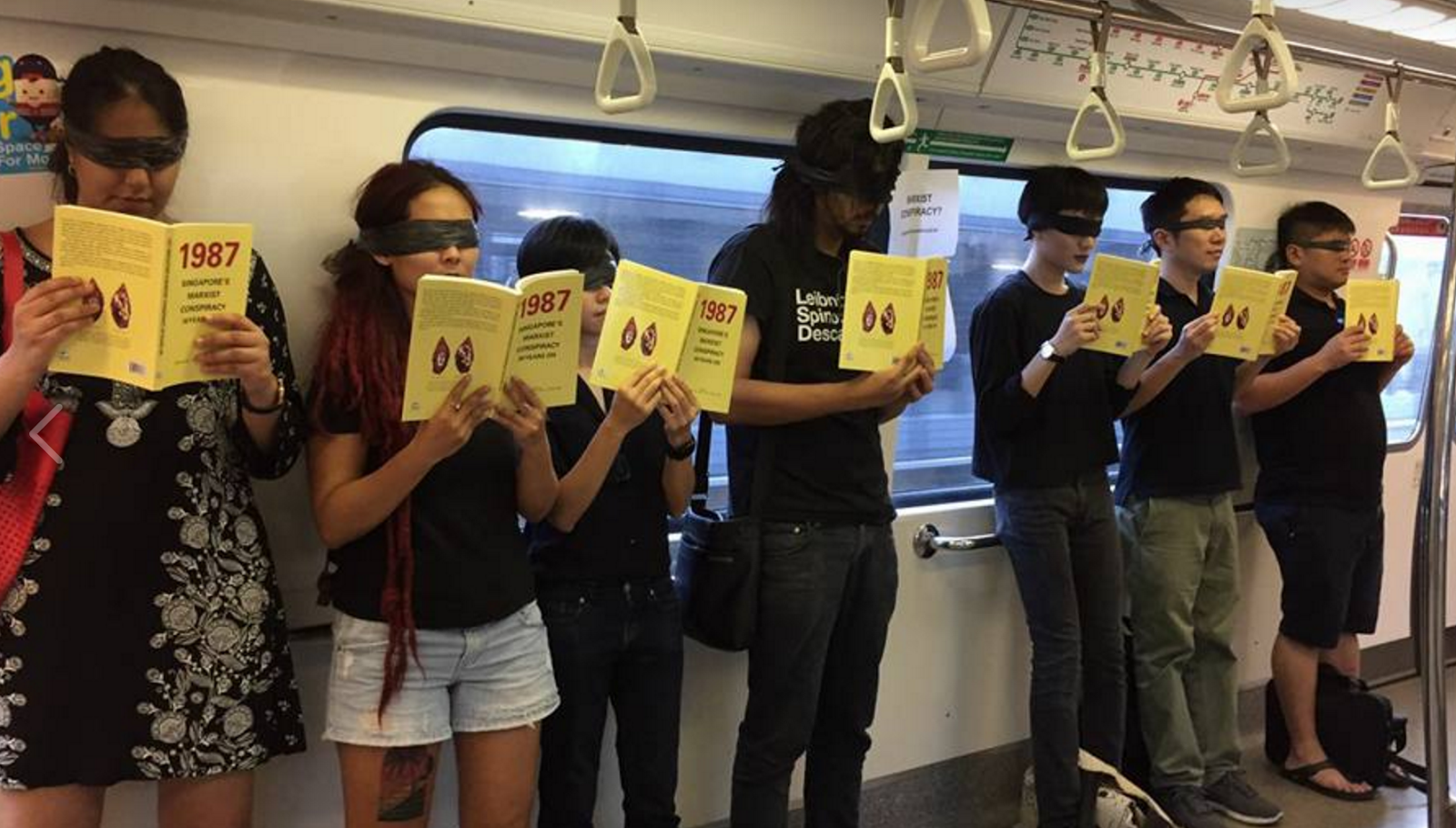
Should Jolovan Wham have held a protest in a train?

On 3 June 2017, Kirsten Han announced that her fellow activist Jolovan Wham had organised a protest in a Singapore Mass Rapid Transit train. Han reposted on her Facebook a series of photographs from Wham's personal page, showing Wham and eight others sitting blindfolded in a train carriage, holding up the recently published 1987: Singapore’s Marxist Conspiracy 30 Years On, with homemade posters stuck on the walls behind them. While Wham was tagged by Han, his collaborators and co-conspirators are instantly recognisable as activists of a certain bent in Singapore. Everyone knows who they are, but their names will not be mentioned here.


On the morning of 3 June 2017 while Kirsten Han was likely involved in the coordination of the dissemination of the news of the protest, if not the protest itself, I was attending in my personal capacity, as I note were some other members of the Community Action Network, the Singapore Heritage Society 30th anniversary lecture by Prof Kwok Kian-woon at the Singapore Management University.

I had no prior knowledge of the protest. I was not involved in its conception, deliberation, or execution. I was not invited to be part of it. If invited, I would have told them it was a stupid idea that would get them thrown in jail, whether they did it in Singapore, New York, or London.

08 November 2017

Singapore transport failure clown show: The Parliament edition

Singapore's train system has been suffering from one public embarrassment to another, breaking its own record for breakdowns every year while the Land Transport Authority (LTA) and the Ministry of Transportation double down by releasing questionable statistics to show that in some metrics they cherry-pick, Singapore's train system is doing better than ever.

You would think when senior management staff get caught falsifying systems management records for at least the past year, that the parliament sitting the next week would be a time of reckoning for the ministry, its regulatory body, their too-big-to-fail train operator Singapore Mass Rapid Transit (SMRT), and its line of incompetent bosses.

But then, this is the same august body that harboured the delusion of thinking it could proclaim the prime minister guiltless in open parliament, based solely on his testimony of events and not an independent investigation by a special counsel. Minister Khaw Boon Wan's performance yesterday is par for the course, in other words, for the national transport clown show.

02 September 2015

Nomination day observations

PAP supporters arriving at a nomination centre via chartered bus
Picture courtesy of The Online Citizen


Up close and personal, the proceedings of Nomination Day are no less theatrical and farcical than the edited version you watch on television: all sound and fury, with candidates and their supporters behaving as though they were at a pro-wrestling event.

26 May 2014

"Daddy where is your car & who are all these poor people?"

From a realist point of view, public policy is never really about discovering via best methods, optimal outcomes for the public at large, but what fits the planner's ideology.

We put a spotlight on Singapore's transport policy to identify the ideologya set of commonsensical assumptions so commonsensical their existence is not denied but unacknowledged—through which the Public Transport Council's (PTC) modelling of the transport system and its pricing and funding calculations are mediated.

In his Straits Times op-ed of 25 May 2014, PTC chairman (2005-2014) Gerard Ee defends the PAP government's current orthodoxy regarding transport fares: i.e. it is right that PTC-approved annual transport fare increases have nothing to do with service standards, and if the public wants better service standards, it ought to pay a premium over the annual fare increases.

That the chairman of the PTC thinks this way is not cause for consternation. He is after all no economist or a transport analyst or expert. He heads a council that is mandated to approve fare hikes by Singapore's bus and train monopolist, and not a research institute for transport policy studies.

But look: the chairman of the PTC lives in a bizarro universe where it is unrealistic for commuters to expect actual quality of service improvements in the face of state-guaranteed transport fare increases. In the reality where we live, it is unrealistic for monopolistic transport operators to enjoy state-guaranteed transport fare increases while failing to prevent near-guaranteed service deterioration every year.

This tells you something about the world-view, the ideology, the ontology of the crafters of Singapore's transport policy and the messenger they've tasked to convey their views to the public via an op-ed piece in yesterday's Straits Times.

And if you read his op-ed piece, it turns out Gerard Ee insists that the annual fare increases have been all about the bus and train monopolies investing in infrastructure. Clearly, Gerard Ee lives in a bizarro universe where the monumental series of train breakdowns of 2012-2014 weren't caused by the train monopolist failing to invest in infrastructure and maintenance for a decade.

Still, that's not a cause for consternation.

What's a real cause for consternation is Gerard Ee's vision of public transport:
"If you treasure your time and comfort, you pay a premium
—there are premium services. If you value your time and comfort even more, buy a car. And then ultimately, get a chauffeur."


THEM'S FIGHTING WORDS!

In just 2 sentences, Gerard Ee's words betray the ideology lurking behind the dry, values-free tables and numbers that prop up current transport policy implementation. In just 2 sentences, Gerard Ee talks about public transport in terms of personal wealth. In just 2 sentences, Gerard Ee ties transport service—the idea of getting there in time and in comfortwith personal wealth.

In just 2 sentences, Gerard Ee whitewashes the very public failures of Singapore's transport policy: the inability of highly profitable monopolists to get people anywhere on time, and the chronic overcrowding and overloading of public transport infrastructure.

In just 2 sentences, one may infer that in the minds of Singapore's policy planners, public transport is a program for the poor, and a poor program because the poor can't afford better service and shouldn't be spoiled by good programs.

This patronising, elitist mindset is not too different from that of one Anton Casey, who riled half of Singapore with his allegedly offensive joke about public transport being for poor people.

And this narrative of the undeserving poor, the paths which cannot be taken for reasons too esoteric for the public to appreciate, is an ongoing habit of Gerard Ee. He has in the past publicly rejected outright lower transport fares for the elderly (while wearing his other hat as chairman for an active aging body), and concessions for polytechnic students (while wearing his PTC hat).

His successor, former judge Richard Magnus, is no better. Like Ee, he is no transport expert. For 2014, Magnus has excluded the poorest 20% from the PTC's transport fare calculations because they should be able to pay for public transport after taking into account the subsidies and handouts they get elsewhere. It is our opinion that this methodology necessarily makes transport more expensive than it would be if fare increases had to take into account the ability of the poorest 20% to pay for it.

Once you identify the ideological root of Singapore's public transport policies, you may begin to also understand the ideological blinkers behind the PTC's blanket refusal to consider several suggestions for fare subsidies and the government's automatic dismissal of several transport reform suggestions.


This is a pity, not only for Gerard Ee's credibility—public transport policy is beginning to turn, and his public pronouncements of "thou shalt not go there" will be forever remembered and measured against these reversals—but also for the fact that the son of Ee Peng Liang, the "father of charity in Singapore", seems to see public transport as a program for the poor, and a poor program.

03 December 2013

Reason #65665872 why Roy Tan is the next worst thing for the gay rights movement in Singapore


Back in 2005, Roy Tan, a gay activist in Singapore, made a suggestion which has not gone unnoticed on our blog. He said with some glee: "We should consider making use of the Sedition Act to stop any local online homophobia dead in its tracks."

Now in 2013, Roy Tan is one of the signatories to the citizens' petition to the AGC, affirming Alex Au's right to free speech or something like that. Sure didn't take too long for the gay rights movement's most ardent supporter of repressive sedition laws to turn into its most ardent supporter of the right to free speech.

But wait, there's more. Back in 2005 after Roy Tan made a statement that, if taken seriously, would set back free speech, it turns out that Alex Au's reply was:

"Would the same Sedition Act be applicable in cases of hate speech targeting gay people? I think yes. Clause 3(1)(e), after all says, "feelings of ill-will and hostility between different races or classes of the population of Singapore."

He goes in for the kill, and suggests that the White Elephant guerrilla installation piece at Buangkok MRT be investigated under the Sedition Act. And if Alex Au's statements were taken seriously, there would be no opening of the Buangkok MRT station -- and no Samantha Lo today because certain types of art. according to Alex Au, are SEDITIOUS.

Meet Alex Au, the worst thing to happen to the gay rights movement in Singapore, a man who has never been a friend of free speech and artistic expression.

And one more thing: Roy Tan is parsimonious with the truth. Since 2011, he has been banned from Wikipedia for a whole host of rules violations including lack of citations, lack of permissions for images, non-neutral point of view writing, conflicts of interest, using wikipedia for promotion, and treating his created pages as a personal website.

03 August 2013

The total hypocrisy of Ng Eng Hen on Total Defence

Beatles drummer Ringo Starr goofing around on a US tour.
This is also the image Ng Eng Hen evokes in his speech.

When one takes into account other social engineering campaigns in Singapore, Total Defence seems to have fared not too shabbily. For one, it hasn't been discarded as a policy failure like population control's "Stop at two", derided as horribly deluded like the moral panic infused campaigns against long hair and rock and roll, or treated as benignly irrelevant like the courtesy/kindness campaign and its beleaguered former mascot, which 'announced' its 'retirement' earlier last month.

One cannot blame Singapore leadership's attempt to keep relevant the Total Defence campaign. There might be a bit of inevitable eye-rolling at the laboured DRUMS acronym Ng employed to highlight the threat of misinformation on the internet. It would be churlish to claim that the entire social-psychological positioning of Total Defence is to instill an atmosphere of paranoia ever-readiness in the population, yet this is precisely the riposte of the blogosphere to minister Ng Eng Hen's recent speech on the online threats to Total Defence.

Even I would find it hard to disagree with the defence minister that a campaign of misinformation may bring a nation down on its knees. One would not need to be a student of Clausewitz, Napoleon, Sun Tze, or Soviet Maskirovka to realise that armies have indeed been brought down by disinformation and deception.

No, silly! You can't really bring down a country with disinformation these days

Granted, the minister's speechwriters have not caught up with the idea that modern democracies are not armies. The benefit of an open, mature democracy is its vibrant, free media, whose professional ethics, ideals, and competing political positionings will enable writers and readers to expose manipulations and untruths in any single disinformation campaign.

If the minister were serious about Total Informational Defence, he would be the first to urge Minilee and the MDA to free the internet, to free government control of Singapore's print media, to repeal the infamous Newspaper and Printing Presses Act. In a mature democracy with a robust, open media market, it is nigh impossible to spread disinformation.

Indeed in the modern day, disinformation campaigns are more a tool of authoritarian governments with unfree presses to influence domestic opinion. To which the priestess of Ise will give the same advice: the Total Defence of the citizenry in an authoritarian state depend on having a strong and free press - digital and print.

Ng Eng Hen: Still the wrong man for the job

One hopes perhaps that the amorphous blogosphere and its horde of angry commentators simply reacted this way against Ng because he is the wrong man for the job.

Perhaps netizens do remember that under Ng Eng Hen, the Ministry of Manpower massaged statistics to give the impression of a lower unemployment rate - and was caught out on it by none other than the Financial Times.

Our more perspicacious readers will recall in 2009, ST reporter Li Xueying's reports of Ng Eng Hen heading the PAP's New Media committee to "mount a quiet counter-insurgency" to counter criticism of the party and government in cyberspace - using PAP members and operatives masquerading as members of the public to engage in online forums. They may do well to note that social media professor Kevin Lim called the campaign an astroturf operation. We wonder if the current crop of "Internet Brigades" on facebook are the current face of that very same counter-insurgency whose mendacious actions seem to have written the manual on DRUMS.

Having overseen such disinformation operations (some of which are still ongoing) himself at the Manpower ministry and the PAP New Media counter-insurgency, Ng Eng Hen is the last person on earth who should deliver a lecture on how disinformation online can destroy a country. The blogosphere will NOT be lectured on disinformation, rumours, untruths, misinformation, and smears by this man. Not now, not ever.

14 May 2013

What the MND review really means


How does one conduct a comprehensive review while wearing blinkers?

Headed by one Mr Tay Kim Poh (apparently a deputy secretary in the Ministry of National Development), the MND team found that the PAP-AIM deal was

1. Not illegal
2. Followed due process and did not represent a conflict of interests

We have already predicted in February that the deal would not be illegal, though the ownership of AIM by PAP would fall under a grey area. The deeper issue of political financing and political donations were not addressed by the "comprehensive" MND review, which only strove to investigate the deal through the blinkers of the Town Council Act.
We've already pointed out that Singapore's regulatory framework of political parties with respect to these two issues is at odds with international legal norms, which ban political parties from owning private enterprises.

Further, it's only through very imaginative acrobatic manoeuvrings that MND could find the deal in accordance with due process and free from conflict of interests. MND had to accept that being town councils, appointments and contracts will be, can be, and can be allowed to be preferential, can be parcelled out as political appointments.

By allowing this, MND in effect says that certain practices which could end the political career and legacy of... let's say a former mayor of Paris, would be perfectly legal and above board in Singapore because we allow that local government is, by nature, "politicised".

Implications of MND's findings

1. The civil service or at least the team headed by Tay was simply incompetent, and utterly stupid.

2. The civil service or at least the team headed by Tay lacked independence, and had become politicised. They were charged by the prime minister to conduct a comprehensive review and turned up a heavily blinkered review.

Whether there was self-censorship or behind-the-scenes political pressure, this may cause some to conclude that the civil service is either very openly batting for the ruling party or intimidated by the prospect of having to investigate the party. The MND review may ironically further undermine public trust in the system.

3. The MND review legitmises the idea that local government in the form of town councils are held to lower standards of corporate governance and due process, and higher thresholds of conflicts of interest than the private sector. This is the gateway to open preferential contracts, clientelism, and procurement corruption.

In light of all these, we at Illusio again renew our call for the Town Council-AIM deal to be investigated fully by the Auditor-General of Singapore and the Register of Societies. We further call upon the Minister for National Development to step down and for his deputy secretary to be censured by the head of the civil service for publishing a review that holds local government to lower standards than the private sector.

09 May 2013

The Ministry of National Development comprehensive clown show

We examine the Ministry of National Development's oft-delayed, long-awaited review of the transaction between the People's Action Party's 14 town councils and Action Information Management, published on 3 May 2013 (PDF link), in light of the parliament sitting on 13 May 2013.

Whatever happens on Monday—a dramatic showdown headed by a bold opposition, a comedy of missed chances authored by an underperforming opposition, or a grotesque self-interested bipartisan agreement to sweep all embarrassing issues under the carpetthe ruling party and the establishment press will declare the sitting a fitting closure to a contentious debate, and call for the citizenry to lay aside their misgivings, move on, and to reinvest their blind trust in a to-be-reformed town council system.

We present this post so our readers can see for themselves on Monday whether Monday's debate is the real thing, a clown show, or pure political kabuki.

Will Monday's parliament session be a farcical pie fight?
Follow the breadcrumbs with Illusio!

The issues as we see it

The public disquiet in the streets, online, and in social media over the AIM affair stems from several concerns:

1. Conflict of interest of the political variety. In the tender process, PAP-appointed party member Ho Pin Teo basically gave the contract to a company only he and other senior party members knew was "owned" by the party and managed by fellow party members. This was special knowledge of a relationship that could not have been found in any public record.

2. Questions of procedural irregularities and non-transparency
a. conflict of interest not reported in town council's annual report on the AIM contract deal(s) amounts to a breach of due diligence.
b. Teo's reason for awarding the contract - that he knew the special status of AIM - was not reported in the town council annual report. This may be perfectly legal within the bounds of the town council regulations, but amounts to another breach of due diligence.
c. non-transparent tender for a contract of no viable commercial value, which basically is one of the criteria for determining procurement corruption (whether legal or illegal).

3. Political trust, legitimacy of the PAP.

How did the PAP come to own a private business and not have the business declare its true ownership or even declare its ownership? Is this legal?

Even if legal, is this a circumvention of laws on political donations in Singapore, and completely at odds with international legal norms on political financing?

Can the people place their trust in the PAP if it owns a clandestine business empire and is legally entitled to own a clandestine business empire?

How can a political party manage become so secretive when the laws regulating political parties (i.e. the Political Donation Act, Societies Act) are written to ensure they operate with transparency and scrutiny?

Note that the majority of these three sets of concerns are ethical and procedural, not legal.

The issues as MND saw it

1. MND reviewed the external audits of the PAP town councils but not AIM's audit reports. It accepts the town councils' assertion that AIM made no profit, that whatever was paid to it was to cover its operating costs... It should have just reviewed the annual audits of AIM instead.

2. MND clears the town councils of any illegality. The public outcry was about ethics, transparency, politicisation of town councils, and conflict of interest.

3. MND clears the town councils and Ho Pin Teo of any conflict of interest only because MND accepts that town councils will have political conflicts of interests, that party MPs will engage party-affiliated companies to manage their town councilsand then pretends these aren't really conflicts of interests that matter.

Strangely enough, MND exonerates AIM. Reason? The company actually developed the TCMS in 1996, so it had a track record prior to the tender in 2010. MND however doesn't ask why AIM was even given the 1996 contract, as a $2 company with STILL zero staff in 1996.

MND, investigating with blinkers on

By refusing to acknowledge the real reasons for the loss of public trust in the system, the MND's review is unlikely to restore this trust.

It is clear that MND's investigation falls far short of popular expectations, even far short of Minilee's directive for a comprehensive review. It has stuck to a purely legalistic review, only of the town councils - leaving AIM and its political affiliations out of the picture. By not questioning AIM and its political affiliations, it obviously does not find any procedural irregularities with a senior PAP member awarding contracts to a company whose PAP affiliations were not public knowledge.


It has not found any conflict of interests because it already accepts as a matter of principle, that political conflicts of interests will arise and are encouraged by the current town council system.

We at Illusio believe that MND's blinkered report fully justifies our stand that it was the wrong agency to investigate the town councils. We call upon the Auditor-General of Singapore and the Registrar of Societies to launch an independent investigation to audit the PAP Town Councils, AIM, and the People's Action Party, to ensure full transparency, to identify weaknesses in the legislation and regulation of town councils and political financing, and to suggest measures that will restore Singaporeans' trust in the political and town council system.

06 January 2013

The PAP clown show continues! (Town council edition)

"Hegel remarks somewhere that all great world-historic facts and personages appear, so to speak, twice. He forgot to add: the first time as tragedy, the second time as farce."
-- Marx's introduction in The 18th Brumaire of Louis Bonaparte

Almost two years ago, half-hearted reports in the mainstream media hemmed and hawed over Aljunied-Hougang Town Council (AHTC) and its award of a contract to a firm which was registered barely on the eve of the elections.

Thanks to my sources, I sought to provide a fuller picture of just what was unsettling about the AHTC case, namely non-transparency, less than proper procedures in the tender process, a clear conflict of interests in the firm that won the contract. Whether or not there was any intention or whether this was simply a matter of non-standard or even slipshod management, it did lead my source and others familiar with town council procurement procedures to question if there was any procurement corruption - intentional or accidental.

Almost two years later, Marx's quip about history repeating itself holds true. We wouldn't say there has been a scandal but at the very least, there has been widespread concern over the blogosphere and media, again composed of half-hearted hemming and hawing, over how 14 PAP-run town councils outsourced their management software solution to a company called AIM.

Like before, as the priestess of Ise, I am bound by duty and obligation to point out the farce that lies before us - even though I fully expect the mainstream media now, as it did before two years ago, to leave the matter hanging while the balls are up in the air, out of sheer cowardice and fear of inquiring after what people need to know and want to know.

The real issue, as before, is conflict of interest

To a process auditor, the fact that (Action Information Management Pte Ltd) AIM is a company with $2 paid-up capital is immaterial.

The real cause for concern is the fact that a firm registered to former PAP MPs was awarded a contract for 14 PAP-held town councils by Teo Ho Pin, who was a sitting MP at that time and now names himself the "coordinating chairman" of these town councils, after being the sole bidder for the tender, and submitting the tender way past the deadline.

The fact of the case is there has been a conflict of interest, just as there was a clear conflict of interest in the AHTC case 2 years ago. AHTC awarded a contract to a firm set up by its former employees and managers. Now, it is revealed that Teo Ho Pin awarded a contract to a firm set up by his former parliamentary colleagues.

But a conflict of interest or a preferential awarding of contracts doesn't necessarily imply that there is any criminal or otherwise illegal behaviour, much less political corruption or procurement corruption.

A hypothetical professional auditor may query MP Dr Teo Ho Pin and former MP Chandra Das thus: Was the conflict of interest disclosed by AIM during the bidding process?

The auditor-general of Singapore, whose purview is checking the books of town councils, may query MP Dr Teo Ho Pin and former MP Chandra Das thus: Was the conflict of interest disclosed by the town councils in their annual reports submitted to him?

If the answer to both questions (both easily verifiable) is no, then according to some process auditors there might be a case for an investigation by the relevant regulatory authority.

Love me tender (as a farce)
We refer to the report in The New Paper, dated 5 January 2013 on page 6. As Lucky Tan points out: "For the tender process to work successfully and fairly, companies have to be provided sufficient information to put in a bid. In this case, the tender involves the purchase a custom software and specifications have to be sufficiently detailed so that companies can value the system and put in a competitive bid."

Instead, Hutcabb Consulting believes that the tender was a non-transparent one, with insufficient information provided about the nature of the work to be contracted. We infer from what the IT procurement experts canvassed by TNP said, that the contract made no business sense, the work had no financial benefit; hence "companies would ordinarily not bid for such contracts." You can find other software experts saying the same thing elsewhere.

And like the AHTC saga from 2 years ago, we come to the same questions of whether the tender process and the terms and scope of the contract was preferential in the sense that no other firm aside from the one awarded would have put in a bid for it. An auditor will ask if the tender process and terms of the contract make no business sense to bid for the contract unless that one firm was connected to the town council or the PAP.

Nothing illegal or corrupt yet but the non-transparency stinks anyway

I admit that even if this were a case of preferential contracts, this is not a smoking gun for political corruption.

What makes this entire affair a clown show and a farce is how Dr Teo Ho Pin and Mr Chandra Das proceed day by day to whittle down their vast reserves of citizen goodwill, reasonable doubt over the rightness of the tender and award process, as well as the general trust in the transparency of Singapore's only ruling party since independence.

We can only say it's nothing short of flabbergasting the elan that possesses Teo when he says that during the time of him awarding the contract to AIM, he already knew that AIM was backed by the PAP. And that's not as farcical as the further admission from Chandra Das himself that AIM is PAP-owned. And perhaps not as mindblowingly hilarious that Das follows that up with a refusal to state how much assets and business his PAP-owned company has.

But let's look at the other real issue of transparency here:

1. How does a company registered under the names of 3 former PAP MPs become a PAP-backed company (according to MP Dr Teo), a PAP-OWNED company (according to former MP Chandra Das)?

2. Is there any reflection in ACRA records that AIM is a PAP-owned company?

3. Do Chandra Das and his other 2 directors have a legal duty to declare that AIM is a PAP-owned company in its official records?

4. Is it legal for the PAP as a political party with donation and funding limitations to 'own' companies registered in the names of private individuals?

5. Does the PAP operate any other businesses that are registered in the names of private individuals, as Das and his other 2 directors were?

6. As a political party, has the PAP furnished the Registrar of Societies, whose purview is in part the management and disciplining of political parties in Singapore, a full list of companies officially PAP-owned and unofficially held in trust for PAP by private individuals, their assets, and their business returns?

As the priestess of Ise retires for the night, we leave these questions hanging in the air for a day or two, or a week or two, as fruit for your thought.

Our thoughts? What a clown show!

25 November 2012

Book Review: Freedom From the Press by Cherian George II

(Read Part I here)

The curious rhetorical device of Cherian George

Some time back, Cherian George published a book called "Freedom From the Press", where a cursory reading reveals that the good professor doesn't want you to take him seriously as an academic. In fact, we argue that he doesn't even take himself seriously as an academic.

We've made hay of a few instances where he resorts to misrepresentation and strawman arguments by summoning faceless, nameless critics out of thin air. But why is this important to us as an indicator of how Cherian George is unfit to be a respected academic, or even an academic at all?

Citations are important. When we read a non-fiction book by an author or academic who wants to be taken seriously, we want to know WHO said WHAT exactly WHERE and WHEN. That's so that we know the author didn't just make things up, or invent people out of thin air and put into their anonymous mouths lame arguments in order to discredit or divert attention from actually existing, stronger arguments.

Now, here's an experiment: try writing an assignment in first year university without proper citations. I'll bet every single dollar I have the professors will fail your assignment. But if you're "Professor" Cherian George, you'd get the entire embarrassment of a book published by the National University Press. And no, you wouldn't be stripped of your teaching post for doing shit like this - which amounts to technical plagiarism.

No comments necessary

And now for your entertainment and enlightenment, here are all the instances where Cherian George does his thing in FOTP. 

I will keep the commentary to a minimum because these excerpts speak very well for themselves the kind of academic Cherian George is. Take your time to read through these gems, then decide if Cherian George didn't just make things up, or invent people out of thin air and put into their anonymous mouths lame arguments in order to caricature actual critics and misrepresent their sensible and strong criticisms - none of which you will read about in his "book".

Your moments of Zen, or Cherian George forgets to cite actual (and respectable) people, actual publications!

For example, otherwise authoritative sources refer to the news publishing behemoth Singapore Press Holdings as "government-owned" when it is not. (p. 2)

(Interestingly on p. 10, Cherian George admits that yeah if you want to look at it critically, SPH is government-controlled.)

Most critics assume that SIngapore's system is unsustainable because it is undemocratic. (p. 7)

Equally dogmatic are those at the opposite end of the political spectrum, in whose eyes the PAP and its instruments are corrupt usurpers of the people's freedom and dignity. This group includes foreign critics with a barely concealed contempt for Singapore and its people... In their eyes, any attempt to analyse the press system in anything longer than a single, colourful, expleteive-deleted (or not) sentence is at best a waste of time... (p. 18)

By misidentifying the ways in which the government controls media and politics, analysts have arrived at erroneous conclusions. According to some, Singapore's unfree media system was supposedly incompatible with an open economy and First World standards of living; it would soon crumble beneath the weight of its own contradictions. Most of these predictions have been based on crude misconceptions about how the press is kept in check... (p. 25)

(There's an entire page's worth of this spiel -- all without citations, presumably because if you were serious to read actual critics and academics take apart Singapore's press system, those won't be the arguments they'd use. Search for Michael Barr's writings, for instance.)

Take any random group of Singaporeans and you will find among them those who appreciate life in PAP-run Singapore and who support strong, decisive government as an integral part of the formula that has provided security and high standards of living. (p. 25)

(Fascinating strawmen you have there, "Professor"!)

Unlike those who see Singapore's media system as a giant contradiction, I would go so far as to say that the PAP has been on the right side of history. (p. 26)

Critics of the PAP had predicted that Singapore's ambitions to be a media hub would be thwarted by its lack of respect for press freedom. (p. 42)

Yet, contrary to the cynics' view that the Singapore press is content with reproducing government handouts, Newscom citations encourage journalists to dig for exclusives and overcome barriers, including obstructive government officials. (p. 54)

Conventional wisdom holds that the PAP -- a regime armed to the teeth with the powers of coercion --- completely overwhelms any professional norms and ideals that the Singapore press may once have possessed. Critics view journalists in a state of unconditional surrender to the government. "They are running dogs of the PAP and poor prostitutes," said David Marshall in 1994. (p. 69)

(This one is interesting. "Conventional wisdom" as a strawman, followed by our usual nameless critics with extreme views, then backed up inexplicably by the late David Marshall, obviously taken out of context. The real-world criticism of SPH that Cherian George is caricaturing and hiding: the press may be 'professional' but is ideologically enslaved, that its reporters are consciously, willingly making up excuses to toe the PAP line. Like say, making up shit about OB markers in the press.

Or as Cherian George himself puts it in p. 48: Professional journalist's' love affair with 'objectivity' and their rejection of journalism's more activist past has made it easier for them to be turned into scribes for the status quo.)


Indeed, Gary Rodan observes that Singapore's media policy may have been partly influenced by a conscious desire to avoid Malaysia's mistakes. Admittedly, this is the kind of observation that enrages critical Singaporeans who would never concede that their press has any credibility. (p. 113)

Singaporean critics of the PAP want to believe that this backwardness is due to government repression. Such a claim would be an insult to media activists elsewhere. (p. 172)
(Here, we have not one but TWO groups of strawmen! Bravo, "Professor"!)

Most believers in democracy want and need to believe that Singapore is closer to the unstable end of the spectrum. They find it too disconcerting the idea that a modern state may have found a way to consolidate authoritarianism... (p. 201)

Opposition politicians and their followers are counting on the PAP's inertia to be its undoing, causing Singapore to succumb eventually to the tide of freedom. (p. 225)

09 September 2012

Book Review: Freedom from the Press by Cherian George

Part I: Cherian George doesn't want you to take him seriously as an academic

If you have a good impression so far of the career of Dr Cherian George as a serious political commentator on Singapore politics or as an academic, don't read his reply to Vernon Chan's review of Cherian's book, "Freedom From The Press" on The Online Citizen.

What are we to make of an academic who reacts in this fashion to an unknown complaining that his book isn't rigorous enough, doesn't follow normal academic writing and research standards? It's one thing to perhaps claim that Chan is a nobody making a mountain of a molehill, or that Chan is wrong about the standards required of academic publications. But it's a very different thing to say: "Fortunately for me, NUS Press – one of Asia’s top academic publishers – applied less lofty standards than Chan." or admit that most of the book is "the result of painstaking original research by my assistant."

We have read Cherian George's book following Chan's review in TOC and Cherian George's curious hissy fit, which is remarkably curious and unprofessional since it amounts to an academic telling a non-academic why he didn't have to declare his theoretical framework, and telling the non-academic why he's pretentious in trying to hold the academic to academic standards in his review.

Now we at Illusio have never shied away from being polysyllabic, hurling theoretical frameworks at readers as a preface before answering any question, or even teaching you all about the media theory of Roland Barthes. We can afford to be pretentious while taking down Dr Cherian George.

Pseudo-Intellectual Waffling

But let's give credit where credit is due. Where it comes to pretentiousness and putting on pretensions, no one outshines Cherian George. Let's take a look at the first two chapters of Freedom From the Press.

Geroge presents no theoretical framework, no consistent strategy of presenting an analysis of "journalism" and its relation to "state power in Singapore". What about the concept of "freedom" then? For some mystifying reason, George spends two entire chapters feeding us red herrings. In the bizarro universe of Cherian George the academic from NTU, there is a huge controversy over the concept of press freedom. He vacillates between acknowledging its existence, viability, and rightness as a concept and denouncing it, Kishore Mahubhani style, as a convenient western invention that isn't quite practised in the west.

Dispensing with references, sources, and resorting to misrepresentation and strawmen arguments

My issue with these two chapters is not the glibness of Cherian's argument but that it's part of his centrist for the sake of centrist schtick, which I've identified before in this blog. Yet what dismays me (and probably Chan) is Cherian's frequent resort to strawman arguments on both ends of the political divide. Sentences like these are littered throughout FOTP, so much so that Cherian should be hauled up for an Intellectual Public Work Order to clean up his tome.

"One favourite retort of defenders of authoritarian press systems is that there is, after all, no country with absolute freedom."


"Those at the opposition end of the political spectrum includes foreign critics with a barely concealed contempt for Singapore and its people..."

In FOTP, which Cherian George crows that NUS Press saw fit to publish, arguments (mostly against the Singapore press system) are attributed to faceless, nameless critics. And foreign academics, who are almost always faceless and nameless unless they happen to be Mary Turnbull, who wrote a coffee table book (commemorating 100 years of The Straits Times, no less!) commissioned by Cherian's former employer, SPH.

We kid you not. This is a sample paragraph in Cherian's book.

"By misidentifying the ways in which the government controls media and politics, analysts have arrived at erroenous conclusions. According to some, Singapore's unfree media system was supposedly incompatible with an open economy and First World standards of living... Most of these predictions have been based on crude misconceptions..."

Who are these analysts? What are the conclusions, however erroneous, they have made? What predictions did they make precisely? What misconceptions did they base all these on? Where are the flood of citations and footnotes that would normally accompany a paragraph like this?

Cherian George doesn't seem to want to be taken as an academic as long as there are mysterious, unnamed analysts whose studies and predictions he rubbishes without the courtesy of 1. naming them, 2. and their actual studies or articles. It's as good as misrepresenting his fellow academics in other parts of the world, who thankfully won't hear of his wretched excuse of a book since no serious journal will bother reviewing it.

On one hand, George wants to be taken seriously eventually as an academic who writes on the media and state control of the media; on the other hand, George also wants to be taken seriously as a serious academic who isn't like the "western critics" and "anonymous critics" whose criticisms of the Singapore press system he denounces - probably because they're not Singaporean, they're Singaporean but anonymous, and they're more truthful about the state of Singapore's press than he allows himself, as a serious and credible commentator within the Establishment on Singapore politics.

Now here's your moment of zen

What gets Cherian George's goat apparently are the Reporters San Frontieres's Press Freedom Index, which places Singapore near the bottom. He seems to be mightily offended, dismisses the entire enterprise of press freedom indices with just one line: "RSF's methodology is dubious, resulting in the Republic being grouped with regimes where journalists lose not just their liberty but even their lives." And just to show what a good little academic he is, Cherian George provides a CITATION and reference for this judgement call. Namely, his own blog post.

No, I guess there haven't been any serious academics publishing articles in peer-reviewed international journals where they try to analyse the methodology, consistency, validity, and coherence of the Press Freedom Index and others.

In the bizarro universe of Cherian George, Google Scholar shows Zero Results for this because Harvard's Ronald Inglehart hasn't bothered to test the RFI, and SAGE isn't interested in academics trying to take apart surveys and indicators to see if they're worth anything. In the bizarro universe of Cherian George, the academics Harvard and SAGE, amongst others, can't really find a way to discredit the methodology or theoretical basis or validity of the various press freedom indices they've looked at.

In the universe we live in though, a simple Google Scholar search reveals all the western academics (amongst others) who have audited the RSF and Freedom House indices for decades and given them a clean bill of health, as well as explain what these surveys are really telling us (and consistently) over time.

I mention Ronald Inglehart because he's a big hitter in the world of political science. His World Values Survey finally made its way to Singapore earlier this decade. The NUS researchers co-conducting the Singapore leg of his survey spent about 6 months of preliminary research to critique or validate the concept, methodology, and validity of the WVS and found it acceptable. Now when Ronald Inglehart spends time doing the same to the Press Freedom Index and finds it passes muster and publishes a paper on it, you'd trust him. Not this Cherian George clown with his glib 'refutation' of the PFI on his 'journalism' blog.

Gee, so much fail just in the first 2 chapters of his book already? We advise "Dr" Cherian George to be a better academic or just stop pretending to be one.

And maybe If you have a good impression so far of the career of Dr Cherian George as a serious political commentator on Singapore politics or as an academic, you should skip the introduction and the first 2 chapters of his book, Freedom From the Press.

07 September 2012

Book review and Cherian George smackdown to come!


We have never been fans of Cherian George and his attempts to be a political commentator and commentary moderator of the blogosphere.

It has come to our notice that following our criticism of Cherian's writing and our unmasking of his political agenda, the NTU pseudo-academic-on-a-political-sinecure has changed the URL of his online essay twice in the past year and very conveniently made his entire website unavailable for most of this year, until the last fortnight. We have of course updated the broken links once again, and will continue doing so each time Cherian George shifts his URLs around. And if Dr Cherian George takes his site or essays offline ever again, I have screenshots of his essays primed and ready.

Even though we are an old fashioned and unpopular site that no one really reads, Cherian George seems to be taking extraordinary measures to hide his embarrassment from our criticisms. We would like to think that Cherian George is doing this to protect what little academic credibility he has left. Then again, it seems Cherian George has all but given up pretense to academic credibility, at least if you read his startlingly embarrassing reply to a review of his recent book.

Now. We do have a copy of Freedom From the Press, and we are more than happy to review his book right here. After all for an academic, Cherian George must publish or perish - and then he must be reviewed as well, or perish. Illusio is not an international, peer-reviewed political science or media studies journal, but then neither are The Online Citizen or The Foreign Correspondents' Club of Hong Kong - which, 6 months after the book's publication, are the only establishments in the world interested in reviewing his book. Of course, we are honoured to increase the reviews of Cherian's book by 50%.

Look for our review this weekend!

07 August 2011

Bringing the gavel down on Workers Party I

MSN builds campaign against WP and Sylvia Lim

There is an unfolding situation over at Aljunied-Hougang Town Council. No doubt it's been angled ever so subtly by the government-owned media in Singapore as the B plot and convenient distraction to its presidential election due to take place on 27 August. Like a carefully plotted campaign, Singapore's news media is content to put its citizens on a drip on this story, calibrating the slow release of information that may build up to an implied allegation of mismanagement or corruption in the AHTC as well as the original HTC.

The reporters have the full story but they will not release all of it, not all at once - even though they have the fullest access to the information for a long time. Their cynical exercise may be rightly dismissed as a ploy but what if the story does have legs?

Non-transparency? Improper procedures? Or something far worse?

Consider this: Almost immediately after winning the ward of Aljunied, the Workers Party's town council HATC employed a new managing agent without a tender. The managing agent is FM Solutions (FMSS).

What is even more peculiar is how Ms Sylvia Lim, the incoming MP for Aljunied and concurrently the chairman of AHTC and HTC before that, defends this decision. She alleges "the decision to award FMSS the contract without calling for a tender was due to the deadline set by the Ministry of National Development".

That's bizarre logic there, Sherlock! If there's a deadline that the town council can't meet, the most obvious thing to do is to retain the old managing agent temporarily for a year - not replacing the incumbent with a new managing agent!

We see no logic for WP to claim grounds for its extraordinary measures. During the last election, the Aljunied ward had the least amount of redrawing. We do not hear of other town councils having to enact such measures despite their greater turmoil and reorganisation.

What's even more bizarre is how the managing agent was formed and registered with ACRA only just - on 15 May 2011, to be precise. Yes, AHTC terminated the ongoing incumbent whose contract was still in existence so they could hire a managing agent that is literally brand new. According to ACRA reports, this entity was formed not long before the elections with a paid up capital of $500,000 for the expressed sole purpose of providing town council services.

Let's say anyone with access to competent polling would have known Aljunied would fall to the Workers Party. Let's say someone is enterprising enough to do pre-emptively sink half a million to form a company whose sole business activity is "town councils" to bid for the managing agent position with the new Aljunied Town Council. And hire 77 people on short notice. But that doesn't really make sense unless they're very certain they'd get the contract. And it makes even less sense if FMSS was formed just to contest for the sole tender of AHTC.

None of us would believe that a newly established, costly venture will be content to get a one year contract by the back door. For all intents and purposes, FMSS will be awarded the full contract next year by the AHTC and hence help the press build up its allegations of procurement corruption.

One director, five directors, how many key directors?

Now Sylvia assures us that its managing agent's "key directors have been in the field for an average of 20 years". I don't know what this sentence means. No one can know what it means because it means nothing. It's nonsense, gobbledegook, balderdash. Here, I'll hold your hand in this exercise.

What is an "average" and why is it a meaningful number? An average is the sum total of the attributes of all the units divided by the total number of units there are.

The statement "FMSS's directors have been in the field for an average of 20 years" would make sense in this case. But to say that its key directors (i.e. not all directors) have an average of 20 years tells you exactly nothing. It's an intellectually dishonest and cynical statement. It's intellectually dishonest because an average of a subset of a population says nothing about the population, and cynical because legally speaking, all the directors of a company are jointly accountable - key directors or otherwise.

FMSS has 6 directors in total. Which are its "key directors"? What is the average experience of all the directors in FMSS? These are questions we want answered!

Of course ACRA has all this on record. You'll also notice how FMSS suddenly increased from its original sole director, Mr Danny Loh Chong Meng, registering 4 more directors hurriedly on 16 June just after the press started reporting on WP town councils. Who are these mysterious men? Are they normal directors or key directors? Where did they work previously and how much experience do they have in town council management?

Of interest to us is of the 4 new directors found their way into FMSS, a certain How Weng Fan also happens to be a former secretary of HTC, the direct precursor of AHTC. Is this not already a conflict of interest? When did How Weng Fan stop being a secretary of HTC? Was that before or after the formation of FMSS? How many other directors of FMSS have rendered services for HTC in the past? How many of them have rendered exclusive services for HTC?

Now you see why the news media is preparing the ground with the initial charge of non-transparent procedure in the Workers Party's management of the Aljunied-Hougang town council? It's so it can lead to the eventual allegation of corruption in public procurement.

Love me tender, WP

In fact, Sylvia's logic is even more warped if you take into account the fact that AHTC did have the time anyway to call for a tender for four other contracts on 17 June, barely weeks after winning the ward. And again, it made this decision over the option of holding on to its existing contractors temporarily for a year. Yes, AHTC had so little time that it found the time to call for a tender for everything but a managing agent in this Classifieds ad.

It has so little time that the tender period from announcement to closing date is just 2 weeks - a quickie compared to PAP-held town council project tenders, which are normally 3 weeks to 1 month.

To town council service providers and managers, this should set off alarm bells. Players in the town council services industry need at least 3 weeks to compete competently for a tender because of the time frames involved to get the necessary documentation, certificates, and licenses from the Building and Construction Authority.

In a more bizarre note, the AHTC tender insists on a "pay first" scheme. Ordinarily (i.e. how PAP town councils do things), interested contractors attend the tender briefing to get an idea of the scope of work, the coverage and condition of the town council's area. Then if they feel they are up for it and are still interested, they'll pay the money for the tender documents.

In contrast, AHTC demands that interested contractors pay first to attend the tender briefing. Under what circumstances would any contractor take part in this ridiculous process? Your guess is as good as mine, dear readers.

If we assume procurement corruption, AHTC's shortened and backwards tender process will certainly benefit players who are certain they'll get the awards, i.e. players who have links to the town council. It would be interesting to note which companies won the tenders and who heads them. It would fit in with the same shortened and illogical awarding of the management agent contract to FMSS too.

26 April 2011

On Vivian Balakrishnan

Vivian Balakrishnan and the video that cannot be named

Last week, Vivian Balakrishnan sounded like a sphinx speaking in riddles and conundrums. Singaporeans are used to the fury of People Action Party attacks on opposition candidates during elections but this time round, the attacks have started even before Nomination Day. Adding to the unseasonal and surreal atmosphere this year is Vivian's mysteriously-worded attacks and half insinuations on Vincent Wijeysingha, a likely candidate for the Singapore Democratic Party.

As previous targets Francis Seow, Tang Liang Hong, Steve Chia, and James Gomez will know, the attacks and scandals begin and suddenly the entire news - and the entire elections - for the next few weeks will seem to revolve around their alleged shortcomings, the attacks from the PAP rising to a crescendo, "Please lah, withdraw!"

Dr Vivian's attacks on Wijeysingha, courtesy of Alex Au:

I am not sure what [the SDP] strategy is. I would like to know whether they have confirmed that they are contesting, I would like to know their line-up. I can’t help feeling that part of the reason for their reticence is they have elements of their agenda they are not prepared to disclose and subject to scrutiny. Eventually, they will have to come out of the closet.     (The Straits Times, 20 April 2011)

Dr Vivian Balakrishnan yesterday described the Singapore Democratic Party (SDP) team running against him as ‘strange bedfellows’ who do not have a shared vision or ideology...In an interview with The Sunday Times, he said: ‘It has been brought to my attention – in fact it is the SDP which is suppressing a certain YouTube video, which raises some very awkward questions about the agenda and motivations of the SDP and its candidates.’    (The Sunday Times, 24 April 2011)
Why would an attack by a sitting minister on a very naughty opposition candidate be this cryptic? The PAP has never been shy from calling a spade a spade  witness its blunt denunciation of Steve Chia in 2003.

Vivian Balakrishnan, the dog whistler

It's taken the blogosphere half a week to figure out the game. Vivian Balakrishnan alludes to the open secret of Dr Vincent Wijeysingha's homosexuality. He alludes to a video taken at a public forum where Dr Wijeysingha discussed issues which were then popularly discussed like the age of consent and the decriminalisation of gay sex in Singapore.

Why would this discussion - in the video, Dr Wijeysingha clearly does not take a stand on either these two issues! - be so horrendously evil? And why would it then warrant such a roundabout, mincing reference?

Vivian Balakrishnan is not a sage, nor a sphinx, nor a fool. He is putting into practice dog whistle politics - carefully parsing his words to target a key demographic. Balakrishnan is not speaking to the press or to the general public that reads The Straits Times.

He is speaking to a key demographic who is not in on the secret but can decipher it with clues like - an agenda, strange bedfellows, closets. He speaks to a demographic that will be spring into action because there is an insinuation of a gay agenda secretly planned by a gay politician who Vivian Balakrishnan simultaneously accuses of fooling his party on his motivations and is also in cahoots with his party to suppress this video.

Consciously or otherwise, Vivian Balakrishnan furiously dog-whistles the demographic consisting of Thio Su Mien, her co-coup leaders at AWARE, Derek Hong, and other concerned conservative Christians. The "Gay agenda", the spectre of homosexual politicians pushing to overturn legislation - an obvious wedge issue for an obvious demographic, dog whistled expertly by a coy minister of very few direct words.

Vivan Balakrishnan, the enabler of religious identity politics

Consciously or otherwise, Vivian Balakrishnan invites Feminist Mentor and conservative Christians to wage another round of their cultural war in Singapore's general election this year. Consciously or otherwise, Balakrishnan will make 2011 the first time in Singapore's history where the conservative Christian vote has wedge issues in the elections brought to their attention.

Vivian Balakrishnan can right now say he meant nothing, that he meant something else which he will not follow up at the present moment but will reveal when the time is ripe, etc. The fact is the wheels have been set into motion and no one can close this Pandora's box.

If a gay man like Alex Au can hear the dog whistle (even though he misconstrues it to be an ad hominem attack), Conservative Christians can likewise hear Balakrishnan's dog whistle shrilly calling. At best, this will be the year in Singapore's history that conservative Christians gel as a voting bloc. At worst - if the PAP allows Balakrishnan to make Wijeysingha this election's key target -  this will be the year where a conservative Christian wedge issue becomes the key issue of a general election.

Vivian Balakrishnan - now, thou art Death, the Destroyer of Worlds

I was here when Thio Su Mien and her co-conspirators took over AWARE. I was here when Thio Su Mien and her co-conspirators had Singapore civil society under strain with their religious intolerance for secularism. I was here when it seemed we would no longer be at peace between peoples of different faiths, between believers and secularists.

I for one do not wish there to be a new cultural war between conservative Christians and everyone else. And yet if Vivian Balakrishnan continues his attacks, this will surely be an issue for conservative Christians. After all, who else would Balakrishnan count on to attack Dr Wijeysingha? His fellow cabinet colleagues, who tilted against the conservative Christian coup of a feminist organisation? Papalee, who thinks being gay is in the genes and can't be helped - and welcomes gay MPs? Goh Chok Tong, who went on record to say that gay civil servants are perfectly okay?

And should Balakrishnan succeed in making the sexual orientation of Dr Wijeysingha THE issue of this election, it is clear conservative Christians will rise up to the occasion - together with their leaders, who may feel obliged to weigh in especially when it comes to chusing politicians who may change the legislation. And should the conservative Christians rise up, will not their old foes in the AWARE saga - feminists, members of other religions, secular and agnostic Singaporeans rise up to counteract the perceived rise of religious politics in Singapore?

Perhaps Vivian Balakrishnan is pleased at the new cleavages he has wrought on Singapore society? Perhaps he is satisfied at the introduction of dog whistling to religious groups on wedge issues? Maybe he fancies himself a trailblazer but I see him as a sower of potential destruction in Singapore.

Will there be religious riots or even religious-secular riots in the future because of Vivian Balakrishnan's dog whistling? I'll make no bones about it - Vivian Balakrishnan's comments on Dr Wijeysingha constitute a threat to Singapore's long term stability as a secular, multireligious society.

I call on Vivian Balakrishnan to step down as a candidate in this election. You sir are not fit to be an elected representative of the people. Please lah, withdraw!

04 March 2011

Tharman Shammugaratnam's crowning clown moment

Economic illiterate or discombobulator?

Finance minister Tharman Shammugaratnam (PAP-Jurong) continues to perform his clown routine in parliament as he defends Singapore's budget for 2010.

Possible in light of strong criticism from the blogosphere, the minister admitted that yes, the GST is a regressive tax. However, it seems that is his knowledge of basic economics ends here. Tweaking the rate of the consumption tax will benefit higher income groups and foreigners more, he claims. Yes. That's what Shammugaratnam said -- reducing the rate of the GST will benefit the rich more because the bulk of the GST is collected from them.

Which part of regressive tax does finance minister Tharman Shammugaratnam not understand? Why will he not admit or acknowledge what any introductory econs text states baldly - that a consumption tax makes the poor pay a higher proportion of their income than the rich and that reducing the rate of a regressive tax will make the poor pay a lesser proportion?

Either finance minister Tharman Shammugaratnam is an economic illiterate and should be removed from his post forthwith, or the minister a glib discombobulator who thinks that Singaporean citizens and residents are economic illiterates and should be removed from his post forthwith.

Why Tharman Shammugaratnam will rather clown about than tell you the truth

In 2003, the GST was introduced to gradually replace income taxes, the complicated system of duties and levies, and corporate taxes as the main revenue source for the Singapore government.

The advantages? The global rich will be more likely to make Singapore their home or at least vacation home. Singapore, I suspect, has one of the world's more lenient tax regimes for the rich. Corporate taxes in Singapore are now the lowest in Asia, next to Hong Kong. Having to deal with less duties and levies lessens the red tape that corporations and entrepreneurs have to deal with.

The downside? The progressive tax instruments that existed prior to 1993 have all been dismantled -- progressive income taxes, corporate taxes, and levies and duties to target the rich. Wealth is redistributed from the poor to the rich in Singapore's post-1993 tax system.

Tharman Shammugaratnam and the PAP will go down defending the GST in the short to medium run as a reform of the entire system will take time and planning. They will go down insisting that the regressive tax structure stay in place (and the poor receive strategic state handouts). They will if necessary play dumb on the regressive tax structure because it constitutes the main revenue source of the Singapore government.

They will attempt to tweak the system and preserve the GST for as long as they can, unless the electorate speaks loudly, unless citizens and residents complain loudly and often, unless bloggers continue to expose the PAP's faulty and discombobulating defense of an indefensible regressive tax.

A chief clown for the clown show?

Tharman Shammugaratnam is the finance minister of Singapore. Goh Chok Tong and Lee Hsien Loong were the finance ministers of Singapore before they became prime ministers themselves.

Tharman Shammugaratnam is unfit to be the finance minister of Singapore. He is either economically illiterate, or a glib discombobulator, or an insincere leader who cannot level with Singaporeans. Tharman Shammugaratnam is unfit to be the next prime minister of Singapore.

In the coming general election, I strongly urge the electors to strongly reject Tharman Shammugaratnam (PAP-Jurong) and deprive him of the opportunity to further damage the poor and the middle class.

01 March 2011

The PAP clown show continues! (GST edition)

This is not your reading for the week. We are suspending your readings for this week and indeed for many months to come. That is because we are in Silly Season. Very Silly Season

The headlines say it all:
PAP MPs question who WP is trying to help
Cutting GST to tackle inflation would benefit rich more than poor, they say

excerpts:

PAP MPs on Monday hit back at Workers' Party chief Low Thia Khiang's broad-ranging attack on the Government's Budget. At least seven MPs from the ruling party stood up to disagree, as they questioned his call for GST cuts...

Mr Christopher de Souza (PAP-Holland Bukit Timah) and Prof Koo Tsai Kee (PAP-Tanjong Pagar) said that trimming GST would be more beneficial to the rich than to the poor

Said Mr de Souza: "High income earners, we know, consume more and therefore pay more GST."

In 2008, finance minister Tharman Shammugaratnam (PAP-Jurong) said that in absolute terms, the bottom 60% of earners here pay less than 25% of the total GST collected each year.

We can only come to one of two conclusions. Singapore is run by

1. A bunch of economic illiterates who don't bother to pick up any econs textbook, which will tell them a consumption tax (i.e. the GST) is a regressive tax.

2. A bunch of glib discombobulators who know that the GST is a regressive tax but refuse to acknowledge it as such. Instead, they work on the assumption that the electorate is composed of economic illiterates.

Finance minister Tharman Shammugaratnam will distract you by talking about absolute terms. He hopes you won't realise that no matter what the bottom 60% pay for their GST, they're still paying proportionately more out of their total income than the top 40%.

Christopher de Souza will distract you by saying the rich spend more and therefore pay more total GST. He hopes you won't realise that the rich spend a lower proportion of their income on consumption - and have a higher proportion of their income in savings - than the poor.

Prof Koo Tsai Kee will distract you by saying that the tax pool gets redistributed disproportionately to the lower income earners in the form of GST credits. He hopes you won't realise that he just conceded the inherent regressiveness of the tax, and that it requires annual government handouts (aka GST credits) to redress the balance or appear to redress it.

The PAP continues to run a clown show.

Whether they are economic illiterates or glib discombobulators, I recommend that the following current MPs be dropped from the PAP slate for the coming elections, and that if reselected to run, the electorate vote against such clowns:

Mr Christopher de Souza (PAP-Holland Bukit Timah)
Prof Koo Tsai Kee (PAP-Tanjong Pagar)
Tharman Shammugaratnam (PAP-Jurong)

Stupidity and disingenuity must never be rewarded.

08 February 2011

The system gets the results it wants

Your reading of the week: The Singapore Monitor interviews Ivy Goh Nair

Discussion questions:

1. What are the properties of a bureaucratic structure that simultaneously absolve individuals within the system from responsibility and accountability and hoist the same responsibility and accountability to other individuals?

2. Who has the function within the Singapore civil service to exercise oversight over this transactional system of shared/deferred/inferred responsibility and accountability?

3. How would this overseer function be expected to work - and how would it actually work out? Why would the two not coincide?

05 December 2010

The good and the godless

Paul Tobin of the Humanist Society is outraged with The Straits Times Saturday feature on 27 November 2010, "God Wants You: Making faith cool".

With all due respect, Paul Tobin is barking up the wrong tree when he complains the feature expresses a "prejudice against those without any religious affiliation".

Pro-religious article or bad journalistic writing?

As a rule of thumb: never attribute to malice that which can be adequately explained by incompetence. As a further rule of thumb: Straits Times journalists - even if they're not Dr. "I don't need no stinking research" Andy Ho - are generally incompetent even when it comes to journalistic standards.

All you need to do is to read through the entire 16-page feature from last Saturday. One will then invariably make the following observations and conclusions:

1. The author has a 16-page, multiple article feature written on youth outreach by religious groups.

1a. This is not a 16-page feature on youth and violence, or solving youth problems through religion.

2. However, the editor sees more readers being interested to read the 16-page feature if the lead article suggests the outreach is tied to the rise in youth gang violence and the current moral panic.

2a. In other words, the lead article of the feature has been tweaked to be 'relevant' to 'current issues'. Hence the throwaway references to youth violence and gangs. Even Matthew Matthews, the pastor-sociologist interviewed here, says *nothing* about violence and gangs, but about religiosity as a youth phenomenon.

3. But anyway, that's why the lead article states early on that the youth outreach efforts have been going on for years to engage gang-prone youth - even though the reports in the next 14 pages mention nothing about reaching out youths and gangs - merely reaching out to youths in general.

4. My proof? How about: the list of interview questions Lee Siew Hwa sent to one of her correspondents in her feature article - which would have been the same set of questions she sent to everyone else.

But what about the line about "losing a generation to godlessness", or losing youths to "cynicism, violence and even fanaticism" in the absence of religion?

If this were Lee Siew Hwa's own words, then we have a case for her apparent bias against atheism and whatnot. A more likely explanation: journalists of The Straits Times - following certain bad practices in second-rate newspapers from the west - do not feel the need to indicate that a particular line or lines of thought are actually quotes or paraphrases from interviewees.

So think: which interviewee(s) would have made a remark about generations being lost to godlessness? Which interviewee(s) from which religious group(s) covered in the feature would have equated the absence of religion to an absence in morality?

[Hat-tip to AngryDoctor]