Showing posts with label campaigns. Show all posts

09 May 2025

Modelling the 2025 General Election: Was it right to apply Dunleavy to Singapore?

Almost a full month before Nomination Day, we at Illusio used Dunleavy’s dominant party system framework to drive our predictions for the outcome of the general election. We made 3 predictions, only of which  was correct: that the People’s Action Party (PAP) would maintain its dominance due to its perceived competence. No reasonable person would've gotten this wrong, with or without a model. The others landed somewhat off the mark. Yes, WP picked up ZERO new wards but they did not lose a GRC. To quote the Black Knight: Let's call this a draw.  No, the Progress Singapore Party (PSP) did not pick up a GRC in the west. That one was a total dud.

Do the outcomes mean Dunleavy's framework has finally broken down and is not applicable to Singapore? Or do the outcomes mean there's something else going on, which complictes but doesn't invalidate Dunleavy?


26 March 2025

Was Pritam Singh crying wolf? Modelling the 2025 Singapore General Election

It must've been an annus horribilis for the Wokers' Party for its leader Pritam Singh to muse publicly that his party could face a wipeout in the imminent 2025 general election. Was it the crushing defeat of the government-appointed Leader of the Opposition in the State Court, on charges of lying under oath to a parliamentary committee and a stinging rebuke by the judge? Or its second ever sex scandal? But then, what would we make of the completely opposite forecast by foreign observers who say this is the most competitive general election of Singapore's history, where the opposition is poised for game-changing victories that will surely transform the political landscape?

Only one of these two predictions can be true, but which? Is Pritam Singh voicing a rare warning to his partisans, or is this an attempt to rally his troops by reusing the boogeyman from the previous election?

Pritam Singh prefers to play a game of electronic football with Death!

14 July 2022

Did the New Naratif Civil War destroy New Naratif?

In April 2022, New Naratif raised the alarm. For the very first time, despite several years of releasing "accountability reports" to his subscribers and the public at large, Dr PJ Thum, the managing director of the website and director of its holding company Observatory Southeast Asia Pte Ltd, admitted to a crippling financial shortfall. Subscriber numbers have been misreported, subscription fees not collected, leading to a corrected revenue shortfall of USD 40,000. Not soon after, he appears to have let go almost all his editorial staff. Even now, New Naratif's restructuring is still in progress as it pivots to a different business model, publishing angle, and reason for existence.

This is par for the course for any financially distressed enterprise—until the staff laid off by Dr Thum chose to fight it out in the public. They allege that Thum misled both his readers and staff. Thum accused the staff of attempting to subvert his management, and furthermore accused them of waging a disinformation campaign. The staff stand by what they said, noting that documented evidence (presumably in the reports and subscriber emails) supports their narrative, not Thum's.

English Civil War woodcut in pamphlet, c.1643

In a fit of madness, Thum and his former employees have fired off the equivalent of ICBMs in a mutually-destructive civil war. Both sides may refuse to issue further responses but the damage is done.

19 May 2020

What can Singapore learn from other countries on Covid-19?

Does Singapore still have an advantage in the lockdown era?

On 3 April 2020, Singapore became one of the last major economies of the world to enter a lockdown. Singapore's lockdown came 2 weeks to a month too late, after the pattern of case doubling had already been observed in early March. The international media has used the massive outbreak in Singapore's guest worker dormitories to write off Singapore as a role model for the pandemic.

To be fair, Singapore's SARS textbook response is a mitigation model aimed at containing the spread of a virus and eradicating it over time. Once community spread and outbreaks occur, Singapore as much as the rest of the world is in uncharted territory. Singapore's mitigation model will become relevant to the world again after nations emerge from their suppression model lockdowns. As for being 2 weeks to a month late to the global lockdown party, Singapore's leaders can fashion its own lockdown policy and implementation from mistakes and successes from the rest of the world.


26 April 2020

Was Singapore just unlucky in its coronavirus fight?

For want of a nail?

Singapore's coronavirus response has been lauded as a golden standard for the international community, an oasis of technocratic competence. In as little as 3 months since the virus arrived in Singapore, a massive outbreak has hit its guest worker community and its sterling reputation.

The media narrative paints a compelling story: Singapore is a poster child that merely got unlucky. Its technocrats had the situation in hand by following the protocols it developed from its encounter with SARS 2 decades ago. They had just an unfortunate, single blind spot in an area no one could predict. To use Benjamin Franklin's retelling of the proverb of the nail, "a little neglect" of Singapore's overcrowded and unsanitary dormitories led to the failure of Singapore's battle against coronavirus.

Wallace Tripp, 1973 illustration from
A Great Big Ugly Man Came up and Tied his Horse to Me: A Book of Nonsense Verse

08 April 2020

Can Singapore's politicians listen to the experts?

We established in our previous post that panic buying is a human response to crisis. Panic is fed by the trio of fear, uncertainty, and doubt.  In Singapore itself, the government dithered and delayed before the politicians put the technocrats in charge to deal with the global pandemic. Before that, various departments issued directives that were at cross-purposes with each other. These public failures of judgement and coordination fed the fear, uncertainty, and doubt in Singapore, which exploded into an wave of panic buying across the island when the authorities raised the national disease outbreak alert to Orange on 9 February 2020.

Trade minister Chan Chun Sing, a ministerial member of the multi-named task force, reacted with a furious, dismissive, and insulting rant some time later, to a group of businessmen at the Singapore Chinese Chamber of Commerce and Industry. He ridiculed the panic buyers, insulted them, and accused them of undermining Singapore's national standing and survival.

Sure, minister Chan might not be a psychologist, sociologist, or a communications expert but was what he said that wrong? Didn't he say what everyone else was thinking? Wasn't this what we'd expect from a straight-talking former career general? Wasn't this highly strategic and forward thinking befitting a former Chief of the Army and a former front-runner for Singapore's next prime minister?

Playing chess with Death during the plague

19 March 2020

Did Singapore do everything right in the coronavirus epidemic?

Even in the developing global Covid-19 pandemic of 2020, the nation state of Singapore punches above its weight when the main action takes place in China, South Korea, Japan, then Iran and mainland Europe. Singapore—or some facsimile of it—is summoned, bound and fashioned by the intersection of medicine and politics.

Depending on the narrative, Singapore is a nigh impossible to imitate exemplar of epidemic containment, a non-dysfunctional authoritarian-technocratic polity poised to seduce the democratic West and its allies in its hour of crisis, an embarrassing failure because panic buying did break out in its otherwise well-behaved, obedient, and acquiescent population, or an embarrassing failure because it was for several weeks, the country with the highest incidents of coronavirus infections outside China. Then there is the  Global Health Security Index, whose inaugural October 2019 edition considered Singapore's pandemic preparedness far behind the developed West and even its neighbours in Southeast Asia.

Did Singapore really do everything right? How could it have done everything right if it wasn't expected to do everything right? Can Singapore's pandemic response be considered a success despite its populace succumbing to multiple bouts of panic buying?

Plague in London, 1625
Title artwork from Thomas Dekker's pamphlet "A Rod for Run-awayes"

20 August 2019

What is the rational solution to the Hong Kong protests?


Thanks to Singapore's authoritarian and paternalistic leadership, its activists have never had a chance to commandeer a successful negotiation with the government. Deprived of such experience and pushed towards the "oppose, protest, and railblock" model of activism, these civil society actors fail to recognise that skilful negotiation is part and parcel of everyday social processes within a polity to moderate policy given disparate and competing preferences on the ground.

From the point of view of Singapore's activists, the Hong Kong protests can only end in a "Springtime for Xi Jinping" (aka the coup from above) or a "Hong Kong Spring" (aka the revolution from below), both of which fit into their experience of activism as futile but dramatic political theatre but are in fact the least likely outcomes in even semi-democratic, moderately liberal, wealthy polities like Hong Kong. Little is expected from Singapore's activists aside from virtuous signalling that they "stand in solidarity" with Hong Kong and will shed the requisite amount of tears of appropriate joy or sorrow when the time comes. But what happens when we approach the protests rationally?

15 May 2019

How will Singapore's leaders use its new Fake News law?

On 8 May 2019, the Singapore parliament passed the Protection from Online Falsehoods and Manipulations bill into law. As of the time of the publication of this blog post, either the president has not given her assent or the minister has not made the decision to commence the law in the Gazette.

We noted earlier that even though the ruling People's Action Party has a supermajority which ensures the passage of any bill proposed by the cabinet, the key issues have always been whether the cabinet can gain the confidence of stakeholders and industry interests in the bill, whether there will be corrections or clarifications of the more unsettling portions of the bill, and whether the bill passed would satisfy that audience.

Power is power, or is it? The power to pass laws is absolute power, or is it?
A snapshot of attitudes, comments, and actions from stakeholders and members of the industry in the run-up to the debate suggest that clarifications at the very least had to be made and made convincingly, especially if no corrections or U-turns could be afforded by the cabinet on the bill.

So did the parliamentary debate provide suitable clarification to gain the confidence of industry interests and stakeholders?

25 September 2018

Will Dr Thum Ping Tjin ever wish Singaporeans a Happy National Day?

Almost a month ago, Singapore celebrity historian Dr Thum Ping Tjin met Dr Mahathir with his fellow New Narratif founders Kirsten Han and Sonny Liew, fellow activist Jolovan Wham, and potentially fellow exiles Tan Wah Piow and Hishamuddin Rais. Did Dr Thum invite Dr Mahathir to interfere with the politics of Singapore? We at Illusio think that Dr Thum had made an ill-considered publicity stunt which was repaid in full by law minister Shanmugam and member of parliament Mr Seah.

On 31 August, Dr Thum fanned the flames further by wishing Singaporeans a "Selamat Hari Merdeka". And 3 days after our previous post examining Seah's allegations of treachery, Dr Thum doubled down and wished Singaporeans a "Happy Malaysia Day" Was this is another ill-advised publicity stunt by Dr Thum? Or is this the smoking gun?

Does this provide ammunition, if not a smoking gun, for a select committee that has already branded the Good Doctor a liar and a perjurer? Or is this just another publicity attempt gone sideways? Is Dr Thum a celebrity academic mugging for an audience or a public intellectual educating the public?


29 November 2017

Should Jolovan Wham have held a protest in a train?

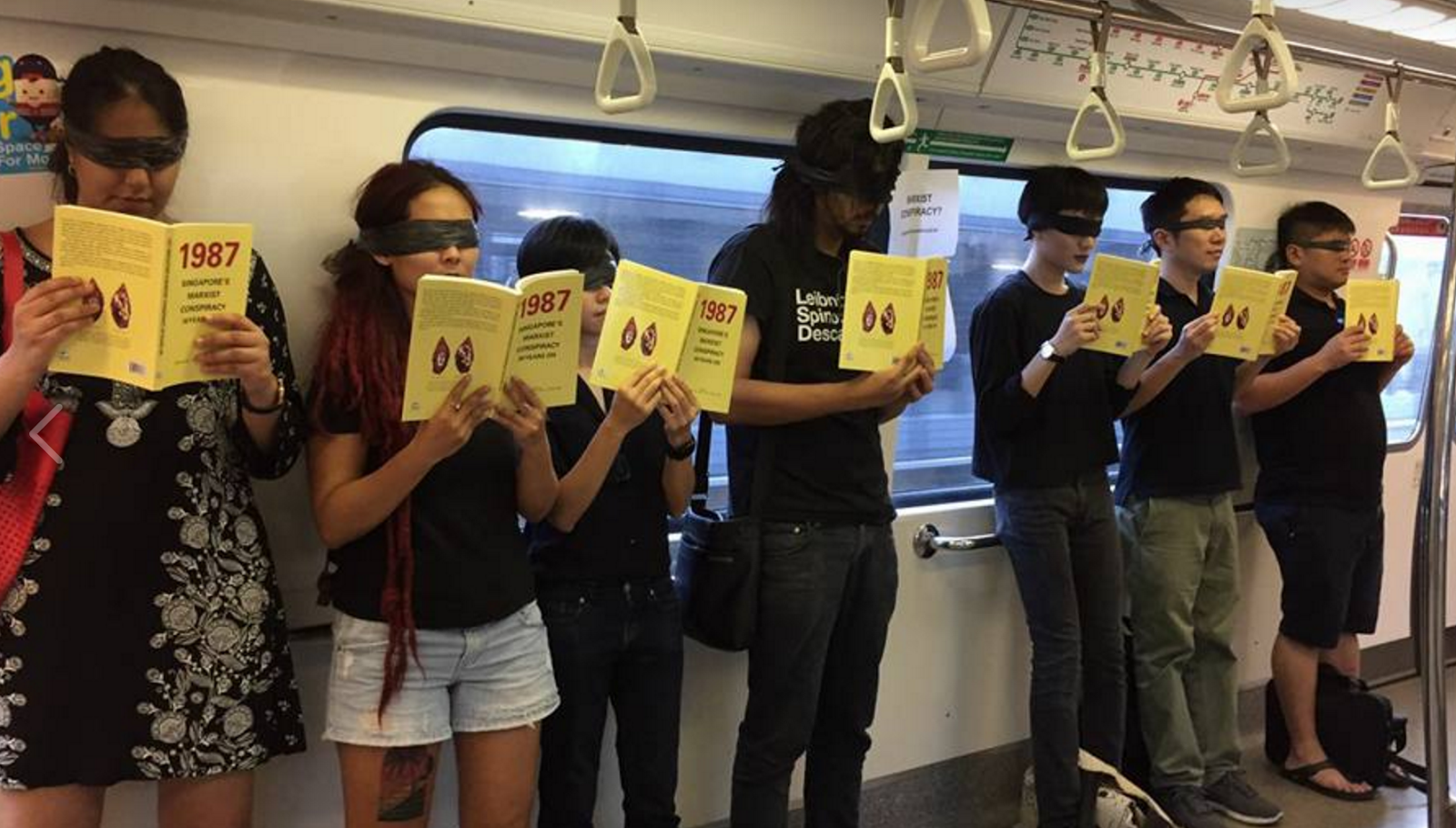
On 3 June 2017, Kirsten Han announced that her fellow activist Jolovan Wham had organised a protest in a Singapore Mass Rapid Transit train. Han reposted on her Facebook a series of photographs from Wham's personal page, showing Wham and eight others sitting blindfolded in a train carriage, holding up the recently published 1987: Singapore’s Marxist Conspiracy 30 Years On, with homemade posters stuck on the walls behind them. While Wham was tagged by Han, his collaborators and co-conspirators are instantly recognisable as activists of a certain bent in Singapore. Everyone knows who they are, but their names will not be mentioned here.


On the morning of 3 June 2017 while Kirsten Han was likely involved in the coordination of the dissemination of the news of the protest, if not the protest itself, I was attending in my personal capacity, as I note were some other members of the Community Action Network, the Singapore Heritage Society 30th anniversary lecture by Prof Kwok Kian-woon at the Singapore Management University.

I had no prior knowledge of the protest. I was not involved in its conception, deliberation, or execution. I was not invited to be part of it. If invited, I would have told them it was a stupid idea that would get them thrown in jail, whether they did it in Singapore, New York, or London.

13 October 2017

Endgame for the 2017 presidential election

Who won the 2017 presidential election?

The big winner of the 2017 presidential election is not the PAP nor its proxy candidate, Halimah Yacob. This honour goes to the outgoing president, Dr Tony Tan.

09 October 2017

Decoding the social media narratives of the 2017 presidential election

It is significant that during the 2017 presidential campaign, the issues that the social media saw as significant to the election had very little congruence with what the candidates themselves, the People's Action Party government, and even we saw as significant and wanted to talk about. It is significant that instead of lulling the electorate to general apathy, this disconnect has served to galvanise them and stoke up their anger at the PAP.

Were these narratives part of an unofficial, yet highly coordinated campaign? Were these narratives more spin, conspiracy theory, and fake news than a reflection of the legitimate issue, that the PAP had compromised Singapore's national principles of multiracialism and meritocracy? Why does it matter if they were? Did we, the people goof up the presidential election as much as the PAP, the elections department, and the candidates themselves?

04 October 2017

Decoding the narratives of the 2017 presidential election campaign

We have established that Singapore's People's Action Party government and its proxy campaign for candidate Halimah failed to craft a winning narrative for the election that was credible. Big picture concepts like meritocracy and multiracialism were thrown up in order to manufacture a consensus around Halimah, yet the effect was to convince the populace that the PAP had become deluded, self-serving, or completely Orwellian.

But what about the semi-campaigns of the three candidates?

28 September 2017

Breaking the presidency and Singapore, straw by straw

The radical changes to the presidency that the People's Action Party mooted and enacted in 2016 have angered a public originally resigned to seeing the office incrementally remade at the whims of the PAP, for the convenience of the PAP. The old changes fooled no one into thinking they were designed to fix the problems of the presidency; the new changes fool very few as well.

In 2016 when the changes were mooted, it was expected that candidate Halimah, whose hat was thrown into the ring by class clown Chan Chun Seng, would have an easy walkover in the reserved election for a Malay president.

But it was the PAP's proxy campaign for candidate Halimah and its off-kilter messaging that convinced a large section of Singaporeans that the ruling party was intent on endangering the social fabric of Singapore itself, just to ensure a win for its candidate.

The PAP succeeded in wrecking the presidency far better than Wreck-it Ralph

23 September 2017

Understanding Singapore's 2017 reserved presidential election: an introduction


We extend our thanks to Dr Tony Tan for his service to the nation, and to Mdm Halimah Yacob for making history as the first female president of Singapore.

Mdm Halimah is a legitimate president, however compromised her mandate may be, however her office has been tainted by the PAP's management of the presidency and the election.

More than a week after her inauguration, the Minilee government continues to fight a PR battle to claw back the trust and public goodwill it squandered and to salvage the credibility of the presidency, while public anger at the PAP and incredulity at its error of judgement remain unabated.

The issue will not go away, nor will the public anger be truly abated or assuaged. The appropriation of #notmypresident and continued attacks on Halimah's Yishtana House are just the beginning, and not the fading scream of some sore losers. This PR battle will last beyond the tenure of Mdm Halimah, or indeed that of prime minister Lee Hsien Loong.

Because you see, the problems with the post of the elected president are written in its DNA and made worse by the PAP's continued tinkering with the office.

27 July 2017

The Apothesosis of Lee Kuan Yew VI

Can we remember Lee Kuan Yew without creating a cult?

A statue of Turkmenbashi, not a statue of Lee Kuan Yew

14 July 2017

Singapore's Speak Mandarin Campaign clown show moment


A funny thing happened on the launch of the 2017 edition of the Speak Mandarin Campaign. The poster, unveiled at the official launch by a minister on 12 July, promotes the 2017 slogan for the campaign, which should translate as "Listen, speak, read, write". Except that the third character 渎 isn't the one for "read" 读. The character 渎 actually means "diss" or "disrespect".

This is what COVFEFE looks like in Chinese. This is what sheer incompetence looks like in Singapore.

15 May 2017

Date with High Court, Cha-cha with Cheng Bock


It was clear from Dr Tan Cheng Bock's press conference on 31 March 2017 that the good doctor would mount a challenge to the reserved presidential election to be held in Singapore before September 2017. It has been a week since Dr Tan broke the news that he had applied for "a clarification" from the High Court - an application which was accepted.

It is time for us to examine the principles that may guide the court when it makes that clarification for both Dr Tan and the Attorney-General's Chambers. We make no attempt to weigh the "correctness" of these principles or the likelihood that they will be accepted by the Court in its judgement.

31 March 2017

Tough Questions with Tan Cheng Bock


On the morning of 31 March 2017, Dr Tan Cheng Bock held a press conference on the upcoming presidential election. During this conference, the good doctor read out the text of his media release (which is also helpfully reproduced on facebook and streamed by The Online Citizen).

As usual, we at Illusio will hold your hand and help you read between the lines.