Showing posts with label media liars. Show all posts

20 March 2018

Are Singapore's fake news public hearings a waste of time?

Singapore's Select Committee on Deliberate Online Falsehoods have begun hearing testimonies from the public.

It is tempting to dismiss the proceedings as a prelude to new laws against free speech online. But it is more profitable to suss out the complexities, competing agendas, inconsistencies, and blind spots that arise from select committee hearings even as the committee balances its fact-finding function with its practical role in parliamentary decision-making and consensus-building.


In other words, ignoring a select committee's public hearings is an indicator of political illiteracy.

26 February 2018

What is a reasonable response to the fake news problem?

The window for public submissions to the Parliamentary Select Committee on fake news shutters on 28 February 2018 in Singapore. We at Illusio have decided not to make a submission to the committee. What we have written on the matter is intended a resource for the public at large, legislators in parliament, media practitioners and consumers, and legal and communications researchers, specifically on the knowledge gaps that the committee is expected to acknowledge, address, and recommend further research on before it authors a White Paper.

There may be unknown unknowns, but have we dealt with all the known unknowns of fake news?

19 January 2018

Everything you know about Fake News is wrong

Aside from Singapore, other far more democratic countries are considering or have already passed laws against fake news. When the inevitable accusations of authoritarianism and censorship are made by the usual quarters, all Singapore's minister for communications and information (or his permanent secretary needs to do is to point at France and Germany, which have just recently enacted them, and Canada, which has had them for decades. Even the UK has begun the process of studying whether it needs a fake news law.

If the minister and his permanent secretary are competent, they will point out that these laws have been passed in the "liberal West" even in the face of criticisms about the chilling effects on free speech, and promise to be responsible and circumspect with their new powers.

But that will still not detract from the elephant in the room: Fake news is fake.

23 September 2016

Balled Over by the Empire

In our "Rise of the anti-intellectual, illiberal left" category, the question is:
Which of the following did not happen this week?

A. Social Justice Warriors waging war on pie. Empire Pie. I miss fafblog and its pie jokes.
B. Social Justice Warriors waging war on a museum. It put on a fundraising dinner called the Empire Ball to kick of its curated exhibition of the Tate's edgy, critical, anti-colonial take on Empire and Artists (co-branding yay or nay?). They object to the word empire, of course.
C. Social Justice Warriors waging war on Fox's Empire. The word empire is imperialist (duh) and triggering.

25 November 2012

Book Review: Freedom From the Press by Cherian George II

(Read Part I here)

The curious rhetorical device of Cherian George

Some time back, Cherian George published a book called "Freedom From the Press", where a cursory reading reveals that the good professor doesn't want you to take him seriously as an academic. In fact, we argue that he doesn't even take himself seriously as an academic.

We've made hay of a few instances where he resorts to misrepresentation and strawman arguments by summoning faceless, nameless critics out of thin air. But why is this important to us as an indicator of how Cherian George is unfit to be a respected academic, or even an academic at all?

Citations are important. When we read a non-fiction book by an author or academic who wants to be taken seriously, we want to know WHO said WHAT exactly WHERE and WHEN. That's so that we know the author didn't just make things up, or invent people out of thin air and put into their anonymous mouths lame arguments in order to discredit or divert attention from actually existing, stronger arguments.

Now, here's an experiment: try writing an assignment in first year university without proper citations. I'll bet every single dollar I have the professors will fail your assignment. But if you're "Professor" Cherian George, you'd get the entire embarrassment of a book published by the National University Press. And no, you wouldn't be stripped of your teaching post for doing shit like this - which amounts to technical plagiarism.

No comments necessary

And now for your entertainment and enlightenment, here are all the instances where Cherian George does his thing in FOTP. 

I will keep the commentary to a minimum because these excerpts speak very well for themselves the kind of academic Cherian George is. Take your time to read through these gems, then decide if Cherian George didn't just make things up, or invent people out of thin air and put into their anonymous mouths lame arguments in order to caricature actual critics and misrepresent their sensible and strong criticisms - none of which you will read about in his "book".

Your moments of Zen, or Cherian George forgets to cite actual (and respectable) people, actual publications!

For example, otherwise authoritative sources refer to the news publishing behemoth Singapore Press Holdings as "government-owned" when it is not. (p. 2)

(Interestingly on p. 10, Cherian George admits that yeah if you want to look at it critically, SPH is government-controlled.)

Most critics assume that SIngapore's system is unsustainable because it is undemocratic. (p. 7)

Equally dogmatic are those at the opposite end of the political spectrum, in whose eyes the PAP and its instruments are corrupt usurpers of the people's freedom and dignity. This group includes foreign critics with a barely concealed contempt for Singapore and its people... In their eyes, any attempt to analyse the press system in anything longer than a single, colourful, expleteive-deleted (or not) sentence is at best a waste of time... (p. 18)

By misidentifying the ways in which the government controls media and politics, analysts have arrived at erroneous conclusions. According to some, Singapore's unfree media system was supposedly incompatible with an open economy and First World standards of living; it would soon crumble beneath the weight of its own contradictions. Most of these predictions have been based on crude misconceptions about how the press is kept in check... (p. 25)

(There's an entire page's worth of this spiel -- all without citations, presumably because if you were serious to read actual critics and academics take apart Singapore's press system, those won't be the arguments they'd use. Search for Michael Barr's writings, for instance.)

Take any random group of Singaporeans and you will find among them those who appreciate life in PAP-run Singapore and who support strong, decisive government as an integral part of the formula that has provided security and high standards of living. (p. 25)

(Fascinating strawmen you have there, "Professor"!)

Unlike those who see Singapore's media system as a giant contradiction, I would go so far as to say that the PAP has been on the right side of history. (p. 26)

Critics of the PAP had predicted that Singapore's ambitions to be a media hub would be thwarted by its lack of respect for press freedom. (p. 42)

Yet, contrary to the cynics' view that the Singapore press is content with reproducing government handouts, Newscom citations encourage journalists to dig for exclusives and overcome barriers, including obstructive government officials. (p. 54)

Conventional wisdom holds that the PAP -- a regime armed to the teeth with the powers of coercion --- completely overwhelms any professional norms and ideals that the Singapore press may once have possessed. Critics view journalists in a state of unconditional surrender to the government. "They are running dogs of the PAP and poor prostitutes," said David Marshall in 1994. (p. 69)

(This one is interesting. "Conventional wisdom" as a strawman, followed by our usual nameless critics with extreme views, then backed up inexplicably by the late David Marshall, obviously taken out of context. The real-world criticism of SPH that Cherian George is caricaturing and hiding: the press may be 'professional' but is ideologically enslaved, that its reporters are consciously, willingly making up excuses to toe the PAP line. Like say, making up shit about OB markers in the press.

Or as Cherian George himself puts it in p. 48: Professional journalist's' love affair with 'objectivity' and their rejection of journalism's more activist past has made it easier for them to be turned into scribes for the status quo.)


Indeed, Gary Rodan observes that Singapore's media policy may have been partly influenced by a conscious desire to avoid Malaysia's mistakes. Admittedly, this is the kind of observation that enrages critical Singaporeans who would never concede that their press has any credibility. (p. 113)

Singaporean critics of the PAP want to believe that this backwardness is due to government repression. Such a claim would be an insult to media activists elsewhere. (p. 172)
(Here, we have not one but TWO groups of strawmen! Bravo, "Professor"!)

Most believers in democracy want and need to believe that Singapore is closer to the unstable end of the spectrum. They find it too disconcerting the idea that a modern state may have found a way to consolidate authoritarianism... (p. 201)

Opposition politicians and their followers are counting on the PAP's inertia to be its undoing, causing Singapore to succumb eventually to the tide of freedom. (p. 225)

09 September 2012

Book Review: Freedom from the Press by Cherian George

Part I: Cherian George doesn't want you to take him seriously as an academic

If you have a good impression so far of the career of Dr Cherian George as a serious political commentator on Singapore politics or as an academic, don't read his reply to Vernon Chan's review of Cherian's book, "Freedom From The Press" on The Online Citizen.

What are we to make of an academic who reacts in this fashion to an unknown complaining that his book isn't rigorous enough, doesn't follow normal academic writing and research standards? It's one thing to perhaps claim that Chan is a nobody making a mountain of a molehill, or that Chan is wrong about the standards required of academic publications. But it's a very different thing to say: "Fortunately for me, NUS Press – one of Asia’s top academic publishers – applied less lofty standards than Chan." or admit that most of the book is "the result of painstaking original research by my assistant."

We have read Cherian George's book following Chan's review in TOC and Cherian George's curious hissy fit, which is remarkably curious and unprofessional since it amounts to an academic telling a non-academic why he didn't have to declare his theoretical framework, and telling the non-academic why he's pretentious in trying to hold the academic to academic standards in his review.

Now we at Illusio have never shied away from being polysyllabic, hurling theoretical frameworks at readers as a preface before answering any question, or even teaching you all about the media theory of Roland Barthes. We can afford to be pretentious while taking down Dr Cherian George.

Pseudo-Intellectual Waffling

But let's give credit where credit is due. Where it comes to pretentiousness and putting on pretensions, no one outshines Cherian George. Let's take a look at the first two chapters of Freedom From the Press.

Geroge presents no theoretical framework, no consistent strategy of presenting an analysis of "journalism" and its relation to "state power in Singapore". What about the concept of "freedom" then? For some mystifying reason, George spends two entire chapters feeding us red herrings. In the bizarro universe of Cherian George the academic from NTU, there is a huge controversy over the concept of press freedom. He vacillates between acknowledging its existence, viability, and rightness as a concept and denouncing it, Kishore Mahubhani style, as a convenient western invention that isn't quite practised in the west.

Dispensing with references, sources, and resorting to misrepresentation and strawmen arguments

My issue with these two chapters is not the glibness of Cherian's argument but that it's part of his centrist for the sake of centrist schtick, which I've identified before in this blog. Yet what dismays me (and probably Chan) is Cherian's frequent resort to strawman arguments on both ends of the political divide. Sentences like these are littered throughout FOTP, so much so that Cherian should be hauled up for an Intellectual Public Work Order to clean up his tome.

"One favourite retort of defenders of authoritarian press systems is that there is, after all, no country with absolute freedom."


"Those at the opposition end of the political spectrum includes foreign critics with a barely concealed contempt for Singapore and its people..."

In FOTP, which Cherian George crows that NUS Press saw fit to publish, arguments (mostly against the Singapore press system) are attributed to faceless, nameless critics. And foreign academics, who are almost always faceless and nameless unless they happen to be Mary Turnbull, who wrote a coffee table book (commemorating 100 years of The Straits Times, no less!) commissioned by Cherian's former employer, SPH.

We kid you not. This is a sample paragraph in Cherian's book.

"By misidentifying the ways in which the government controls media and politics, analysts have arrived at erroenous conclusions. According to some, Singapore's unfree media system was supposedly incompatible with an open economy and First World standards of living... Most of these predictions have been based on crude misconceptions..."

Who are these analysts? What are the conclusions, however erroneous, they have made? What predictions did they make precisely? What misconceptions did they base all these on? Where are the flood of citations and footnotes that would normally accompany a paragraph like this?

Cherian George doesn't seem to want to be taken as an academic as long as there are mysterious, unnamed analysts whose studies and predictions he rubbishes without the courtesy of 1. naming them, 2. and their actual studies or articles. It's as good as misrepresenting his fellow academics in other parts of the world, who thankfully won't hear of his wretched excuse of a book since no serious journal will bother reviewing it.

On one hand, George wants to be taken seriously eventually as an academic who writes on the media and state control of the media; on the other hand, George also wants to be taken seriously as a serious academic who isn't like the "western critics" and "anonymous critics" whose criticisms of the Singapore press system he denounces - probably because they're not Singaporean, they're Singaporean but anonymous, and they're more truthful about the state of Singapore's press than he allows himself, as a serious and credible commentator within the Establishment on Singapore politics.

Now here's your moment of zen

What gets Cherian George's goat apparently are the Reporters San Frontieres's Press Freedom Index, which places Singapore near the bottom. He seems to be mightily offended, dismisses the entire enterprise of press freedom indices with just one line: "RSF's methodology is dubious, resulting in the Republic being grouped with regimes where journalists lose not just their liberty but even their lives." And just to show what a good little academic he is, Cherian George provides a CITATION and reference for this judgement call. Namely, his own blog post.

No, I guess there haven't been any serious academics publishing articles in peer-reviewed international journals where they try to analyse the methodology, consistency, validity, and coherence of the Press Freedom Index and others.

In the bizarro universe of Cherian George, Google Scholar shows Zero Results for this because Harvard's Ronald Inglehart hasn't bothered to test the RFI, and SAGE isn't interested in academics trying to take apart surveys and indicators to see if they're worth anything. In the bizarro universe of Cherian George, the academics Harvard and SAGE, amongst others, can't really find a way to discredit the methodology or theoretical basis or validity of the various press freedom indices they've looked at.

In the universe we live in though, a simple Google Scholar search reveals all the western academics (amongst others) who have audited the RSF and Freedom House indices for decades and given them a clean bill of health, as well as explain what these surveys are really telling us (and consistently) over time.

I mention Ronald Inglehart because he's a big hitter in the world of political science. His World Values Survey finally made its way to Singapore earlier this decade. The NUS researchers co-conducting the Singapore leg of his survey spent about 6 months of preliminary research to critique or validate the concept, methodology, and validity of the WVS and found it acceptable. Now when Ronald Inglehart spends time doing the same to the Press Freedom Index and finds it passes muster and publishes a paper on it, you'd trust him. Not this Cherian George clown with his glib 'refutation' of the PFI on his 'journalism' blog.

Gee, so much fail just in the first 2 chapters of his book already? We advise "Dr" Cherian George to be a better academic or just stop pretending to be one.

And maybe If you have a good impression so far of the career of Dr Cherian George as a serious political commentator on Singapore politics or as an academic, you should skip the introduction and the first 2 chapters of his book, Freedom From the Press.

07 September 2012

Book review and Cherian George smackdown to come!


We have never been fans of Cherian George and his attempts to be a political commentator and commentary moderator of the blogosphere.

It has come to our notice that following our criticism of Cherian's writing and our unmasking of his political agenda, the NTU pseudo-academic-on-a-political-sinecure has changed the URL of his online essay twice in the past year and very conveniently made his entire website unavailable for most of this year, until the last fortnight. We have of course updated the broken links once again, and will continue doing so each time Cherian George shifts his URLs around. And if Dr Cherian George takes his site or essays offline ever again, I have screenshots of his essays primed and ready.

Even though we are an old fashioned and unpopular site that no one really reads, Cherian George seems to be taking extraordinary measures to hide his embarrassment from our criticisms. We would like to think that Cherian George is doing this to protect what little academic credibility he has left. Then again, it seems Cherian George has all but given up pretense to academic credibility, at least if you read his startlingly embarrassing reply to a review of his recent book.

Now. We do have a copy of Freedom From the Press, and we are more than happy to review his book right here. After all for an academic, Cherian George must publish or perish - and then he must be reviewed as well, or perish. Illusio is not an international, peer-reviewed political science or media studies journal, but then neither are The Online Citizen or The Foreign Correspondents' Club of Hong Kong - which, 6 months after the book's publication, are the only establishments in the world interested in reviewing his book. Of course, we are honoured to increase the reviews of Cherian's book by 50%.

Look for our review this weekend!

11 July 2007

Theonlinecitizen replies

Choo Zheng Xi, currently a law undergrad at NUS and the co-editor of theonlinecitizen, has replied via MSN. He is the original author who broke Alfian's story, advised Alfian to send in his essay on Francis under a pseudonym, and also published Alfian's op-ed piece "Should homosexuals be allowed to teach" as an uncredited article.

The sum of it: Choo Zheng Xi has refused to answer any of the questions raised almost 2 weeks ago. I am reproducing his reply, stating his refusal to reply, word for word here, with no additions, subtractions or alterations:

[01:47] choo: hey sorri dont think ile be replying to your piece
[01:47] akikonomu: i didn't expect you to
[01:48] choo: ok
[01:53] akikonomu: you see, i don't expect you to have what it takes to explain away that breach of journalistic ethics
[01:53] choo: more like i dont think i need to actually
[01:54] akikonomu: nope. because you can't explain it anyway
[01:54] choo: well you wouldnt know would you =)
[01:55] choo: honestly it'd give the issue more publicity than a non issue deserves
[01:56] choo: none of the grand total of 3 ppl ive asked to look at your piece thinks it matters
[01:56] choo: they're probably the only ppl who read it
[01:56] choo: if i'd replied
[01:56] choo: i might have doubled your readership
[01:59] *** "choo" signed off at Wed Jul 11 01:59:14 2007.

I would like to thank Choo Zheng Xi for taking the time to explain that an explanation isn't needed, and to take the effort to impress upon me that this is a non-issue.

27 September 2006

How can we trust Tan Tarn How?

Granted, the man may now be a researcher at the Institute of Policy Studies, and he may have retooled himself as an analyst and an advocate, according to his blog>, but doubts remain.

Why is he one of the very few researchers at the venerable IPS without even a postgraduate degree? Just how did he manage to be a "senior research fellow", given that other senior research fellows in the IPS have not just postgraduate degrees, but teaching qualifications to boot?

And why was he even chosen as a key speaker in the Singapore Theatre Festival 2006 (otherwise known as the Singapore Political Theatre Festial) "Art and Life Sessions" forum, alongside other pro-democracy dissidents like Gayle Goh, Martyn See, and Sylvia Lim?

Does anyone remember this hatchet job of a piece, written by the same Tan Tarn How on 29 Oct 2001? Does anyone remember how Tan Tarn How was the hatchet man at the Straits Times, or how he single-handedly demolished the credibility of the Worker's Party 2 election cycles ago, by whispering... either WP is honest but incompetent or they are dishonest and putting a joke on us?

Bungle and break-up may help WP, Poll Watch, Tan Tarn How

Disqualified from Aljunied GRC, it can focus its resources on two wards, while JBJ's exit may strengthen Low's hand.

The joke going round after the disqualification debacle by the Workers' Party (WP) is that it is junking its "Power to the People" slogan for a new one: "No More Forms".

Whether that would go down better with the electorate, no one will ever know.

Meanwhile, being barred from contesting in the Aljunied Group Representation Constituency after the pathetic slip-up with the statutory declaration forms leaves Mr Low Thia Khiang's party with fights in only two single wards, Hougang and Nee Soon East.

Add to that the acrimonious break-up with former party boss JB Jeyaratnam and his supporters, and some are saying the WP now looks a little like the walking wounded, shot in the foot both by itself and its former commander-in-chief.

This, after the recent hype that Mr Low is likely to lead the party and the opposition into a new future.

But things may not be what they seem on the surface.

While Mr Jeyaratnam's joining forces with Singapore Democratic Party chief Chee Soon Juan and the slur on his erstwhile protege for the bungling at Aljunied will, no doubt, draw some of Mr Low's blood, it may make the incumbent MP in Hougang and his party stronger for the future.

The reason: Mr Low's rebuilding of the WP is perceived to be strapped not just by Mr Jeyaratnam's legacy but by his continuing membership of the party.

Thus, Mr Jeyaratnam's quitting legitimises Mr Low's succession by sparring him the difficult task of removing the old warrior, which would have tarnished Mr Low for betraying a former patron.

As for the disqualification, it leaves the WP with only two contestants and this is four short of the six needed to get free air time for political broadcast on television. It has denied itself the straight to the living room search given the PAP, the Singapore Democratic Alliance (13 candidates) and the Singapore Democratic Party (14 candidates).

If the WP has ended as a "small player" this time round, so be it, Mr Low said.

The new WP faces among the rejected Aljunied hopefuls, Mr James Gomez and Mr Yaw Shin Leong, would also not be able to earn their bustings spurs, valuable since in the last 20 years, no opposition candidate had made it to Parliament on his first try.

But the pros of the disqualification may overweigh (sic) the cons.

Fighting fewer battles will help the WP by concentrating its forces.

Mr Low's Hougang bid thus gets a lift; but more crucially for the party, Dr Poh Soh Guan's closely-watched one-on-one skirmish with PAP candidate Ho Peng Kee in Nee Soon East will get a boost from the extra hands - and handshakes - in a widely anticipated close contest.

And the Aljunied red card lets Mr Low plug the party fine and accuse the PAP of not giving the people a choice.

The PAP's stand that it was the Election Department which made the decision and that the PAP would not have objected about the technicality is unlikely to work with Mr Low's supporters.

All in all, the WP may now stand a better chance of wrestling a second seat from the PAP - and if the SDA and SDP fizzle out, Mr Low will then be the de facto leader of the opposition, ahead of Mr Chiam.

It is not how many seats you contest but the number you win that counts.

In the end, the most beguiling theory about the Aljunied fiasco is that it was an elaborate piece of wayang put up by Mr Low.

How else can one explain that he did not spot the basic error?

Mr Low, the theory goes, intentionally did not fill in the name of the GRC in the candidate's statutory declarations for all the above considerations.

There is only one hitch: Mr Low seemed visibly and genuinely frantic on the mobile phone when he heard of the trouble with the forms on Nomination Day.

He didn't seem like acting, so there goes that line of speculation.

Unless, of course, he is a better actor than anyone can imagine.

And the joke wasn't on him, but on all of us.

22 August 2006

NDRS focus!

Analyses of NDRS 2006 should be filing in soon in every corner of the Singapore political blogosphere.

Okay, so maybe Gayle Goh is the only one to attempt an in-depth post on the NDRS. It just has the trademark hindsight of her youthful years, with gems like "There was no mention of new policies, which is a change from last year's National Day Rally Speech". Girl, every year NDRS got new policy announcments. Mr Wang is taking the NDRS apart, piece by piece. It's certainly a far better read. The bloggers at Singaporeangle have made predictions on this year's NDRS, but haven't come back with a post-mortem of the speeh.

However, an interesting exercise is to observe how the media is spinning the speech and deciding how the reader-citizen should react to it. I imagine the Straits Times spin will be covered by other writers very soon, so I'll just stick to Channelnewsasia.

PM Lee's rally speech inspiring and assuring, say Singaporeans

I suspect you wouldn't read this article if it were titled: MPs and other invitees full of praise for NDRS - yet this is what the article is really about. The article talks about the reactions of Singaporeans but neglect to mention they were all invited to the speech and are the type of people whom you can count to applaud vigorously at any Baby Bonus announcements regardless of the soundness of the policy, or laugh heartily at any lame joke Minilee would make. Yet according to CNA, they are not members of the establishment who attended the rally, but merely "many of those who heard Prime Minister Lee Hsien Loong's speech".

Channelnewsasia is just as bad as The Straits Times. Wong Siew Ying, Noor Mohd Aziz, and S Ramesh are hacks who have less integrity and honesty than bloggers.

Singaporeans say PM Lee's rally speech resonates with them


CNA spoke to Singaporeans among the lunchtime crowd at Raffles Place, one day after PM Lee Hsien Loong's speech on Sunday. But does this even count as a news article?

"Many felt it touched their lives"
"They said they liked what they heard"
"It was a speech that resonated with them"
"Blah blah blah," said a Singaporean.
"Yakkity yak," said another.

And for those who have just arrived on our shores, they said that Singapore is a most welcoming home away from home.

"Blah blah blah," said one immigrant turned citizen.
"Yadda yadda," said another immigrant.
"So on and so forth," said a third.
... and a fourth.
Whatever their views, Singaporeans took Mr Lee's message to heart.

Dominique Loh certainly fails as a reporter, with his torrent of unnamed, anonymous, unverifiable sources. Is it that difficult to get those people to stand up for what they said? That's troubling, actually.

Who are these people who said Minilee's speech is good?
What are their names?
How many people did you interview?

And no, I am not channelling the spirit of Papalee here.

But this is how the media is attempting to pre-shape the reactions of really existing Singaporeans to this year's NDRS, and creating an orthodoxy of opinion, an acceptable range of responses for them to choose from.

22 May 2006

Singapore Urban Legends Part Deux

Cherian George opines: Opposition coverage has been greater and fairer than at any point in the past 30 years at least.

Get your debunking tools ready!

In the previous post, I went to the National Archives with fellow SBPer Pleinelune to search for the Holy Grail of Singapore politics: undeniable proof that Papalee threatened to find out who exactly voted in Jeyaratnam and Chiam in 1984, and why.

We didn't find any such account in the Straits Times.

What we did find:
A much more sympathetic report of the opposition in its stories (although numerically, articles covering the Whiteshirts still dominated).
More critical reporting of the Whiteshirt campaign and election issues, compared to the 2006 election.
The combination of sympathetic and critical reporting led Papalee to accuse the press of being biased against his party, a claim he continued to make as late as 2006, in a televised dialogue session with ST journalists.

What does Cherian George say about this editorial from the Straits Times, in 1984?
"Let's take it in our stride"
What is disturbing is talk of the need to re-examine the one-man, one-vote system in light of what happened. Equally disturbing is the prospect that residents of Anson and Potong Pasir are in for a lesson, for voting in opposition candidates.

Can Cherian George honestly say that today's Straits Times is capable of printing such editorials? That it is more fair towards the opposition?

We also paid attention to photographs of the politicians. All were of low quality and in black and white. Papalee had one of the worst photos (him in side profile, clenching a fist at the microphone), while other PAP and opposition MPs and candidates had full-face passport photo style mugs, regardless of position and post.

There was also a half page interview with Chiam, where he outlined what he'll do in Parliament. A quarter page interview with an outgoing opposition party leader, his analysis of how his Malay party managed to garner suprise Chinese votes in 1984. ST also published full articles from foreign newspapers (the Bangkok Post, the New Straits Times, the Wapo). These were articles chastising Papalee for being a sore loser, pondering over his rejection of one-man one-vote democracy, and suggesting that voters, in their 12% national swing towards the opposition, were rejecting the increasingly hectoring style and torrent of Papalee's national campaigns.

Which is the Pro-PAP ST?

A. ST in 1984: Quoting Whiteshirts word for word, no matter what they say. Headlines are direct quotes from their speeches, and come with quote marks.

B. ST in 2006: Spinning Whiteshirt speeches, dressing up headlines to mislead readers, editing out unfortunate phrases like "fix them and buy my supporters votes".

Cherian George, I'd like to see a retraction of the statement in your blog, really. And it took just 2 people 1 hour at the National Archives to do what you thought would take 2 years by NUS/NTU honours thesis candidates. Gah.

Bonus Section

Just to see how the Whiteshirts have commited the mistakes it accused opposition parties of making in 1984, and how little things have changed, here are the headlines of the post-election coverage from 24 and 26 December 1984:

PM replies to voters' signal (papalee promises a more open and less austere government)
Genuine distress or blackmail, asks Raja (Raja vows to show voters they cannot blackmail the government into compromising policies and principles. This man does not understand the meaning of democracy)
Senior ministers' pay to go up (he did promise a less austere government. and is leading by example)
PAP has support of most younger voters (claim by Goh Chok Tong, then a new MP)
26,000 voters cast spoilt or rejectd votes
Snake pit politics will scare off credible candidates (now we know why the Whiteshirts find it so hard to recruit)
Brigadier-General Lee makes early "thank you" call
We will settle accounts (Papalee refuses to congratulate Chiam and JBJ, vows not to put election clashes behind)
PAP must make greater effort (to bond with voters. GCT)
Not so much a vote for opposition: Mah (it's a plebiscite)
Chua to step down from Cabinet
By-elections may be needed (to allow Mah Bow Tan to get back into parliament after defeat by Chiam)
Let's take it in our stride (critical editorial by ST chief. Soon replaced by a more pliant and cooperative candidate)

26 December

Voting is not like making a film (excerpt from Papalee election victory speech)
Voting not based on racial lines, says Yatiman (denies Malays ever vote as a bloc)
Opposition denies playing gutter politics

23 April 2006

The first real test

I never expected such crap from Reuters.

"SINGAPORE (Reuters) - Singapore's government dissolved parliament on Thursday and called an election for May 6, a poll that will be the first real test of Prime Minister Lee Hsien Loong's leadership."

For those of us living in the reality-based world,

1. the death of Papalee will be the first real test of Minilee's leadership.
2. the suing of Chee Soon Juan will be the first real test of Minilee's leadership.

26 February 2006

On Rajaratnam

What pomp, what ceremony! Rajaratnam's funeral is a full-dress rehearsal for papalee's great requiem mass!

How does one plan for the Great Leader's death spectacle? By setting precedents, by letting the state media machine work itself into pious breastbeating and tearing of sackcloths on the death of a member of the Old Guard.

Rajaratnam may have been a decent man, but he was no great man. One has to wonder about what went on in the vast expanse between the ears of the man who wrote the national pledge: "One united people, regardless of race, language or religion" but silent on the issue of sex and gender, class and political belief, this man is no thinker and no humanist.

14 December 2005

The posthumous pardon of Devan Nair

Chengara Veetil Devan Nair died in exile in Canada, aged 82.

Much has been made about Papalee's character assasination of President Nair, which continued years after the latter's forced resignation in 1985. Even more has been said about how Nair was to survive, for the next 20 years, in Canada, where he stepped up criticisms of the authoritarian rule of Papalee, his proscription of various opposition leaders, and his perversion of NTUC (whose independence was guaranteed in its founding constitution) into a branch of the Whiteshirt Party. Absent in the national propaganda press's coverage and state-coordinated posthumous pardon of Devan Nair is his outspoken support of the opposition movement in Singapore during his exile.

It amazes me that Malaysian blogs constitute the vast majority of online writing about the passing of Devan Nair, reporting with more objectivity and honesty than the Singaporean press.

Dear Reader, you can find them easily, and I shan't repeat their talking points and accurate historical narration. Instead, let's examine why the need for Papalee to invoke the vast machinery of the state to pass what is effectively a posthumous pardon for Singapore's 3rd President.

One might note that amongst Papalee's Old Guard, Devan Nair stands out as the most politically loyal (until his forced resignation). He was the only leftist member of the pre-schism Whiteshirt Party who did not cross over to Dr Lee Siew Choh's Barisan Socialis. He was the father of the national union movement that proved to be a shortcut for Papalee's control of the masses. And yet the stalwart soldier became the voice for a non-authoritarian polity, even deterring Papalee from one of his trademark suits against the Globe and Mail, a Canadian newspaper, in 2002.

Despite his forced and dishonourable resignation, despite the years of character assasination that followed, Devan Nair's credentials as former Lee loyalist, patriotic anticolonialist fighter, and father of the NTUC gives him and his later criticism of the Lee regime credibility. This makes Devan Nair more dangerous in death than in life.

If Papalee could not finish his character assasination properly, the sensible action would be to pardon the former President, let the NTUC hold a memorial service for the dead hero, just in case a genuine love by the natives for Devan Nair turns him into Singapore's Hu Yaobang.

07 October 2005

Cultural Arrogance Supremacy

Mr Wang gets into fits whenever he reads the Straits Times. Consequently, more than half the entries in his blog fall into the category of "ST stupidity of the day". I get annoyed by our national newspaper propaganda press, but not to that extent. The media of my choice has to be television. Whenever I turn on the set to any of our national stations, the random stupidity of the news and the lack of quality in its tv productions would make me scream within 5 minutes.

When Twiddledum and Twiddledee merged early this year, Channel U was spared the chops. Viewers should now be happy that the "revamp" of the station (the programming hardly changed) and its new branding will ensure more of the same dramas that MediaworksTV has been showing.

Of course, the cosmetic revamp (in part to delete all traces of MediaworksTV's existence) has to be accompanied with a new ad campaign to be played incessantly on every channel: 带动亚洲流行!

Will someone please tell those yellow skin chauvinists that Asia is not HK, Korea, China, Taiwan, and Japan? Where oh where are the trendy Indian, Iranian, Indonesian, Egyptian, Turkish, Middle Eastern dramas on Channel U?

24 August 2005

National Day Rally Speech (Quickie Version)

Diary of a Dragon Prince Edition

1. Much improved from last year. Incidences where I pause for applause and audience misses cue are lessened. University Cultural Centre MUST be retrofitted with APPLAUSE signs!

2. Should consider giving the NDRS next year at Hong Lim Park.

3. Made a minor blunder in Chinese speech by mangling the Chinese idiomatic saying into 行行出英雄. Was reminded by private tutor during intermission (that's the real reason for the break, incidentally!) and then used the correct idiom in the English speech.

4. Haul up the government's speech archive on the internet and get them to perform some historical revisionism. I NEVER want people to remember I said 行行出英雄.

5. Haul up any Chinese newspapers which said I did.

6. Now, for the repeat telecast of the NDRS for this weekend, maybe should get Mediacorpsuckers to reshoot that 5 second segment?

08 August 2005

Happy National Day!


The Whiskey Tango Foxtrot Edition

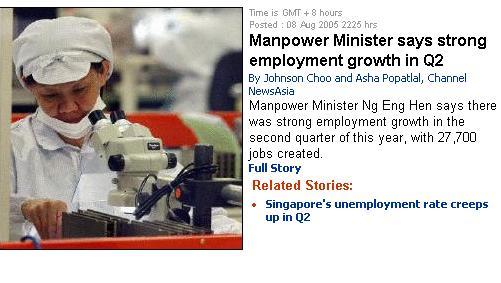
Singapore's premier news website can't make up its mind what its peasants should believe, apparently. Also, the link to the other story doesn't work (???), and only through the marvels of google can you find the original article here.

Excerpt:

Singapore's unemployment rate in the three months to June crept up slightly to 3.4 percent from a revised 3.3 percent in the previous quarter as fresh graduates joined the search for jobs, preliminary estimates released on Monday showed.

The Manpower Ministry said in its preliminary report that 27,700 jobs were created in the June quarter, an improvement from 17,800 in the previous three months and 10,900 for the same period last year.


No shit, Sherlock! To those of us who didn't skip 2004 in our Truman Show Machine, Singapore's job creation was abysmal! An improvement of this many jobs created a corresponding 0.1% in change in unemployment, yay!

Evidently job creation in Singapore is barely keeping up with the increase in labor force, and actual unemployment continues to increase.

15 June 2005

Beyond the Great Internet Firewall of China lies its greatest secret - the Reality Distortion Field.

From the Globe and Mail,

In China, cigarettes are a kind of miracle drug

Here's some exciting medical news from the Chinese government: Smoking is great for your health.

Cigarettes, according to China's tobacco authorities, are an excellent way to prevent ulcers.

They also reduce the risk of Parkinson's disease, relieve schizophrenia, boost your brain cells, speed up your thinking, improve your reactions and increase your working efficiency.

And all those warnings about lung cancer? Nonsense.


If you believe the official website of the tobacco monopoly, cigarettes are a kind of miracle drug...

31 May 2005

The Good President

The month of May opened with the death of former President Wee Kim Wee and the media extravaganza of his state funeral. Eileen Chew remarked that "on camera, everyone kept emphasising his goodness but I see only a handful shed tears at his passing." Johnny Malkavian goes one-up on her: on camera, in front of the entire nation, MiniLee was smiling as he commented on Dr Wee’s passing. Malkavian rants, "Nathan cried, and for goodness sake, even his (i.e. MiniLee's) father wept."

But I digress. The media extravaganza was reminiscent of St Reagan the Good's funeral last year. In both cases, party hacks from the press and the broadcast media invented the mythology of the People's President, to be repeated ad nauseum to the public until they relent and agree. For Wee Kim Wee though, the script was less credible and even more transparent - in short, insincere.

ST readers would've noticed, in the coverage of the lying-in-state (yes, we were bombarded with the coverage of the People's President for a whole week), an unironic piece on how a primary school pupil was made to attend the funeral by their teacher, so as to better understand the greatness and good nature of the man. That, despite the fact that the kid wasn't even born when Dr Wee retired from his post.

I mean, NO ONE called President Wee a People's President during his term in office from 1985 to 1993. Think about that for a moment. Not only do we have party hacks in the ST, they apparently are also staffed with revisionist historians.

Good President, Bad President

It does make rational sense (as much as malevolence is rational), if we consider what ST thinks are the needs of the nation.

1. The nation must be reminded that Devan Nair is a Bad President. There is no better way than to contrast him with the Good President Wee.

2. The Bad President Devan Nair is like Snowball; the threat he represents must be engraved in the minds of all Singaporeans without the need to invoke his name.

3. President Wee is a People's President. President Wee has always been the People's President.

4. President Ong Teng Cheong was a Bad President. As the first Elected President to hold the powers of guardianship over the national reserves, President Ong erred in applying his job description to his own political party and masters, who held 77 out of 81 seats in Parliament. No, you see, the Elected President is expected to function aa a figurehead, like the old President post. It's only in the case of an upset victory by the opposition that the EP is expected to function as the guardian.

By taking his office seriously and challenging Goh Chok Tong's government on the issue of the reserves, President Ong had become an obstructionist. This is why he wasn't given a state funeral or the idolising media treatment upon his death in 2002. He is the only one out of the nation's 4 dead Presidents who has not had a state funeral.

In fact, the incumbent (or should I say outgoing?) President SR Nathan knows what is expected of a Good President. In the words of Devan Nair, who thought it was the silliest job in the world, all you need to do is cut ribbons and attend charity concerts.

09 May 2005

Our Very Own...

Seen and heard on the Australian, via SDFonline:

There's Chua Lee Hoong, the ST's most prominent political columnist. She might be Singapore's Maureen Dowd, except the New York Times's Dowd didn't work with the secret police for nine years.


ST headline tomorrow: Singapore has global culture?

There's the founding father of Singapore, the island republic's most prominent (and *still* not retiring) statesman. He might be Singapore's Qin Shi Huang, except the founding father of unified China didn't have the luck of getting an army of foreign geneticists and biopharmaceuticals to work on his immortality potion.

There's MiniLee, the island republic's most prominent son. He might be Singapore's Baby Doc Duvalier, except the son of Papa Doc didn't have a Newspeak tutor.

There's that controversial Philip Yeo, minister and head of a statutory board. He might be Singapore's John Bolton, except the nominee for ambassador to the United Nations didn't actually threaten to sue bloggers for unspecified defamation, or publicly blacklist ex-civil servants in the national propaganda press because they broke their scholarship bonds by pursuing higher degrees and research positions overseas.