Showing posts with label the arts. Show all posts

15 September 2017

No kiss and make-up: Sonny Liew and Singapore's National Arts Council

After Sonny Liew won several Eisner awards for the graphic novel which the National Arts Council (NAC) of Singapore has previously denounced as "potentially undermines the authority and legitimacy of the Government and its public institutions", the government agency (despite its reluctance to spell out its direct affiliation to the ministry of culture on its own website) and self-declared champion of the arts in Singapore released a congratulatory statement whose mixture of embarrassment and halfhearted conciliation did not escape notice.

It appears that this would not be the end of the matter, and it was wrong to expect a kiss and make-up between award-winning artist and the nation's arts administrators.

So we decided to interview Sonny Liew ourselves.

19 August 2017

Sonny Liew's Eisner win and the future of arts censorship in Singapore

When we wrote a mini-review of Sonny Liew's presentation of The Art of Charlie Chan Hock Chye almost 2 years ago, we remarked that the graphic novel telling an alternate history of Singapore appeared to be "a pastiche of various periods and styles of comic art that were popular during the 1940s to 1970s".

In the intervening year, we bought a copy of the graphic novel and were amazed at how vastly Liew had undersold himself. Sure, Liew didn't research actually existing comics made by artists in pre-independence Singapore. The Art of Charlie Chan Hock Chye isn't just a pastiche of various periods and styles of comic art; it is a love letter to giants such as Osamu Tezuka, Steve Ditko, Walt Kelly, and Jack Kirby, who have influenced Liew as an artist.

But his book isn't at all an alternate or secret history of Singapore; it is a self-critiquing narrative informed by a historian's understanding that official history is enhanced when it is tempered and even interrogated by the inclusion of multiple viewpoints and the appreciation of paths not taken. It is a masterful love letter to Singapore, warts and all, and a tribute to Singapore's big men and smallfolk alike, and all their dreams.

A post shared by Red Dot Diva (@reddotdiva) on

Photograph of Sonny Liew, reproduced with kind permission from Red Dot Diva

But let's talk about how the clown show at the National Arts Council has to deal with Liew's multiple Eisner wins.

30 May 2017

Racism in Singapore comedy? Goodness gracious me!


Youtube influencer Shrey Bhargava attended an audition for the next installment in Hack Neo's "Ah Boys to Men" NSploitation comedy series. It went badly because the casting director requested Shrey to put on a funny Indian accent, and Shrey refused because it was insulting and racist.

Blogger influencer Xiaxue hit back hard, twice, at Shrey. So did his potential cast mates. All hell has broken loose.

Take it from us: This entire thing is a clown show. One that demands your attention.

And why should you listen to us? We actually have writing credits for The Noose. Made our own short films that were screened at The Substation when it was a cultural hub, as well as at the National Museum. And we've even written stand-up routines for local comedians. So let's begin, shall we?

05 August 2007

Asian Boys Vol. 3

At the end of Kill Bill Vol. 2, Uma Thurman as The Bride walks out of the mansion with her young daughter- not into the sunset, for that fate has been reserved for Bill (David Carradine). Instead, the lioness and her cub retire to a hotel where The Bride, resolved of the burden of her karmic duty, experiences joy mixed with an equal amount of sorrow, held together by tremendous relief.


Uma Thurman crying and sobbing next to the water closet, in a closet-like room

Asian Boys Vol. 3 is a theatrical adaptation as peculiar as the novel on which it is based. The 2-act drama takes Singapore's first published gay novel, Peculiar Chris, and does very different things to it in each act - the first half takes a playful, postmodern view on the original text, while the second "plays it for real", as a straightforward speculative continuation of the novel, almost 2o years on. What makes ABV3 a peculiar fish is how the concepts of these 2 acts struggle at odds with each other.

The idea behind Act 1 is a postmodern presentation of Peculiar Chris: Joe the author is himself a character in this play, in the process of completing Singapore's first published gay novel; amidst the reenactment of the novel's highlights, the author - doubling in the part of Chris - is on occasion reproached and interrogated by his muse and all other characters of the novel.

The metatextual repartee between the author and his subjects make up much of the wit in this act, but it is a wit that dulled by the simultaneous urge of the play to pay tribute to the landmark status of the novel. Act 1 is queer fish indeed; one cannot decide whether this is a somewhat straightforward adaptation of the original material, a gushing tribute to the importance of Peculiar Chris and Johann S Lee, or with the references to sometimes naive writing of a 19-year-old, a arch deconstruction of the novel. It is unfortunate, because the script fails to see through any of these 3 approaches far enough.

Armed with the best lines of the play (all taken from Peculiar Chris) and a playful and inventive approach, it's a mystery how Act 1 falls a short distance off the mark it should have reached.


This scene with Uma Thurman stretches for almost a full minute

Act 2 is a fresh beginning, a fresh approach: imagine if all the characters of Peculiar Chris were "real characters" existing in the current milieu. The setup is brilliantly done: Chris returns from the UK to a Singapore changed radically (at least for the gay community), and in revisiting old friends, finds himself embroiled in the politics of gay activists in the island, amidst a gathering movement for a repeal of Section 377A of the Penal Code, an upcoming talk by an ex-gay ministry, and the sacking of a gay teacher from MOE.

The setup is well-done and mostly carefully constructed, garnering laughs from its skewering of current affairs. However, what follows feels more like a pleasant evening at the 4th National Bolshevik Theatre for the People. Audiences will find themselves lectured at by several characters serving as mouthpieces for various ideological positions within the community - all shouting at each other. One must have a great reserve of patience to sit through the laborious and lengthy speeches, all telegraphed beforehand so you know when it's coming. One must have a great deal of curiosity for Singapore's gay politics to stomach through a Communist purge style denunciation of the class traitors, the fifth columns within the community. And above all, one must have a great deal of tolerance and forbearance for the out-of-control ranting and constant references to gay teachers sacked by MOE.

Well, you know what they say when art imitates life, but I'm very curious to know how Act 2 of ABV3 could have turned out if Alfian bin Sa'at had not had his unfortunate run-in with the Ministry of Education. Surely, a playwright who has more than 15 years of writing experience can do far better than the second act of ABV3.


The Bride rolls on the floor, at times laughing, at times sobbing

Looking at both acts, one realises that ABV3 is afflicted with the same problems as most of Alfian bin Sa'at's plays - often the latter halves fail to match the first halves, in terms of coherence as well as quality. Often, the two halves are more like 2 self-contained plays, conceptually complete in themselves. Now, there are 2 things I don't get in the play - two things that illustrate Alfian's continuing problems with the 2-act structure:

1. Act 1 ended with the muse revealing himself to be Chris, and inviting the Author to hop into Act 2 with him, to find out what happens to his characters after more than 10 years.
A. Where is the Author in Act 2?
B. Why, if Act 1 allows the Muse to deconstruct, comment on, and at times poke gentle fun at the self-seriousness and naivete of the Author and Peculiar Chris, does Act 2 not extend the same self-reflexivity?

2. Why does the play end with the Muse asking the Author how things will turn out in the end, when Act 1 ended with the Muse inviting to show the Author how things turn out in 10 years?


"Thank you. Thank you. Thank you." The Bride whispers this gratefully between her tears and laughter


Let me make it clear that it is possible to like Asian Boys Vol. 3. It's a good play to watch if you haven't been exposed to the theatre, or if you're a gay person seeking some form of self-validation through the gay play, through community theatre. And even if you're not that way, Act 1 of ABV3 is probably one of the best postmodern adaptations ever attempted in Singapore theatre - it is far more sincere and authentic than certain other postmodern plays like the "Amazing Asia" production of Lear, for example. It's a pity that the level of invective in Act 2 may well de-endear any audience to the homosexual cause, and for queer people who are more comfortable in their skins, the artistic shortcomings of this play will be what they'd latch onto, instead of the fact that it's a gay play.

The Summary

Asian Boys Vol. 3, as a gay play and a piece of politicised community theatre, can only find justification for its existence from closetted and newly-out gay people who need to find justification for their existence from the play. There is something off-putting about the strident politics of this play - from its fast and loose attacks at the evil oppressive government1, the class traitors, the fifth columns, and the almost Marxist project of creating class consciousness: that gay people must act as a class-for-itself, and stop existing as a class-in-itself.

The disconcerting thing is how ABV3 leaves no room - no, glosses over entirely the existence of well-adjusted gay people who reject both a life spent in local gay activism and a life spent in clubs and saunas. In the universe of Asian Boys, in the politics of Alfian bin Sa'at, you cannot exist, you do not exist.

1. References were made in Act 2 to the police raids of gay saunas. The truth is, gay saunas are a legitimate business in Singapore and have been allowed to operate unmolested for much of their existence. There has been a grand total of 1 drug bust at a sauna. Once every 2 or 3 years following lurid sauna exposes by The New Paper, the police feel obliged to make general and cursory inspections - to check for alcohol licenses and serving of underaged customers. That hardly qualifies as a "raid", and this frequency hardly qualifies as a pattern of oppression. One could argue artistic license - except when this is a community play.

07 March 2006

The Substation Loves White Elephants

It has been 4 months since the Substation launched its monthly online magazine ("The Substation Magazine"). While it does mostly performance and visual arts reviews, the magazine editor Cyril Wong seems to be steering it towards some social commentary as well as metacriticism of Singapore's art and artists.

Hopefully the Substation Magazine will shape up to be a more assessable and frequent counterpart to Focas.

(Disclosure: I wrote the top feature article for the March issue of the Substation Magazine.)
Updated 5 Sep 2007: Full text of article released here as the archives of the Substation Magazine is down, perhaps for good)

White Elephants in Singapore Art

The artist, unfettered?

Singapore’s artists have deep-set beliefs of themselves and their work. They often find it necessary to defend the value of art in a technocratic state like Singapore, especially at public forums, seminars, or even Q&A sessions at arts events. As if artists are somehow emotionally alien and distinct from the rest of humanity and completely incomprehensible:

“Why (or how) do you struggle with making art, instead of just following the rat race?”
“Is it worth it, being a round peg in a universe of square holes?”
And occasionally, even: How do artists here operate, given the restrictions of the state?

These are predictable questions that are perennially raised in almost every public forum. Of interest to us is the artist’s reply to the final question: There is freedom of speech, and we have to be very creative in putting certain politically-sensitive points across, and we occasionally have to exercise some self-censorship. So as an artist, I do not feel the heavy hand of the state.

The artist’s answer is, of course, as predictable and obligatory as the questions of of the public audience. An obligatory question meets with an obligatory reply: such is the nature of the social ritual, a liturgy of art, that establishes a kind of truth. Through each re-enactment, that truth is restated and reaffirmed as a timeless fact in itself. The coolness of the answer drowns out the doubts raised in the initial question, and re-establishes the primal state of innocence of the uncompromised artist ? a state of innocence natural, undisputed, commonsensical, and eternally so.

For all the qualities of a 10-year series answer, I hope audiences at the next public forum or Q&A session with an artist ask this question: Why was last year’s most important public art installation not done by an artist?

White elephants as art

Instead, the white elephants installation piece was created by a local businessman and minor grassroots activist from the Punggol South constituency. One August morning, eight white cardboard elephants stood outside the expensive, unopened Buangkok train station, a stunning reminder of the contest between the residents of the estate and the mandarins at the Land Transport Authority that may have shamed vacillating authorities, intent on postponing the opening of the train station in the due ripeness of time, into actually opening the station.

Even though they were exhibited for less than an hour (the grassroots activist feared reprisals and a genuine embarrassment to the visiting politician), these white elephants provide the wider audience in Singapore the idea of public art.

Good public art is:
1.Site specific art that speaks directly to the public. The work was integrated in the Buangkok MRT locale. At the same time, its installation raised the problematics of locality ? for instance, the residents campaign and the Land Transport Authority contested over the number and location of residents who would have used the station.
2.Relevant to area residents. There wasn’t any need to contemplate too deeply about what the installation meant, at its primary level. Yet, it provided much food for thought and public discussion.
3.Strong, clear social and political commentary. To call into question the judgement of technocratic mandarins, to contrast between the residents, who needed the station for their transport, and the white-collared mandarins, who did not see their need as sufficient for providing public transport. To call train station that cannot be opened a white elephant...
4.Controversial, yet humorous and cheeky. Despite its radical nature, the installation was well-liked and brought smiles to the fortunate spectators who saw it in person. Compared to other legitimate public art installations in Singapore during the same period, the public will have an enduring memory of the white elephants.
5.Safe and almost legal. The police could find no grounds to prosecute the activists involved, as the installations did not cause public annoyance or nuisance (notwithstanding the ire of the patriotic citizen who made the police report), even though the installation had not been approved within the Public Entertainment and Meetings Act.

The question, reprised

Why was the installation not done by an artist? Or, as a typical audience member in a forum might put it: Does the artist wish they had done this instead?

Let us assume first that the mythos of the unfettered artist is true. Then, there is something deficient about the white elephant installation.

Perhaps the idea of using white elephant cut-outs as an installation piece for Buangkok MRT was not creative and subtle enough? Was it too crude, the imagery not polysemic enough? If so, there wouldn’t have been a public debate or controversy over the installation. Or perhaps, was the installation socially relevant, but not art? An installation wouldn’t be real installation art if no reader disputed its status, and to remark that something is more social than artistic betrays the speaker’s ideas of what acceptable art should be...

Or, perhaps, it is time to admit that the artist has become removed, even alienated from entire types of art, through his creativity, prudent sensitivity, good taste, and self-censorship. In the oeuvre of the typical Singaporean artist, there is a lacuna that becomes the more conspicuous each time the artist insists on keeping the image of their self-censorship not affecting their creative work.

Installation art with Singaporean characteristics

Conceptual, aesthetic, avowedly non-confrontational, even to the point of avoiding biting socio-political commentary. Interred in formalised spaces within galleries; if public, curiously uninterrogative of public discourse. Perhaps the public aren’t that naive when they ask: “How do (can) artists here operate, given the restrictions of the state?” The internalisation of legal and political strictures creates a commonsensical second nature of the artist to instinctively reject certain tropes as beyond artistic markers, while maintaining protestations of his unsullied creativity.

What sort of installation art is missing in Singapore? More ephemeral pieces that last less than an hour, and only survive immaterial, in the minds of the public and their popular discourse; pieces which, in an age of mechanical reproduction, can be sold by some enterprising students on T-shirts; whose continued secondary existence point towards the multiplicity of meanings and contestations of meanings between orthodoxy and the public?

Perhaps it is time for someone to wrap the Supreme Court with a kilometre of yellow ribbon. Or plant cut-outs of a politician on a soapbox giving a speech to a large crowd in the Speaker’s Corner. Or cut-outs of picnickers, skateboarders, children flying kites ? at the wide open grass spaces prohibiting any sort of activity (State Land: No trespassing). The aim of public installation art should alert the public to alternative imaginings of public spaces; but first, practitioners should be alerted to alternative imaginings of public art.

09 January 2006

The Artist's Pledge

The social ritual establishes a kind of truth; through each re-enactment, that truth is restated, reaffirmed as a timeless fact in itself. The speaker reads from an ancient score, his voice and part, an obliggato which drowns out the initial question, and reestablishes that primal state of innocence of his endeavor in the eternal silence of the natural, undisputed, commonsensical state of always-now.

Question: How do artists here operate, given the restrictions of the state?
Artist's ritual answer: There is freedom of speech, and we have to be very creative in putting certain politically-sensitive points across, and we occasionally have to exercise some self-censorship. So as an artist, I do not feel the heavy hand of the state.

So why is it the most important piece of art here in 2005 was created by a local businessman and PAP minion grassroots activist? I refer to the 1-day display of 8 white elephant cardboard sculptures at the unopened Buangkok train station last August, organised by Mr Leow, a grassroots activist of Punggol South and other leaders minions.


The white elephants installation epitomise the best of public art:
1. Site-specific art accessible to the public
2. Relevant to area residents
3. Strong, clear social and political criticism commentary that speaks on a national level
4. Controversial, yet humourous and cheeky
5. Safe and almost legal

Question: How do the grassroots minions leaders of Punggol South operate, given the state's testiness and control of public art and politics?

Surprisingly, their answer involves none of the 10-year series model artist's answer that we've heard far too often in arts forums. No, they did NOT have to tread carefully and censor themselves in order to put up the white elephant installation. No, they were not creative enough to avoid such a sensitive issue and an entanglement with the police and the incestuous transport authority-business complex. But they were bold enough to see a good idea and to see it through.

When will local artists make socially relevant public art instead of safe, state-sponsored, high concept, sterile public art?

20 December 2005

The Great Singaporean Novel

In your opinion, what should the Great Singaporean Novel be about?

Some answers from offline people so far:

Protagonist(s) contemplating emigration
A taxi driver (perhaps contemplating emigration... to Perth?)
Compilation of Xiaxue's online posts
A researcher/scholar finding out some discrepancies between official history and actual history (Major whoopass and conspiracy follows??)
The rise and fall of civilization with 3 generations, a story of transition and transience.

What is your opinion? Consider this an open thread, or post the reply on your site, or ask other people you know!

12 September 2005

Poets Without Irony

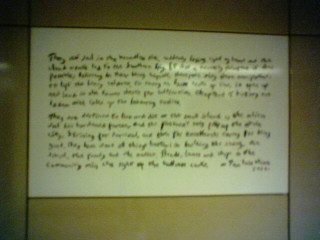
Chinatown train station, at the waiting bays.


A moving poem lionising the Chinese immigrants who came to Singapore in the 19th century. Yet the choice of words in the second stanza suggests a glorious lack of irony or self-awareness of the present.

They are destined to live and die on this small island.

I'm sure Tan Shie Hwee has won some dubious poetry award for this.

23 October 2003

Not Wordsworth

Only those people who have been to Little India, or lived in the Northeast in late 1999, would know what's going on... But I'm interested to know what others might think when they read this too.

Notes: final revision.

Lines composed on a bus in Little India, during a traffic jam on my way home, October 1999

i.
Is the city an architectural space
or an afterimage of our constant motion?
We recognise urbanity only in a traffic jam.

ii.
We dragged Little India into modernity.
Its settlements hastily torn down,
the residents labelled squatters and redistributed.
Today, a commercial space of ethnic products
for the Indian community.

iii.
The traffic jam is a totally random
yet regular feature.
A persistent epiphenomenon.

iv.
Little India is a one-way street.
Migrant workers alight at Jalan Besar
whose Chinese-run motor parts and home decor stores
neither invite or entice.
The visitor crosses the road
into the no-man's land of the red-light district
and magically appears in Little India.

v.
Once, being a pedestrian was a subversive act.
Migrant workers disregard the 'do nots' of walking:
They jaywalk, creep into the bus lane, ignore traffic signals;
stop at road junctions, on the pavements, in the open fields.
Little India is a true pedestrian mall. Unlike Orchard Road.

vi.
Because they loiter, or maybe because they wander,
migrant workers are dangerous and vaguely criminal:
Bright fluorescent lights and security cameras
shall drive them away from the jewellery shops.

vii.
No matter, we will curb them:
fences to keep them off the road
hired coaches to keep them out of public buses.

viii.
This is all history erased.
There are no migrant workers in Little India.
They are transported safely, 20 to a truck
from their quarters to work and back again.
Nevermind it violates their basic safety,
we now have a world-class traffic system.

04 October 2003

Great Classics

The Romance of the Three Kingdoms (三国演义) counts as one of the 3 great Chinese literary epics, the others being Journey to the West (西游记) and Outlaws of the Marsh (水浒传), all written in the Ming era. I term these epics and not novels. Strictly speaking, the first (or first great) modern Chinese novel was the Qing dynasty Dream of the Red Mansions (红楼梦).

The Romance of the Three Kingdoms is of unknown authorship, and the earliest surviving print copy dates from 1522. The great sequence of stories in Romance detail the interregnum between the Han dynasty and the Jin dynasty, in a brief period where China was divided into 3 warring nations, each bent on reunifying the old empire under its own banner.

In this period of strife, the Romance sequence focusses on the "Great Actors" of history, the relationships between leaders and their loyal (or treacherous) followers, and their claims to legitimate power and sole rulership of China.

Yet, it troubles me, this Romance. Through all its 120 chapters, much is made of the brilliant military strategies, the shifting alliances, the heroic battles, the little crises of self-doubt that leaders occasionally fall to. War is brutal, yet the novel's heroes and villians (poor, misunderstood Cao Cao!) must soldier on towards that manifest destiny of reuniting their sundered nation. The phrase "blood flowed like running rivers", figures in every alternate battle sequence. Which is just about every chapter. 3 nations fought a 60-year war that probably killed millions. More than half the "peacetime" chapters describe the devastating famines and poverty that the war brought on.

And yet... the novel's heroes, Liu Bei and his 2 sworn brothers, soldier on to fight their battles, and to lead more men to fight. In the novel, the trio lose their wives and families in more than one occasion, when their cities fell to maurading armies of Cao Cao, Lu Bu and Yuan Shao. And yet... the trio proclaim several times that these wives and family... are of less importance to them then their brotherly ties. And presumably, the war.

How would the Romance look like, if it was written from the view of the random slain soldiers whose blood often stain the battlefield "like a river", instead of from the view of the Hero-generals? How would the Romance look like, if it was written from the view of the peasants who were either forcibly conscripted, had their food produce "taxed for the war effort", aside from the famine and droughts? How would the Romance of the long war look like, written by the women? Would it be just as "Romantic"?

07 August 2003

Love Song for a Merlion

I was born in kk hospital and delivered
through the singapore mill
the standard life cycle of a clone
(the limited presidents scholars edition is now available)
reproduced in strict quality control
allowing, of course, for a touch
of personal creativity.

in my years in kindergarten, hao kong ming, social studies,
and now the national education module in university
i have bowed to the icons of singaporeanista
drawn the courtesy lion the orchid
and crude representations of the singapore flag
(this is not a singaporean flag
but it really is, since i'm not a
countercultural american liberal artist)

never have i heard
the name of merlion
uttered in the same breath as the courtesy lion
singlish or garden city

i was lied to.
all tourist brouchures compress this nation
to an icon the size smaller than a postage stamp
but placed in the same upper right-hand corner
a fish-lion in the posture of a sea-horse.
another singapore first:
proud product of our life sciences industry.

when the merlion turns 80
perhaps there will rise
from the concrete ground of this manicured garden
scribes, biographers, each hired pen mythologising.

for them, the merlion did not just exist
and was created by the wild imaginings
of a tourist promotion board
but had stood since time immemorial
a singaporean - OUR VERY OWN!!!! - colossus of rhodes
benign guardian of the singapore harbour
that has seen this country rise from the sea-foam
small fishing town to the aphrodite of the knowledge economy.

the missionaries of our urban redevelopment gospel,
the excavation tractor and the demolition pile
shall boldly put to death the real
transmogrify place to memory
replace it with a million ornamental plaques
and a merlion:

We can learn to remember.