You've probably heard about the blind men and the elephant. In the dominant narrative, the moral of the story one should learn is the limitations to knowledge, how imperfect and incomplete information on the Truth may lead equally wise people to disagree on things. For my readers, I offer a counter narrative. The blind men and the elephant is an allegory for how things look to people who refuse to see what they're looking at.

Showing posts with label straits times. Show all posts
Showing posts with label straits times. Show all posts
12 January 2016


04 October 2007
Sedition! Russian Edition
Jonathan Eyal (read as "isle") is the research director of the Royal United Services Institute for Defence and Security Studies, and also apparently the correspondent for the Straits Times Europe bureau in London. On most days of the week, Eyal has a doctorate in International Law and Relations, and is by all means a respectable military historian and analyst.
Of course, respectable is a relative term; as a respectable analyst and Eastern Europe specialist, Eyal was part of the intellectual community that facilitated and provided justifications for the conquest and occupation of Serbia, but still he did deconstruct the GWOT for the charade that it is.
What I do not get is how Eyal manages to be a ST correspondent on some days of the week. Note that whenever he talks about Europe, it is almost always through a libertarian set of glasses: Europe outside UK is almost always economically sclerotic, addled with overtaxed citizens paying for exorbitant and inefficient social welfare, losing the civilisational will to live in contrast to its immigrants and probable heirs, the Muslim immigrants. And so on, and so forth. While not supportive of Bush, Eyal has made a living supporting any European leader who supported Bush. And so on, and so forth.
Here's Jonathan Eyal on Putin's Power Play:
"Russian President Vladimir Putin has indicated that he intends to retain political influence when he steps down from the presidency... By accepting to lead United Russia - the country's biggest political formation - he could become the next prime minister.
It all sounds cleverly simple: a new figurehead president will be elected to respect existing constitutional provisions, while Mr Putin continues to run the show as prime minister...
Top powers will have to be granted to the government rather than the head of state. Furthermore, Russian prime ministers are not popular for long. They are expected to take controversial decisions..."
Eyal muses therefore that "Mr Putin... could become a kingmaker from the sidelines."
"But this scenario would be even more confusing. Governments and investors would have to deal with officials who, despite their formal titles, would have no real power, while the man really pulling the strings would have no official position."
I'm sure Jonathan Eyal would have realised that's how Sonia Gandhi is the leader of India even though she isn't the President of India.
And looking closer to who's paying for Eyal's bills, he might as well have saved us the sight of reading yet another "analysis article" (WTH is it that all his analysis articles are in the news section and not the op/eds?) if he just wrote a 4-word article:
Senior Minister Vladimir Putin
Of course, respectable is a relative term; as a respectable analyst and Eastern Europe specialist, Eyal was part of the intellectual community that facilitated and provided justifications for the conquest and occupation of Serbia, but still he did deconstruct the GWOT for the charade that it is.
What I do not get is how Eyal manages to be a ST correspondent on some days of the week. Note that whenever he talks about Europe, it is almost always through a libertarian set of glasses: Europe outside UK is almost always economically sclerotic, addled with overtaxed citizens paying for exorbitant and inefficient social welfare, losing the civilisational will to live in contrast to its immigrants and probable heirs, the Muslim immigrants. And so on, and so forth. While not supportive of Bush, Eyal has made a living supporting any European leader who supported Bush. And so on, and so forth.
Here's Jonathan Eyal on Putin's Power Play:
"Russian President Vladimir Putin has indicated that he intends to retain political influence when he steps down from the presidency... By accepting to lead United Russia - the country's biggest political formation - he could become the next prime minister.
It all sounds cleverly simple: a new figurehead president will be elected to respect existing constitutional provisions, while Mr Putin continues to run the show as prime minister...
Top powers will have to be granted to the government rather than the head of state. Furthermore, Russian prime ministers are not popular for long. They are expected to take controversial decisions..."
Eyal muses therefore that "Mr Putin... could become a kingmaker from the sidelines."
"But this scenario would be even more confusing. Governments and investors would have to deal with officials who, despite their formal titles, would have no real power, while the man really pulling the strings would have no official position."
I'm sure Jonathan Eyal would have realised that's how Sonia Gandhi is the leader of India even though she isn't the President of India.
And looking closer to who's paying for Eyal's bills, he might as well have saved us the sight of reading yet another "analysis article" (WTH is it that all his analysis articles are in the news section and not the op/eds?) if he just wrote a 4-word article:
Senior Minister Vladimir Putin
09 October 2006
Straits Times School Pocket Money Fund 2006
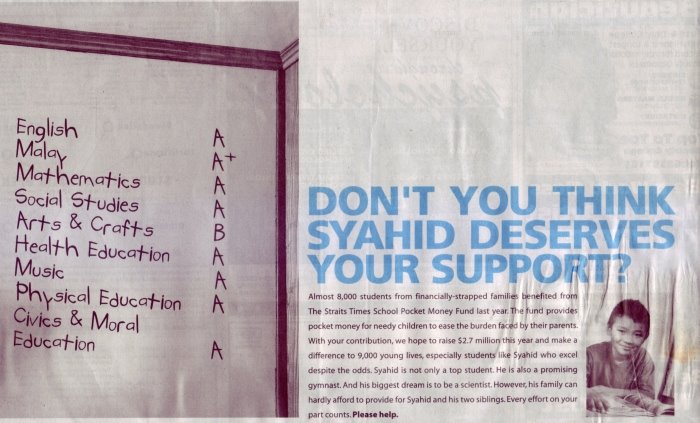
Don't you think Syahid deserves your support, the advertisement asks. Err... no. I'd rather support those who clearly need it - students who are poor and weak in their studies.
In fact, ST hopes to raise 2.7 million dollars to 9000 students who, like Syahid, "excel despite the odds". I struggle to comprehend why they would STILL need any kind of monetary help, and I really struggle to comprehend why the Straits Times feels it should fund poor top students and not poor, weak students.
I may not be a singapore economist (I sometimes wish I were), but let's see if the ST school fund makes any economic sense, and what kind of economic sense if it does.
From the looks of it, the ST pocket money fund is a Meritocratic Charity. The advertisement (you can click on it for a full-size image) says the money is especially for needy top students. Why needy average or needy struggling students won't receive your money is made through a silent appeal to the word *DESERVE* in the ad headline.
But really:
1. Decreasing marginal returns.
It is far easier to pull up a straight-Cs student to a straight-B performance than to pull up a straight A student like Syahid to straight A pluses. You'll need less resources to benefit the more numerous weaker students than to benefit the elite (but poor).
2. Deserving to needing.
Social statistics available online (for other countries) could be used to predict a student's salary on their first job from their grades in school. Syahid's straight As are an indicator of his probable rich bastard or high-flying senior civil servant status 15 to 20 years down the road. This is like tax cuts for the rich, even before they become rich.
He doesn't need the money. The weak students who will be stuck with lesser education and MacJobs in the future do. Syahid has the means to break out of the circle of poverty. They don't. His current poverty will be outweighed over time with the riches he'll be earning in the future. For society to give him money now is to tip the balance even further. For society to privilege him over poor and weaker students is to simultaneously create a legion of the "undeserving poor", the poor that you should spit upon and despise because they fully are responsible for their poverty.
I believe society has a duty to alleviate its poor out of the poverty trap, and that takes precedence over... setting up a meritocratic charity.
3. (mis)Allocation of resources?
From the description, Syahid is doing tremendously well for a poor kid. Poverty has not impeded him from getting straight As, having a healthy ambition, and ample extracurricular activities. Like most other star students, Syahid will be streamed to a class taught by the best teachers in his school, following the next round of streaming. He has access to an entire pool of resources that poor, weak students can never touch.
Tell me, if he's such a star student, doesn't he already qualify for some scholarship? I can imagine half a dozen school and community centre bursaries. If he's dirt poor and brilliant, there are plenty of avenues for him to get the money, even if I feel he doesn't need and shouldn't need the help.
Evidently state and quasi-state welfare schemes are insufficient means to help poor students, and the question is... what's wrong with the way they are allocated, why not enough of it is going automatically to the kids who need it, and how this famine of support can occur despite our national reserves.
20 years from now, as Syahid leads a department, will his underlings admire him because he was brilliant but poor, and succeeded to the top due to his own efforts, or because he was brilliant and taxpayers eliminated his poverty?
I prefer a little truth in advertising here: ST should just rename this fund to "Tax Cuts for the Future Rich", "The Straits Times Meritocratic Charity", or simply the "Straits Times Bursary/Scholarship". Don't go on about pocket money, because that's not the real issue or motivation for the fund.
27 September 2006
How can we trust Tan Tarn How?
Granted, the man may now be a researcher at the Institute of Policy Studies, and he may have retooled himself as an analyst and an advocate, according to his blog>, but doubts remain.
Why is he one of the very few researchers at the venerable IPS without even a postgraduate degree? Just how did he manage to be a "senior research fellow", given that other senior research fellows in the IPS have not just postgraduate degrees, but teaching qualifications to boot?
And why was he even chosen as a key speaker in the Singapore Theatre Festival 2006 (otherwise known as the Singapore Political Theatre Festial) "Art and Life Sessions" forum, alongside other pro-democracy dissidents like Gayle Goh, Martyn See, and Sylvia Lim?
Does anyone remember this hatchet job of a piece, written by the same Tan Tarn How on 29 Oct 2001? Does anyone remember how Tan Tarn How was the hatchet man at the Straits Times, or how he single-handedly demolished the credibility of the Worker's Party 2 election cycles ago, by whispering... either WP is honest but incompetent or they are dishonest and putting a joke on us?
Bungle and break-up may help WP, Poll Watch, Tan Tarn How
Disqualified from Aljunied GRC, it can focus its resources on two wards, while JBJ's exit may strengthen Low's hand.
The joke going round after the disqualification debacle by the Workers' Party (WP) is that it is junking its "Power to the People" slogan for a new one: "No More Forms".
Whether that would go down better with the electorate, no one will ever know.
Meanwhile, being barred from contesting in the Aljunied Group Representation Constituency after the pathetic slip-up with the statutory declaration forms leaves Mr Low Thia Khiang's party with fights in only two single wards, Hougang and Nee Soon East.
Add to that the acrimonious break-up with former party boss JB Jeyaratnam and his supporters, and some are saying the WP now looks a little like the walking wounded, shot in the foot both by itself and its former commander-in-chief.
This, after the recent hype that Mr Low is likely to lead the party and the opposition into a new future.
But things may not be what they seem on the surface.
While Mr Jeyaratnam's joining forces with Singapore Democratic Party chief Chee Soon Juan and the slur on his erstwhile protege for the bungling at Aljunied will, no doubt, draw some of Mr Low's blood, it may make the incumbent MP in Hougang and his party stronger for the future.
The reason: Mr Low's rebuilding of the WP is perceived to be strapped not just by Mr Jeyaratnam's legacy but by his continuing membership of the party.
Thus, Mr Jeyaratnam's quitting legitimises Mr Low's succession by sparring him the difficult task of removing the old warrior, which would have tarnished Mr Low for betraying a former patron.
As for the disqualification, it leaves the WP with only two contestants and this is four short of the six needed to get free air time for political broadcast on television. It has denied itself the straight to the living room search given the PAP, the Singapore Democratic Alliance (13 candidates) and the Singapore Democratic Party (14 candidates).
If the WP has ended as a "small player" this time round, so be it, Mr Low said.
The new WP faces among the rejected Aljunied hopefuls, Mr James Gomez and Mr Yaw Shin Leong, would also not be able to earn their bustings spurs, valuable since in the last 20 years, no opposition candidate had made it to Parliament on his first try.
But the pros of the disqualification may overweigh (sic) the cons.
Fighting fewer battles will help the WP by concentrating its forces.
Mr Low's Hougang bid thus gets a lift; but more crucially for the party, Dr Poh Soh Guan's closely-watched one-on-one skirmish with PAP candidate Ho Peng Kee in Nee Soon East will get a boost from the extra hands - and handshakes - in a widely anticipated close contest.
And the Aljunied red card lets Mr Low plug the party fine and accuse the PAP of not giving the people a choice.
The PAP's stand that it was the Election Department which made the decision and that the PAP would not have objected about the technicality is unlikely to work with Mr Low's supporters.
All in all, the WP may now stand a better chance of wrestling a second seat from the PAP - and if the SDA and SDP fizzle out, Mr Low will then be the de facto leader of the opposition, ahead of Mr Chiam.
It is not how many seats you contest but the number you win that counts.
In the end, the most beguiling theory about the Aljunied fiasco is that it was an elaborate piece of wayang put up by Mr Low.
How else can one explain that he did not spot the basic error?
Mr Low, the theory goes, intentionally did not fill in the name of the GRC in the candidate's statutory declarations for all the above considerations.
There is only one hitch: Mr Low seemed visibly and genuinely frantic on the mobile phone when he heard of the trouble with the forms on Nomination Day.
He didn't seem like acting, so there goes that line of speculation.
Unless, of course, he is a better actor than anyone can imagine.
And the joke wasn't on him, but on all of us.
Why is he one of the very few researchers at the venerable IPS without even a postgraduate degree? Just how did he manage to be a "senior research fellow", given that other senior research fellows in the IPS have not just postgraduate degrees, but teaching qualifications to boot?
And why was he even chosen as a key speaker in the Singapore Theatre Festival 2006 (otherwise known as the Singapore Political Theatre Festial) "Art and Life Sessions" forum, alongside other pro-democracy dissidents like Gayle Goh, Martyn See, and Sylvia Lim?
Does anyone remember this hatchet job of a piece, written by the same Tan Tarn How on 29 Oct 2001? Does anyone remember how Tan Tarn How was the hatchet man at the Straits Times, or how he single-handedly demolished the credibility of the Worker's Party 2 election cycles ago, by whispering... either WP is honest but incompetent or they are dishonest and putting a joke on us?
Bungle and break-up may help WP, Poll Watch, Tan Tarn How
Disqualified from Aljunied GRC, it can focus its resources on two wards, while JBJ's exit may strengthen Low's hand.
The joke going round after the disqualification debacle by the Workers' Party (WP) is that it is junking its "Power to the People" slogan for a new one: "No More Forms".
Whether that would go down better with the electorate, no one will ever know.
Meanwhile, being barred from contesting in the Aljunied Group Representation Constituency after the pathetic slip-up with the statutory declaration forms leaves Mr Low Thia Khiang's party with fights in only two single wards, Hougang and Nee Soon East.
Add to that the acrimonious break-up with former party boss JB Jeyaratnam and his supporters, and some are saying the WP now looks a little like the walking wounded, shot in the foot both by itself and its former commander-in-chief.
This, after the recent hype that Mr Low is likely to lead the party and the opposition into a new future.
But things may not be what they seem on the surface.
While Mr Jeyaratnam's joining forces with Singapore Democratic Party chief Chee Soon Juan and the slur on his erstwhile protege for the bungling at Aljunied will, no doubt, draw some of Mr Low's blood, it may make the incumbent MP in Hougang and his party stronger for the future.
The reason: Mr Low's rebuilding of the WP is perceived to be strapped not just by Mr Jeyaratnam's legacy but by his continuing membership of the party.
Thus, Mr Jeyaratnam's quitting legitimises Mr Low's succession by sparring him the difficult task of removing the old warrior, which would have tarnished Mr Low for betraying a former patron.
As for the disqualification, it leaves the WP with only two contestants and this is four short of the six needed to get free air time for political broadcast on television. It has denied itself the straight to the living room search given the PAP, the Singapore Democratic Alliance (13 candidates) and the Singapore Democratic Party (14 candidates).
If the WP has ended as a "small player" this time round, so be it, Mr Low said.
The new WP faces among the rejected Aljunied hopefuls, Mr James Gomez and Mr Yaw Shin Leong, would also not be able to earn their bustings spurs, valuable since in the last 20 years, no opposition candidate had made it to Parliament on his first try.
But the pros of the disqualification may overweigh (sic) the cons.
Fighting fewer battles will help the WP by concentrating its forces.
Mr Low's Hougang bid thus gets a lift; but more crucially for the party, Dr Poh Soh Guan's closely-watched one-on-one skirmish with PAP candidate Ho Peng Kee in Nee Soon East will get a boost from the extra hands - and handshakes - in a widely anticipated close contest.
And the Aljunied red card lets Mr Low plug the party fine and accuse the PAP of not giving the people a choice.
The PAP's stand that it was the Election Department which made the decision and that the PAP would not have objected about the technicality is unlikely to work with Mr Low's supporters.
All in all, the WP may now stand a better chance of wrestling a second seat from the PAP - and if the SDA and SDP fizzle out, Mr Low will then be the de facto leader of the opposition, ahead of Mr Chiam.
It is not how many seats you contest but the number you win that counts.
In the end, the most beguiling theory about the Aljunied fiasco is that it was an elaborate piece of wayang put up by Mr Low.
How else can one explain that he did not spot the basic error?
Mr Low, the theory goes, intentionally did not fill in the name of the GRC in the candidate's statutory declarations for all the above considerations.
There is only one hitch: Mr Low seemed visibly and genuinely frantic on the mobile phone when he heard of the trouble with the forms on Nomination Day.
He didn't seem like acting, so there goes that line of speculation.
Unless, of course, he is a better actor than anyone can imagine.
And the joke wasn't on him, but on all of us.
22 May 2006
Singapore Urban Legends
"Some elections back when the 'Mentor' was PM, he threatened the electorate by saying he would find out why those who voted against the PAP did so. That was in a speech after an election when the public was beginning to be brave enough to rub the dictatorship up the right way. I still remember the sinister and menacing tone when Harry Lee made his open threat."From A.K. Tan, in comment to Voting must be kept secret
Pleinelune and I went down to the National Archives during the weekend to verify this claim. A.K. Tan has to be referring to the 1984 General Elections, notable for the loss of 2 seats to the opposition JB Jeyaratnam (WP-Anson) and Chiam See Tong (SDP-Potong Pasir). As the election was on 23 December, we checked the Straits Times from 24-27 December.
Results:
There was no account of Papalee issuing threats to find out who voted for whom. The Straits Times in the 1980s had to print every single word of Papalee's speeches; we waded through 5 pages of his election victory speech, printed over 2 days, and found nothing similar to AK Tan's anecdote.
That's not to say there weren't any harsh lectures from the then-PM.
On the morning of 24 December 1984, Papalee made several interesting remarks:
Because they had begun losing seats to the opposition: "at this rate, the one-man, one-vote system could lead to decline and disintegration"
He accused the opposition of "gutter politics": "Every election campaign starts off on a reasonable note, then in order to get the crowds excited, they make more and more brazen, scurrilous, wild accusations." (Like for example, accusing their opponents of planting bombs with their election manifestos?)
Papalee sternly warned the electorate in Potong Pasir and Anson that they would have to live with their choices; "the party would withdraw services to the two opposition-held seats of Anson and Potong Pasir"
Of course, there were the usual admonitions about Singapore descending into riots, that the people must realise this is not a game, you cannot change governments, etc.
However, the best lines came from the recently deceased S Rajaratnam, then Second Deputy Prime Minister in Papalee's cabinet. Said the man who wrote the national pledge: "If this is an attempt by voters to blackmail the government, to compromise on important issues or principles, then we must show them we cannot be blackmailed. No government should succumb to blackmail." That was the most chilling quote from the 1984 election, and it didn't come from Papalee.
It was Rajaratnam who made the threat AK Tan remembers. In "Genuine distress or blackmail, asks Raja", the then-2DPM wanted to find out whether the vote swing to the opposition was a genuine distress signal or an attempt by voters to blackmail the Whiteshirts. He then followed up by saying "we must show them that we cannot be blackmailed". Perhaps due to the passage of time, we now have the impression that it was Papalee who threatened "he would find out why those who voted against the PAP did so"?
Now, on that night, with Papalee raising a clenched fist at the microphone during the election victory speech and interview, with Rajaratnam, Mah Bow Tan, Richard Hu taking turns to reiterate their leader's disappointments, one threat would've seemed indistinguishable from the next.
So please, everyone. Let that urban legend rest. Papalee did not threaten to undermine the secrecy of the vote.
21 March 2006
The ST's latest brickbat
My tuition kid and I love to read the Straits Times. So far we've learnt that:
1. Forum letters all seem to say "I so angry/stupid at X, will the relevant authorities please comment."
2. Straits Times photographers in the Home crimes page assign varying degrees of guilt depending on how closely cropped the mug of the suspect is. Clearest sign of guilt: when ST crops off the top part of the hair, takes away the neck and collar, and squishes just the face into a small box.
3. Most nonpolitical articles in the Home section seem to be written to provoke an immediate response by the reader: "What a stupid/evil/lame/unfortunate/boh liao etc. person". I call this the Incitement to Kneejerk JudgeMentality.
1. Forum letters all seem to say "I so angry/stupid at X, will the relevant authorities please comment."
2. Straits Times photographers in the Home crimes page assign varying degrees of guilt depending on how closely cropped the mug of the suspect is. Clearest sign of guilt: when ST crops off the top part of the hair, takes away the neck and collar, and squishes just the face into a small box.
3. Most nonpolitical articles in the Home section seem to be written to provoke an immediate response by the reader: "What a stupid/evil/lame/unfortunate/boh liao etc. person". I call this the Incitement to Kneejerk JudgeMentality.
23 February 2006
The creeping SumikoTanning of the Straits Times
Attention! A mutant strain of the SumikoTan virus, under development in the top secret labs of ST's Toa Payoh labs, has broken out and infected other journalists!
Seen in a recent edition of the Urban ST section, otherwise respectable fashion reporter and Urban art director Dylan Boey writing a full-page article on how and why he got his braces.
According to unnamed sources in the virological research unit of the Straits Times, this outbreak may be less unintended and accidental than let on. "This virus has been perfected through months of testing on bloggers. We've already succeeded in the Bantustanisation of the blogosphere, and with that, do you think they'd let this weapon sit around, with so many rebellious ST journalists inserting subtle barbs at the establishment?"
Expect a SumikoTan pandemic, and even more inane, chewed curd writing from ST soon.
UPDATE
It appears fashion reporter Dylan Boey has proved to be a superspreader of the SumikoTan virus. At the Toa Payoh interchange/MRT station/mall, scores of ST journalists were observed wandering aimlessly, whining piteously about their singlehood, their failed relationships, and the trials and tribulations of 30somethings. Dear readers, if you come across one of these journos, please do not breathe in the air around them!!
UPDATE
Intrepid reporter Aki spent the day yesterday connecting the dots and tracing the history of the anomalous pathogen! Did you know that a previous outbreak was contained in 1999? We speak of none other than Richard Lim!
The former chief editor of the Life section, he with the fey mannerisms, overweening ego, and a desperate habit of namedropping literary greats, was a former victim of the SumikoTan virus. His rivalry with his eventual successor is the best-kept secret among journo circles, but even he succumbed to a rare fit of narcissistic introspection, when he wrote an entire series of articles about his travel experiences, which include lamentations of lost opportunites for relationships with exotic Japanese ladies, and being hit on by an elderly but debonair English gentleman.
Apparently the antidote that brought Richard Lim back to the reality-based universe was his retirement and his work on the biography of Papalee. That's a cure that might be much worse than the ailment, but there are troubling signs that the virus has had time to gain resistance to this antidote...
Seen in a recent edition of the Urban ST section, otherwise respectable fashion reporter and Urban art director Dylan Boey writing a full-page article on how and why he got his braces.
According to unnamed sources in the virological research unit of the Straits Times, this outbreak may be less unintended and accidental than let on. "This virus has been perfected through months of testing on bloggers. We've already succeeded in the Bantustanisation of the blogosphere, and with that, do you think they'd let this weapon sit around, with so many rebellious ST journalists inserting subtle barbs at the establishment?"
Expect a SumikoTan pandemic, and even more inane, chewed curd writing from ST soon.
UPDATE
It appears fashion reporter Dylan Boey has proved to be a superspreader of the SumikoTan virus. At the Toa Payoh interchange/MRT station/mall, scores of ST journalists were observed wandering aimlessly, whining piteously about their singlehood, their failed relationships, and the trials and tribulations of 30somethings. Dear readers, if you come across one of these journos, please do not breathe in the air around them!!
UPDATE
Intrepid reporter Aki spent the day yesterday connecting the dots and tracing the history of the anomalous pathogen! Did you know that a previous outbreak was contained in 1999? We speak of none other than Richard Lim!
The former chief editor of the Life section, he with the fey mannerisms, overweening ego, and a desperate habit of namedropping literary greats, was a former victim of the SumikoTan virus. His rivalry with his eventual successor is the best-kept secret among journo circles, but even he succumbed to a rare fit of narcissistic introspection, when he wrote an entire series of articles about his travel experiences, which include lamentations of lost opportunites for relationships with exotic Japanese ladies, and being hit on by an elderly but debonair English gentleman.
Apparently the antidote that brought Richard Lim back to the reality-based universe was his retirement and his work on the biography of Papalee. That's a cure that might be much worse than the ailment, but there are troubling signs that the virus has had time to gain resistance to this antidote...
09 October 2005
Singapore's Climate of Fear

My tuition kid has deconstructed, at the tender age of 13, the Straits Times forum page!
It's easy to get a letter published there, following 5 simple rules.
1. Describe an incident/series of incidents that happened to self or self witnessed.
2. Describe danger, trauma, anguish, or frustration experienced or may potentially experience.
3. Extrapolate to put entire population at risk.
4. Make your point: I VERY SCARED (or angry)!
5. Query: Will the relevant authorities please look into this?
Examples (in both ST and Today) include:
Ceiling tile at shopping centre fell, narrowly missing self. I VERY SCARED.
Can mosquitoes spread dengue from one person to another? I VERY SCARED.
Blogging is so dangerous! I VERY SCARED.
My son was advised by one doctor to wear specs and another not to. How? I VERY SCARED.
Taupok is very dangerous to our kids. I VERY SCARED.
Will the relevant authorities please look into this?
As you can see, Singaporeans live in a perpetual climate of fear.
11 July 2005
Functional Illiteracy (now in triplicate!)
The ST doesn't get it edition
(aside: Yes, there was a hiatus lasting 3 weeks. A very bad throat infection, then a near-death experience of my pc. Oh well.)
"What's ASEAN? Most teens don't know", decries our national propaganda machine.
There are a few things going on in the rest of the article, each feeding into one another and forming a greater mythology of the Uninformed Singaporean Teenager:
1. "Everyone" knows what Asean is.
2. Asean is an integral tool of Singapore's regional diplomacy and means of keeping itself safe from its potentially troublesome neighbours.
3. It is hence inconceivable, shocking, and disgraceful that our teenagers know nothing about Asean.
It is popularly 'known' that Singaporean students are notorious for producing straight-A results academically while remaining ignorant of current affairs and history, because they don't seem to read widely enough beyond their textbooks - if at all. I am not interested in the truth value of that claim, but I do contend that this ST survey serves no purpose except to further the mythology. In fact, it has no scientific or informational value due to its horrendous survey design and methodology. Instead of highlighting the functional illiteracy of the average Singaporean teenager, it brings the investigative function of the ST into disrepute.
What are some things a proper survey requires in order to generalise results to a larger population?
1. A large enough sample.
In statistics, you need to know the size of the population you want to study (In this case: how many Singaporean teenagers are there?) You also need to know how accurate you want your survey to be, or how representative of the population your sample could be, i.e the Confidence interval (In this case: if we want the survey to be 95% accurate, i.e. 95% probability that the sample we just chosen is representative of the total population of Singaporean youths, how large should the sample be, given the total population?)
2. Either a representative or a truly random sample
Sampling is a delicate science. In general, you want to choose a sample that isn't biased at all. Are the youths you find on Orchard Rd on Saturday afternoon representative of the general teenage population?
This survey fails on both counts, and then some more.
Note ST doesn't bother to say how accurate its survey is. If it did, those of us armed with calculators and a copy of the census would point out its 'survey' or 'straw poll' has a sample size far insufficient to generate a generalisation. Note also ST doesn't actually say its survey is meant to generalise about Singaporean youths, aside from its headline "Most teens don't know". That's a little dishonest and waffling.
In every survey, you need to record the number of people who refused to do the questionnaire. Only 3 out of 24 teenagers could give the correct answer to the ST survey, but how many uncounted teenagers refused to participate? A very low response rate marks any survey as useless.
The Singapore education system doesn't get it edition
History is taught to Singapore's students from the age of 10 to 18, as Social Studies in primary school and History or Combined Humanities in secondary school. There is no way, short of not reading the book, for the possibility that a majority of Singaporean students on weekend break from studies could not know what Asean is. There is a possibility, though, that most Singaporean students tend to ignore what is taught in Social Studies and History once lessons end.
I've seen the different History, Social Studies, and Combined Humanities (chiefly geography and history) syllabuses over the years. Come to think of it, if I were a student, I would tend to ignore the stuff taught in those textbooks, when it comes to national and regional history, for the simple reason that most of it is sheer national propaganda, and worse still, stupid, wrong, and uncritical propaganda.
Why, of all things, in a discussion of Venice and the Italian Renaissance, bring in SINGAPORE and remark in passing - without any collaboration or examination of facts, that the reason Venice declined was due to the complacency of its leaders, and Singapore avoids this because of its meritocratic system and emphasis on constant innovation? This is not history, this is National Education; not education, but pious hectoring and political moralisation.
Why are Singaporeans, especially the young, not interested in history or current affairs? Because the most common venues of this knowledge here make assses of them. If I were a Singaporean teenager faced with a History syllabus hell-bent on brainwashing me into pious patriotism/parrotism, I'd rather throw away the knowledge and learn history on my own, when I'm an adult. School isn't the only avenue for learning, the last I heard.
The common sense edition
As far as I know, the knowledge of humans - beyond eating, shitting, and fucking - are a result of enculturation. Our knowledge comes from learning, not instinct. The young are simply that: young and less well-read than older people, and that is something we all know without the ST reminding us. Give them time to learn.
If the ST wanted to make a meaningful survey or even non-representative study, it could've done better by comparing
1. how much more ignorant our youths are, compared to teenagers from elsewhere, or
2. how much more ignorant our youths are, compared to teenagers 10, 20, 30, and 40 years ago (but it doesn't have the resources to do so...)
(aside: Yes, there was a hiatus lasting 3 weeks. A very bad throat infection, then a near-death experience of my pc. Oh well.)
"What's ASEAN? Most teens don't know", decries our national propaganda machine.
Only three out of 24 Singapore [sic] teenagers The Straits Times approached on Orchard Rd on Saturday knew what the acronym Asean stands for and could name the countries in the grouping.
The rest, including two students from a top junior college, were stumped.
There are a few things going on in the rest of the article, each feeding into one another and forming a greater mythology of the Uninformed Singaporean Teenager:
1. "Everyone" knows what Asean is.
2. Asean is an integral tool of Singapore's regional diplomacy and means of keeping itself safe from its potentially troublesome neighbours.
3. It is hence inconceivable, shocking, and disgraceful that our teenagers know nothing about Asean.
It is popularly 'known' that Singaporean students are notorious for producing straight-A results academically while remaining ignorant of current affairs and history, because they don't seem to read widely enough beyond their textbooks - if at all. I am not interested in the truth value of that claim, but I do contend that this ST survey serves no purpose except to further the mythology. In fact, it has no scientific or informational value due to its horrendous survey design and methodology. Instead of highlighting the functional illiteracy of the average Singaporean teenager, it brings the investigative function of the ST into disrepute.
What are some things a proper survey requires in order to generalise results to a larger population?
1. A large enough sample.
In statistics, you need to know the size of the population you want to study (In this case: how many Singaporean teenagers are there?) You also need to know how accurate you want your survey to be, or how representative of the population your sample could be, i.e the Confidence interval (In this case: if we want the survey to be 95% accurate, i.e. 95% probability that the sample we just chosen is representative of the total population of Singaporean youths, how large should the sample be, given the total population?)
2. Either a representative or a truly random sample
Sampling is a delicate science. In general, you want to choose a sample that isn't biased at all. Are the youths you find on Orchard Rd on Saturday afternoon representative of the general teenage population?
This survey fails on both counts, and then some more.
Note ST doesn't bother to say how accurate its survey is. If it did, those of us armed with calculators and a copy of the census would point out its 'survey' or 'straw poll' has a sample size far insufficient to generate a generalisation. Note also ST doesn't actually say its survey is meant to generalise about Singaporean youths, aside from its headline "Most teens don't know". That's a little dishonest and waffling.
In every survey, you need to record the number of people who refused to do the questionnaire. Only 3 out of 24 teenagers could give the correct answer to the ST survey, but how many uncounted teenagers refused to participate? A very low response rate marks any survey as useless.
The Singapore education system doesn't get it edition
History is taught to Singapore's students from the age of 10 to 18, as Social Studies in primary school and History or Combined Humanities in secondary school. There is no way, short of not reading the book, for the possibility that a majority of Singaporean students on weekend break from studies could not know what Asean is. There is a possibility, though, that most Singaporean students tend to ignore what is taught in Social Studies and History once lessons end.
I've seen the different History, Social Studies, and Combined Humanities (chiefly geography and history) syllabuses over the years. Come to think of it, if I were a student, I would tend to ignore the stuff taught in those textbooks, when it comes to national and regional history, for the simple reason that most of it is sheer national propaganda, and worse still, stupid, wrong, and uncritical propaganda.
Why, of all things, in a discussion of Venice and the Italian Renaissance, bring in SINGAPORE and remark in passing - without any collaboration or examination of facts, that the reason Venice declined was due to the complacency of its leaders, and Singapore avoids this because of its meritocratic system and emphasis on constant innovation? This is not history, this is National Education; not education, but pious hectoring and political moralisation.
Why are Singaporeans, especially the young, not interested in history or current affairs? Because the most common venues of this knowledge here make assses of them. If I were a Singaporean teenager faced with a History syllabus hell-bent on brainwashing me into pious patriotism/parrotism, I'd rather throw away the knowledge and learn history on my own, when I'm an adult. School isn't the only avenue for learning, the last I heard.
The common sense edition
As far as I know, the knowledge of humans - beyond eating, shitting, and fucking - are a result of enculturation. Our knowledge comes from learning, not instinct. The young are simply that: young and less well-read than older people, and that is something we all know without the ST reminding us. Give them time to learn.
If the ST wanted to make a meaningful survey or even non-representative study, it could've done better by comparing
1. how much more ignorant our youths are, compared to teenagers from elsewhere, or
2. how much more ignorant our youths are, compared to teenagers 10, 20, 30, and 40 years ago (but it doesn't have the resources to do so...)
04 June 2005
Elected Presidency Sweepstakes
A ST Still Doesn't Get It Edition
M Nirmala of the Straits Times writes more convincingly and professionally than her colleagues at the paper. However in her article "Why so few takers for this job?", she misses the entire point of the weakness of the Elected Presidency. She mistakes the man for the office, procedural legitimacy for credibility, the symptom for the problem. The issue is not whether the next Elected President, most likely be unopposed, will be seen as illegitimate; the issue is whether the office of the elected president will be seen as a discredited institution.
Recall that the Elected President has, since 1993, the power to veto spending of national reserves and key public appointments, and powers to override ministers who try to cover up graft investigations. As the received wisdom goes, previously the presidency was a ceremonial post, but now there is real power - the power as a watchdog and rapper of heads of irresponsible and profligate governments.
Ong Teng Cheong tested if he could indeed exercise his powers, by asking for a list of the national reserves. He did not say he wanted to veto anything or to investigate graft, but you do need to know what the reserves are. We know from history that then-PM Goh Chok Tong's government stonewalled the President, then rewrote the constitution to curb his powers. And so on.
In their roundup and summary of SR Nathan's following presidency, the ST (Singapore's Xinhua News Agency) applauded his "non-activist" style, his studied avoidance of conflict with the government, and most interestingly did not bother to elaborate that this avoidance could only come about by not exercising his constitutional duties as a guardian of the reserves. No, the genial gentleman is remembered more for attending charity concerts and cutting ribbons. And refusing to pardon a former Singaporean athlete from his death sentence. But genial and jovial overall. This reversion to a ceremonial presidency by Singapore's first unelected elected president (Nathan stood unopposed in 1999) does not diminish Nathan's legitimacy, it does however diminish the credibility of the office.
The lack of contenders, according to M Nirmala, may lead to a key weakness of the institution. That is slightly incorrect: the institution of the elected presidency, with its strange rules that seem to limit contenders to only high-level senior civil servants and businessmen, is weak because there is no interest in it. If you (say, Ngiam Tong Dow) were a top-level senior civil servant in charge of national policy before your retirement, and were still interested in commenting on civil service reform, the Elected Presidency will be your ideal platformtomb. If President Ong (alledgedly) got into trouble for trying to do his job seriously, imagine what will happen if the next President decides to influence public debate and foster reform? Why, that would be an abrogation of MiniLee's domain?!
So, our leaders have created a post that expected a smart and independent brain, but demand its holder to act pretty. Very few people (top civil servants? elite businessmen?) would want to jump for this sinecure, unless they're very unmotivated and undriven.
After almost 50 years of Presidents of Singapore, Lee has finally found his machinations foiled: Singapore has run out of top civil servants in their sunset years, cabinet ministers will treat an "invitation" to run for president to be a convenient way of being kicked upstairs, and businessmen are more ambitious than accept the intellectual death the presidency implies.
M Nirmala of the Straits Times writes more convincingly and professionally than her colleagues at the paper. However in her article "Why so few takers for this job?", she misses the entire point of the weakness of the Elected Presidency. She mistakes the man for the office, procedural legitimacy for credibility, the symptom for the problem. The issue is not whether the next Elected President, most likely be unopposed, will be seen as illegitimate; the issue is whether the office of the elected president will be seen as a discredited institution.
Recall that the Elected President has, since 1993, the power to veto spending of national reserves and key public appointments, and powers to override ministers who try to cover up graft investigations. As the received wisdom goes, previously the presidency was a ceremonial post, but now there is real power - the power as a watchdog and rapper of heads of irresponsible and profligate governments.
Ong Teng Cheong tested if he could indeed exercise his powers, by asking for a list of the national reserves. He did not say he wanted to veto anything or to investigate graft, but you do need to know what the reserves are. We know from history that then-PM Goh Chok Tong's government stonewalled the President, then rewrote the constitution to curb his powers. And so on.
In their roundup and summary of SR Nathan's following presidency, the ST (Singapore's Xinhua News Agency) applauded his "non-activist" style, his studied avoidance of conflict with the government, and most interestingly did not bother to elaborate that this avoidance could only come about by not exercising his constitutional duties as a guardian of the reserves. No, the genial gentleman is remembered more for attending charity concerts and cutting ribbons. And refusing to pardon a former Singaporean athlete from his death sentence. But genial and jovial overall. This reversion to a ceremonial presidency by Singapore's first unelected elected president (Nathan stood unopposed in 1999) does not diminish Nathan's legitimacy, it does however diminish the credibility of the office.
The lack of contenders, according to M Nirmala, may lead to a key weakness of the institution. That is slightly incorrect: the institution of the elected presidency, with its strange rules that seem to limit contenders to only high-level senior civil servants and businessmen, is weak because there is no interest in it. If you (say, Ngiam Tong Dow) were a top-level senior civil servant in charge of national policy before your retirement, and were still interested in commenting on civil service reform, the Elected Presidency will be your ideal platform
So, our leaders have created a post that expected a smart and independent brain, but demand its holder to act pretty. Very few people (top civil servants? elite businessmen?) would want to jump for this sinecure, unless they're very unmotivated and undriven.
After almost 50 years of Presidents of Singapore, Lee has finally found his machinations foiled: Singapore has run out of top civil servants in their sunset years, cabinet ministers will treat an "invitation" to run for president to be a convenient way of being kicked upstairs, and businessmen are more ambitious than accept the intellectual death the presidency implies.
Subscribe to:
Posts (Atom)