Showing posts with label education. Show all posts

26 April 2020

Was Singapore just unlucky in its coronavirus fight?

For want of a nail?

Singapore's coronavirus response has been lauded as a golden standard for the international community, an oasis of technocratic competence. In as little as 3 months since the virus arrived in Singapore, a massive outbreak has hit its guest worker community and its sterling reputation.

The media narrative paints a compelling story: Singapore is a poster child that merely got unlucky. Its technocrats had the situation in hand by following the protocols it developed from its encounter with SARS 2 decades ago. They had just an unfortunate, single blind spot in an area no one could predict. To use Benjamin Franklin's retelling of the proverb of the nail, "a little neglect" of Singapore's overcrowded and unsanitary dormitories led to the failure of Singapore's battle against coronavirus.

Wallace Tripp, 1973 illustration from
A Great Big Ugly Man Came up and Tied his Horse to Me: A Book of Nonsense Verse

08 April 2020

Can Singapore's politicians listen to the experts?

We established in our previous post that panic buying is a human response to crisis. Panic is fed by the trio of fear, uncertainty, and doubt.  In Singapore itself, the government dithered and delayed before the politicians put the technocrats in charge to deal with the global pandemic. Before that, various departments issued directives that were at cross-purposes with each other. These public failures of judgement and coordination fed the fear, uncertainty, and doubt in Singapore, which exploded into an wave of panic buying across the island when the authorities raised the national disease outbreak alert to Orange on 9 February 2020.

Trade minister Chan Chun Sing, a ministerial member of the multi-named task force, reacted with a furious, dismissive, and insulting rant some time later, to a group of businessmen at the Singapore Chinese Chamber of Commerce and Industry. He ridiculed the panic buyers, insulted them, and accused them of undermining Singapore's national standing and survival.

Sure, minister Chan might not be a psychologist, sociologist, or a communications expert but was what he said that wrong? Didn't he say what everyone else was thinking? Wasn't this what we'd expect from a straight-talking former career general? Wasn't this highly strategic and forward thinking befitting a former Chief of the Army and a former front-runner for Singapore's next prime minister?

Playing chess with Death during the plague

19 March 2020

Did Singapore do everything right in the coronavirus epidemic?

Even in the developing global Covid-19 pandemic of 2020, the nation state of Singapore punches above its weight when the main action takes place in China, South Korea, Japan, then Iran and mainland Europe. Singapore—or some facsimile of it—is summoned, bound and fashioned by the intersection of medicine and politics.

Depending on the narrative, Singapore is a nigh impossible to imitate exemplar of epidemic containment, a non-dysfunctional authoritarian-technocratic polity poised to seduce the democratic West and its allies in its hour of crisis, an embarrassing failure because panic buying did break out in its otherwise well-behaved, obedient, and acquiescent population, or an embarrassing failure because it was for several weeks, the country with the highest incidents of coronavirus infections outside China. Then there is the  Global Health Security Index, whose inaugural October 2019 edition considered Singapore's pandemic preparedness far behind the developed West and even its neighbours in Southeast Asia.

Did Singapore really do everything right? How could it have done everything right if it wasn't expected to do everything right? Can Singapore's pandemic response be considered a success despite its populace succumbing to multiple bouts of panic buying?

Plague in London, 1625
Title artwork from Thomas Dekker's pamphlet "A Rod for Run-awayes"

24 March 2018

5 basic principles you can learn at a select committee hearing

On 22 March 2018, select committee for deliberate online falsehoods member Minister Shanmugam subjected Facebook representative Simon Milner to a long and tough question session. That is a fact. Incontrovertible.

It is possible to track how the domestic and international news reportage, as well as general commentary by various interest groups is playing out. Several narratives have arisen from that one incontrovertible fact. Each narrative is indicative of the position, positioning, and position-taking of its respective author.

Did Facebook prevaricate? Did Milner discombobulate? Did Facebook get what it deserved? Was a normally unaccountable Facebook taken to task? Was Facebook treated unfairly? Was Shanmugam an inquisitorial bully? A competent publicist for the Singapore government might have even spun a narrative about Shanmugam striking a blow for consumer rights worldwide.

Don't forget advertising and PR agencies!

19 January 2018

Everything you know about Fake News is wrong

Aside from Singapore, other far more democratic countries are considering or have already passed laws against fake news. When the inevitable accusations of authoritarianism and censorship are made by the usual quarters, all Singapore's minister for communications and information (or his permanent secretary needs to do is to point at France and Germany, which have just recently enacted them, and Canada, which has had them for decades. Even the UK has begun the process of studying whether it needs a fake news law.

If the minister and his permanent secretary are competent, they will point out that these laws have been passed in the "liberal West" even in the face of criticisms about the chilling effects on free speech, and promise to be responsible and circumspect with their new powers.

But that will still not detract from the elephant in the room: Fake news is fake.

30 May 2017

Racism in Singapore comedy? Goodness gracious me!


Youtube influencer Shrey Bhargava attended an audition for the next installment in Hack Neo's "Ah Boys to Men" NSploitation comedy series. It went badly because the casting director requested Shrey to put on a funny Indian accent, and Shrey refused because it was insulting and racist.

Blogger influencer Xiaxue hit back hard, twice, at Shrey. So did his potential cast mates. All hell has broken loose.

Take it from us: This entire thing is a clown show. One that demands your attention.

And why should you listen to us? We actually have writing credits for The Noose. Made our own short films that were screened at The Substation when it was a cultural hub, as well as at the National Museum. And we've even written stand-up routines for local comedians. So let's begin, shall we?

07 October 2015

17 November 2014

Living with Myths: First quarter quell

 Nobody expects the QUARTER QUELL!

A monthly, mostly episodic review of the Living with Myths seminar series is all dandy but leaves out the big picture: the evolution of state-academia ties in Singapore.

Before Living with Myths, academics in Singapore's universities functioned as the dominated fraction of the dominant class: they were counted on to lend their intellectual capital to burnish state policy, and to collaborate if they wished as consultants on ministry-approved research projects, to voice their dissent in approved, closed doors arenas, and to remain silent in public if they disagreed with official policy, especially if they had in their possession solid evidence and research.

Before Living with Myths, the only public dissension from academia came from NTU economists Lim Chong Yah, Chen Kang, and Tan Ghee Khiap in 2003 when the trio attempted to construct employment figures and trends for the non-resident workforce in Singapore at a time when this statistical data was not available. The dons were forced to recant and apologise for suggesting that "out of four jobs created, only one job went to a Singapore resident, three jobs went to the intake of foreign workers."

It took Lim Chong Yah almost a decade before he would yet again challenge the state on its economic policy, this time on the distorting effect of Singapore's stalled, or rather aborted, productivity reforms of 1982 on our modern economic growth model.

In between, foreign academics who were roped in as labour consultants have lost their shirts in Singapore for pointing out, with best intentions that our overwhelming foreign labour import policy was in fact not good for Singaporeans.

In light of the past dissension of academics, Living with Myths is striking for several reasons:

1. Dissenting academics come from the softer side of the social sciences

Who would have thought that history and representations of history would present a bigger, more popular challenge to state authority and legitimacy than economics and labour statistics?

It's all fluff, all superstructure. Karl Marx of the 18th Brumaire of Louis Bonaparte would probably be proud to know that right here and now, the base of the state is being chipped away by the attacks on the superstructure, far more effectively than direct attacks by economists and hard data bloggers on the state of Singapore's economic management.

2. Dissenting academics are increasingly from the mainstream, if not the establishment itself

To be sure, Lysa Hong and Thum Pin Tjin are outsiders, even mavericks as far as Singapore academia goes. Yet Living with Myths has attracted presenters and moderators who are establishment figures who have played their part over the past decades in state consultation and policy-making. And what did they have to tell us?

Kwok Kian Woon said in passing that the authorities' stand on Tan Pin Pin's To Singapore with Love was indefensible.

Huang Jianli said as a historian, the ban on Tan Pin Pin's To Singapore with Love was embarrassing.

Lai Ah Eng felt that the foreign talent and immigration policy of the last decade has been wrong-headed, and the "ZOMG XENOPHOBIA" defense even more wrong. And even remarked that a decade ago, she and other academics would not have been able to talk to the public, that Living with Myths would have been impossible back then.

What does it mean when establishment figures who have been cooperating quietly, obediently with the state start making telling remarks in public? What does it mean when Minilee makes a snarky remark questioning the professionalism and intellect of "revisionist historians" and is told off by Tommy Koh? And make no bones about it: it is a telling-off!

"You shouldn't be so disrespectful to academics!"

Living with Myths is contested by the state apparatus and its political appointees and grandees in the academia as revisionist history. What breathes life into Living with Myths and drives more and more establishment academics to make telling remarks of dissension though is the state's pure incompetence at grasping the simple elements of history. Or social science. Or human nature. That is: Papalee's memoirs and writings are not, will not, and will never be seen as Word of God, and are to be read with equal distance and skepticism as the memoirs of other self-interested, similarly one-sided accounts by Lim Chin Siong and his party).

The more the state contorts itself, giving indefensible and nonsensical reasons to ban documentary films, the more the dominated fraction of the dominant class is compelled to take a stand - if only because their legitimacy lies in being correct and intellectually defensible rather than being in power.

What Minilee, his clown show cabinet, and their political appointees in academia have done this year is not just an overreaction to the threat of "historical revisionism". In little less than a decade, Minilee's clown show cabinet has gone from provoking the odd academic to say, "With all due respect, but I think your policies are wrong on this very complicated issue that only 3 people in this country understand", to provoking establishment academics to say, "With all due respect, you're either insane or plain stupid if that's your response to this simple topic." That's an achievement, even for Minilee!

23 May 2013

What does conflict of interest really mean?


This is business as usual


But if you wear too many hats


Or if you are both the left and right hand


You're really playing games with public funds

Conflict of interest is very easy to understand, very easy to identify

Here's the egghead definition and its restatement into simple English, courtesy of the Journal of Business Ethics (39:1-2, 67-74). It is:

"...a situation in which a person has a private or personal interest sufficient to influence the objective exercise of his duties as say, a public official, an employee, or a professional.

Simply put, a conflict of interest occurs when your obligations to a party or the greater public could be influenced or compromised by self interest, a prior commitment, competing loyalties, or an inability to be objective."

On the very specific issue of town councils, the Victoria state ombudsman says in its 2008 report "Conflict of interest in local government": 

"Those interests may be pecuniary... or non-pecuniary, such as the interests of the official's family or other close associates, or organisations to which the official belongs."

That is to say, conflict of interests occur when you:
Give contracts to friends, party members, or family members;
Are both the drafter/approver of contracts as well as the bidder for a contract;
Are both an employee of local government as well as a shareholder or director in a company engaged by local government; or
Oversee for the town council the work you carry out for the town council.

To put it even more simply: conflict of interests happen when you wear too many hats; or when you are both the left and the right hand when the key principle in corporate governance is never let the left hand know what the right hand is doing.

To put it for dummies: conflict of interests happen when you're not independent.

So what happens when there is a conflict of interest? The standard advice given in all governance textbooks is to recognise it; disclose it; then remove yourself from the decision making and ideally from the entire discussion.


No exemptions for the PAP and WP; or, a plague on both your houses!

We do not wish to rehash the details of the AIM saga, the FMSS saga, or the Jurong town council saga. But here's what happens when we apply everyday standards of corporate governance, as well as international norms (as represented by the Victoria ombudsman's report on conflict of interest in local government) to Singapore's town councils.

AIM: owned by party members - conflict of interest
FMSS: owned by "friends" and supporters - still conflict of interest


FMSS: directors and shareholders are also employees of town council - conflict of interest

AIM: awarded contract by party member, precisely because he knew AIM was party owned - conflict of interest

Esmaco Town Management Services. GM of town council is MD of company hired as estate manager - conflict of interest!

It does not matter if he was appointed GM after his company got the contract. In corporate management, all we are interested in is whether 1. he reported the conflict of interest and 2. whether he reported the conflict of duty, and 3. whether he has recused himself from evaluation and overseeing the work carried out by Esmaco.

Still more conflict of interest issues in WP's AHTC?

Khaw Boon Wan raised (13 May 2013, Straits Times) and Sylvia Tan acknowledged (14 May 2013, Straits Times) that FMSS is owned and operated by party supporters, not party members.

Leaving aside this very clear-cut textbook conflict of interest, we'd like to ask WP three more questions.

1. Can WP confirm that no party member or their family or associates have ever been awarded a WP town council contract or sub-contract?

2. The shareholders and directors of FMSS are also employees of the town council, who is their client. Leaving aside the conflict of interest, can WP tell us who at the town council then oversees and supervises the work of FMSS?

3. As town council managing agent, has FMSS sub-contracted to any party who has a conflict of interest - i.e. any WP member; relatives of WP members; FMSS shareholders and directors themselves; town council members; relatives or friends of FMSS shareholders and directors; relatives or friends of town council members?

04 March 2011

Tharman Shammugaratnam's crowning clown moment

Economic illiterate or discombobulator?

Finance minister Tharman Shammugaratnam (PAP-Jurong) continues to perform his clown routine in parliament as he defends Singapore's budget for 2010.

Possible in light of strong criticism from the blogosphere, the minister admitted that yes, the GST is a regressive tax. However, it seems that is his knowledge of basic economics ends here. Tweaking the rate of the consumption tax will benefit higher income groups and foreigners more, he claims. Yes. That's what Shammugaratnam said -- reducing the rate of the GST will benefit the rich more because the bulk of the GST is collected from them.

Which part of regressive tax does finance minister Tharman Shammugaratnam not understand? Why will he not admit or acknowledge what any introductory econs text states baldly - that a consumption tax makes the poor pay a higher proportion of their income than the rich and that reducing the rate of a regressive tax will make the poor pay a lesser proportion?

Either finance minister Tharman Shammugaratnam is an economic illiterate and should be removed from his post forthwith, or the minister a glib discombobulator who thinks that Singaporean citizens and residents are economic illiterates and should be removed from his post forthwith.

Why Tharman Shammugaratnam will rather clown about than tell you the truth

In 2003, the GST was introduced to gradually replace income taxes, the complicated system of duties and levies, and corporate taxes as the main revenue source for the Singapore government.

The advantages? The global rich will be more likely to make Singapore their home or at least vacation home. Singapore, I suspect, has one of the world's more lenient tax regimes for the rich. Corporate taxes in Singapore are now the lowest in Asia, next to Hong Kong. Having to deal with less duties and levies lessens the red tape that corporations and entrepreneurs have to deal with.

The downside? The progressive tax instruments that existed prior to 1993 have all been dismantled -- progressive income taxes, corporate taxes, and levies and duties to target the rich. Wealth is redistributed from the poor to the rich in Singapore's post-1993 tax system.

Tharman Shammugaratnam and the PAP will go down defending the GST in the short to medium run as a reform of the entire system will take time and planning. They will go down insisting that the regressive tax structure stay in place (and the poor receive strategic state handouts). They will if necessary play dumb on the regressive tax structure because it constitutes the main revenue source of the Singapore government.

They will attempt to tweak the system and preserve the GST for as long as they can, unless the electorate speaks loudly, unless citizens and residents complain loudly and often, unless bloggers continue to expose the PAP's faulty and discombobulating defense of an indefensible regressive tax.

A chief clown for the clown show?

Tharman Shammugaratnam is the finance minister of Singapore. Goh Chok Tong and Lee Hsien Loong were the finance ministers of Singapore before they became prime ministers themselves.

Tharman Shammugaratnam is unfit to be the finance minister of Singapore. He is either economically illiterate, or a glib discombobulator, or an insincere leader who cannot level with Singaporeans. Tharman Shammugaratnam is unfit to be the next prime minister of Singapore.

In the coming general election, I strongly urge the electors to strongly reject Tharman Shammugaratnam (PAP-Jurong) and deprive him of the opportunity to further damage the poor and the middle class.

01 March 2011

GST, inequality and regressive taxes: A Model Answer

Joseph Henry Greene is part of the Citibank team headed by Johan van Oenen that made Goh Keng Swee and Singapore its first billions, betting the US dollar against the British pound. The team subsequently recommended that Dr Goh develop Singapore as a finance hub servicing the "Asian dollar market".

Here is Joseph Henry Greene on the subject of the GST just when the consumption tax was about to be set in place:
This sales tax which is coming on is regressive. Why the government would have a sales tax – which is regressive – at a time like this? It won’t hurt the people at the moment but if there should be any trouble in the future, it’s going to make the disparity between the very wealthy and the average working class of Singapore... It will cause a strain and it will exacerbate.

(Economic development of Singapore, Interview with Joseph Henry Greene. National Archives, Oral History Centre. 1994)

Here is a member of the economic literati telling you the GST is a regressive tax. Listen to him instead of the PAP clown show.

28 January 2011

Underemployment in post-crisis economies

Your comparative readings for the week

Ex-NUS graduate: I'm a failed product of our meritocratic system
In Japan, young face roadblocks
The curse of the class of 2009

Discussion questions
1. What is a labour market?

2. As a perfect market, how would we theorise it to work? In a perfect, rational world how would the labour market deal with a recession situation? How would a "recession graduate" experience this?

3. Consider the real world examples. Why does it not work perfectly? Can there be cultural, social reasons why a local labour market will never work perfectly?

06 May 2010

MOE and sex ed: let the culture war begin!

Last week, Singapore's Ministry of Education released its new approved sex education vendors list after a revamp and audit of external vendors and their programmes. Word has it that liberals and secularists in Singapore are concerned with the new list - 5 out of 6 of the vendors are linked to Christian organisations.

Should this be a concern? The ministry wants you to stop asking this question because "external vendors affiliated to religious groups are reminded not to proselytise or make reference to their religions during activities".

For Singaporeans who have been keeping tabs over the years of the objectionable content of the programmes by these vendors (showing the infamous Silent Scream video which shows gory abortion pics but doesn't say that these were pics of procedures now banned and from miscarried foetuses rather than aborted foetuses, requiring students to sign chastity promises, teaching that masturbation is morally wrong)... Well, let's just say that these Singaporeans won't buy MOE's Jedi Mind Trick that easily.

So have the fundamentalist Christians won this culture war? Should we all be worried that our children are going to be mis-educated in schools?

Interest; or Means, Motives, and Opportunity

Let us construct a hypothetical social field of sex education, where the players can be situated and bounded by their interest(s) and subsequent positioning and position-taking in the struggles of this field - which like all other social fields, are centred on who is a "legitimate" member and taking a "orthodox" stand.

Who would be interested to offer sex education in the institutional context of schools?
Who would be interested to offer sex education as a comprehensive subject?
Who would be interested in defining sex education as a normative subject, as opposed to a scientific subject?

I put it to you that the paucity of non-Christian and even non-fundamentalist Christian CSE providers is due to the lack of interest of any other factions (from the wider society, from the wider conservative majority, from even the varied Christian community) to offer sex education.

Out of society at large, it is the fundamentalist Christians are interested in sex education as a political issue. It is the fundamentalist Christians are most interested to see sex education taught as a subject in schools.

Sex education in schools is a narrow interest of fundamentalist Christians - and it should be no surprise that they constitute the bulk of the supply and demand for sex education in schools - and that the orthodox or consensus principles of sex education from these vendors are going to be the ultraconservative, with a hard Christian core.

The tyranny of the minority

Wider society may be conservative, but not all conservatives make an issue out of sex education or insist on a moralistic approach to sex education - aside from a tiny faction of fundamentalist Christians.

As demand and supply for this form of sex education is mostly from this small but vocal minority, I am scandalised that MOE has decided to allow these vendors to offer sex education to ALL schools in Singapore, a free platform to push their narrow philosophies on sexuality, which go further right than most conservatives in Singapore.

These sexuality programmes pander to such a small minority of Singaporeans, I am surprised that MOE is allowing these providers to push their programmes under the protection of the ministry, and even to charge money from it. As even retired Rev Yap Kim Hao has mentioned in the Straits Times forums, these CSE programmes are unlikely to be effective or informative or practical.

Why is MOE allowing taxpayers money (i.e from non-Christian and secular Singaporeans) to fund these clearly Christian, clearly impractical, clearly anti-educational programmes?

Whose philosophy? Whose transparency?

"MOE's philosophy on sexuality education is that it does not encourage nor promote masturbation, abortion and oral and anal sex."

MOE's sex education philosophy is counter to its stated objectives of tackling problems related to teenage pregnancies, STDs, sexual activity in teens.

Hardcore, ultraconservative sex education programmes have had a track record of abject failure. When GW Bush pushed them as a condition for aid to third-world countries, we have not seen data to show any relief in sex-related problems in these regions.

Instead of asking vendors for transparency, the Ministry of Education should be asked to be transparent - what groups did it consult to reach its philosophy of sex education? What criteria did it even use to say that these vendors' programmes are credible, truthful, or even "work"? Which other groups had approached the Ministry of Education and were rejected? Can the public examine the curricula and teaching material of these sex education vendors?

Officially, we live in a secular society. Even the ministers say so!

A growing list of distinguished ministers, senior ministers and deputy prime ministers and prime ministers of Singapore have made speeches and remarks over the past year about the secular nature of Singapore, repeating assurances that Singapore will never ever see the kind of cultural wars fought in schools and classrooms all across the US.

The Klever Kids at the Ministry of Education just made all these assurances worth precious little. I would like to ask Ministers Wong Kan Seng, S Jayakumar, Tharman Shanmugaratnam, Senior Minister Goh Chok Tong, and Prime Minister Lee Hsien Loong just how committed they are to keeping Singapore a secular society, and in particular, keeping classrooms in Singapore free from religious activists pushing their narrow ideas of sex education.

11 June 2007

The campaign to confer the martyrdom award to Alfian Saat

An incident, a talking point, a concerted campaign

Dear readers, we've known for almost a full month that Alfian Sa'at has been sacked from his relief teaching post at East View Secondary School. Word travels fast, especially since the playwright took it upon himself to tell his friends, fans, and acquaintances about it. We are not unsympathetic to Alfian's loss of the beginnings of a meaningful vocation, but since he has made it a public matter and since it appears that there is an ongoing campaign involving various bloggers to turn this into an issue to bash the MOE, the civil service, and maybe even the PAP with, it falls unto me to urge caution - and more importantly, common sense.

The talking points seem to go like this:

1. Draw issue to Alfian Sa'at, prize-winning, decorated playright having lost his job
2. Draw attention to MOE's refusal to provide an explanation for his sacking
3. Hint heavily at an unofficial campaign of persecution
a. He was sacked because he is a politically troublesome creature: a liberal, radical, and a critical Malay
b. He was sacked because he is an openly gay person who has written gay-themed plays
4. Ergo, Alfian Sa'at is a martyr for the cause - whichever cause it is. All hail his staggering genius and mourn his unjust persecution!
5. Storm the Bastille, lads!

My dear friend, the Blogger Samurai, has an important dictum that I wish whoever is participating in the campaign to award the martyrdom award to Alfian Sa'at could drill into their memory: Never attack in anger. I, too, have another dictum that I wish could have guided the leaders of this coordinated web campaign: Never sacrifice intellectual honesty for political ends.

Is there an unofficial campaign of persecution? No one knows, and by definition it can't be proven, which means it plays up to the very angry and radicalised hordes on the blogs right now. But the campaign does itself and the blogosphere an injustice when its proponents pointedly miss out the most obvious and probable cause of Alfian's sacking - one that could be backed with more tangible evidence than 3a or b.

The case against Alfian Sa'at

It is always a good practice to go back to the source material when unsure of the facts. In this case, it would be a good idea to pay a visit to the playwright's blog. This act alone could have saved the ongoing campaign from guaranteed embarrassment, and its participants from any fallout of credibility, really.

We note the following 2 entries on 24 April and 11 May.

Both are entries where Alfian Sa'at blogs about his teaching experience.

excerpt from the first entry:

The din from the classroom was overwhelming; a tidal wave of restless yelps, red-faced bully laughter, the wailing of the freshly-smacked...a boy at the back gripped the sides of his table and screamed, 'I hate History!' A girl at the side of the class stared at me as if she was putting a hex on me; how in the world did she leave her house in the morning with eyeliner on? A boy ran out of one of the classroom doors and re-entered through the other, as if he was an actor rushing to make an entrance from the opposite wing. A girl was putting some green dye in her mouth, probably Art Class leftovers, and spitting foul green liquid at her classmates. A rosette of lurid green sputum bubbled on her desk. She was like Linda Blair in the Exorcist, but ten times worse, because I couldn't wave a crucifix at her and make her hair evaporate.

Now, I wouldn't know, but that sounds like extremely bad form for a teacher to blog about his students in a demeaning manner. This isn't so bad until you realise that we know who the teacher is, where the school is, and we can thus identify the students...

But it's more than just that, of course. Alfian Sa'at is a master playwright, and we admire his narrative abilities that are shown off here. But not quite - why is Alfian Sa'at adopting this passive-agressive love-hate tone towards his students? Like some colonial anthropologist studying a native tribe, he exclaims how much they drive him up the wall, and in the next breath tearfully admits how charming they are, in their impish innocence. Like some arrogant, patronising colonial anthropologist:

It is an illusion to think that the classroom is a homogenous neighbourhood. There are overlapping ghettoes.

Impossible how a member of an oppressed ethnic minority ends up conferring the word ghetto on the students of a neighbourhood school. But there we have it - an exoticisation, a romanticisation of the neighbourhood school students. Who are of course tamed by the redeeming quality of Art:

I have to constantly strain my throat to get them to quieten down, but I realised that when I draw on the whiteboard they are rapt, respectful. And thus I would sketch the faces of Brahmins and Shudras, the four Ministers of the Melakan Sultanate, the Shang dynasty Emperor. I would draw four-clawed dragons, cavemen, even the faces of some of the students, who would blush at the attention. I have had so many requests for drawings: Stamford Raffles, a character called Lady Xin, exhumed from her tomb, from their textbook, and even a hamster.

Alfian Sa'at teaches racial harmony, of the exoticised mythical peoples category.

And if that weren't enough, the second entry takes the cake:

12:40 pm - red river
I'm a relief teacher.
WHY AM I MARKING THE EXAM SCRIPTS FOR 16 CLASSES????????


You see where I'm getting at, hopefully? Anyone would be fired for blogging about their work and workplace in such a manner.

And if that weren't enough, remember this is a blog where Alfian Sa'at posts updates on his gay plays, his coterie of hangers-on, his adventures in New York - meeting up with self-exiled dissidents and telling the MDA "Fuck you".

A clear inability to apply common sense, to keep professional and personal matters separate, to behave professionally.

The moral of the story: Never blog about work in a negative manner

References:
Beware if your blog is related to work
Microsoft fires worker over weblog
Looming pitfalls of work blogs
Blogging on the Job

12 June update: The Blogger Samurai has spoken on the issue. Listen to him.

09 October 2006

Straits Times School Pocket Money Fund 2006


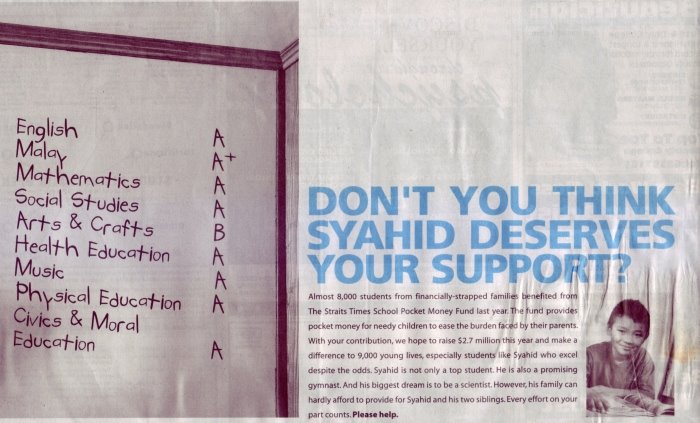
Don't you think Syahid deserves your support, the advertisement asks. Err... no. I'd rather support those who clearly need it - students who are poor and weak in their studies.

In fact, ST hopes to raise 2.7 million dollars to 9000 students who, like Syahid, "excel despite the odds". I struggle to comprehend why they would STILL need any kind of monetary help, and I really struggle to comprehend why the Straits Times feels it should fund poor top students and not poor, weak students.

I may not be a singapore economist (I sometimes wish I were), but let's see if the ST school fund makes any economic sense, and what kind of economic sense if it does.

From the looks of it, the ST pocket money fund is a Meritocratic Charity. The advertisement (you can click on it for a full-size image) says the money is especially for needy top students. Why needy average or needy struggling students won't receive your money is made through a silent appeal to the word *DESERVE* in the ad headline.

But really:

1. Decreasing marginal returns.

It is far easier to pull up a straight-Cs student to a straight-B performance than to pull up a straight A student like Syahid to straight A pluses. You'll need less resources to benefit the more numerous weaker students than to benefit the elite (but poor).

2. Deserving to needing.

Social statistics available online (for other countries) could be used to predict a student's salary on their first job from their grades in school. Syahid's straight As are an indicator of his probable rich bastard or high-flying senior civil servant status 15 to 20 years down the road. This is like tax cuts for the rich, even before they become rich.

He doesn't need the money. The weak students who will be stuck with lesser education and MacJobs in the future do. Syahid has the means to break out of the circle of poverty. They don't. His current poverty will be outweighed over time with the riches he'll be earning in the future. For society to give him money now is to tip the balance even further. For society to privilege him over poor and weaker students is to simultaneously create a legion of the "undeserving poor", the poor that you should spit upon and despise because they fully are responsible for their poverty.

I believe society has a duty to alleviate its poor out of the poverty trap, and that takes precedence over... setting up a meritocratic charity.

3. (mis)Allocation of resources?

From the description, Syahid is doing tremendously well for a poor kid. Poverty has not impeded him from getting straight As, having a healthy ambition, and ample extracurricular activities. Like most other star students, Syahid will be streamed to a class taught by the best teachers in his school, following the next round of streaming. He has access to an entire pool of resources that poor, weak students can never touch.

Tell me, if he's such a star student, doesn't he already qualify for some scholarship? I can imagine half a dozen school and community centre bursaries. If he's dirt poor and brilliant, there are plenty of avenues for him to get the money, even if I feel he doesn't need and shouldn't need the help.

Evidently state and quasi-state welfare schemes are insufficient means to help poor students, and the question is... what's wrong with the way they are allocated, why not enough of it is going automatically to the kids who need it, and how this famine of support can occur despite our national reserves.

20 years from now, as Syahid leads a department, will his underlings admire him because he was brilliant but poor, and succeeded to the top due to his own efforts, or because he was brilliant and taxpayers eliminated his poverty?

I prefer a little truth in advertising here: ST should just rename this fund to "Tax Cuts for the Future Rich", "The Straits Times Meritocratic Charity", or simply the "Straits Times Bursary/Scholarship". Don't go on about pocket money, because that's not the real issue or motivation for the fund.

06 October 2005

Napola

My recent posts have attracted some email feedback from readers.

I'll say this just once: I'm not a school superintendent in charge of a certain western cluster in Singapore. In fact, I'm not even employed by the Ministry Of Education. There may be a low-level witch hunt going on to find out the identity of the snitcher who's posting all the embarrassing photos of schools in Singapore, and it's fair to pre-empt the loss of innocent livelihoods and career advancements by making this statement.

That said, this will be my final school story for some time to come.

We were at another primary "super school" in the west of Singapore. Yes, there are super schools even at primary level, and even the Ministry uses such language in everyday conversations. It wasn't too long before all of us noticed a most unique thing about the students - a few of them had uniforms decked with more badges than an active scout.

We counted: these students had 6 to 8 badges, some shaped like name-tags, some like circular military badges. And we took a close look. The badges were:

Monitor
Prefect
Star Pupil
Group Leader
Science Monitor
Maths Monitor
Arts Monitor
Energy Savings Monitor

When we raised the issue, the teachers explained that:
1. Good pupils tend to be given positions of authority
2. Those who lead in one area can obviously lead in other areas
3. Therefore, there are a few students in each class who wear badges, and when they do, they wear many badges.

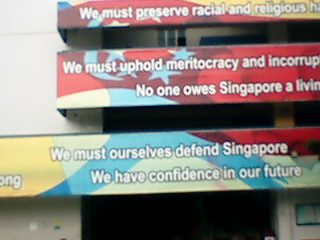
Yes. I can see why we must start them young, so that the students can be groomed into future leaders of Singapore, who are dedicated to the concepts of meritocracy and incorruptibility.

This is Napola. These are Minilee's Elites.

24 September 2005

Tharman's Grand Vision

Amidst all the talk about the great educational reforms of Tharman, as promised in Minilee's speech, we have here a prime exhibit of how well things are moving on the ground.


Exhibit A: In a prominent primary school in the west of Singapore, an 11-year-old student draws a rendition of a classic painting. Instead of counselling the kid, his parents, or his teacher, school authorities fall in love with his artistry and frame the painting in the student gallery.

I bet they'll make tonnes of moneh when the kid kills himself in a few years. Singapore, education and arts hub of Asia.

17 September 2005

Start them young!

Another primary school in Singapore. This time, the theme is propaganda of the North Korean variety... It's just a matter of time before Singapore has its own Youth Cadets for Minilee.

15 September 2005

In a school in Singapore...


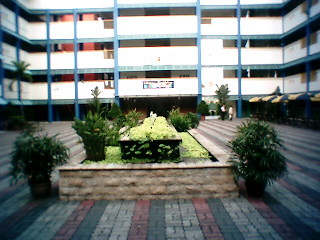
What is Lenin's tomb doing in a school in Singapore???

Filed under: bad architecture, koi ponds, Leninist state

11 July 2005

Functional Illiteracy (now in triplicate!)

The ST doesn't get it edition

(aside: Yes, there was a hiatus lasting 3 weeks. A very bad throat infection, then a near-death experience of my pc. Oh well.)

"What's ASEAN? Most teens don't know", decries our national propaganda machine.

Only three out of 24 Singapore [sic] teenagers The Straits Times approached on Orchard Rd on Saturday knew what the acronym Asean stands for and could name the countries in the grouping.

The rest, including two students from a top junior college, were stumped.


There are a few things going on in the rest of the article, each feeding into one another and forming a greater mythology of the Uninformed Singaporean Teenager:

1. "Everyone" knows what Asean is.
2. Asean is an integral tool of Singapore's regional diplomacy and means of keeping itself safe from its potentially troublesome neighbours.
3. It is hence inconceivable, shocking, and disgraceful that our teenagers know nothing about Asean.

It is popularly 'known' that Singaporean students are notorious for producing straight-A results academically while remaining ignorant of current affairs and history, because they don't seem to read widely enough beyond their textbooks - if at all. I am not interested in the truth value of that claim, but I do contend that this ST survey serves no purpose except to further the mythology. In fact, it has no scientific or informational value due to its horrendous survey design and methodology. Instead of highlighting the functional illiteracy of the average Singaporean teenager, it brings the investigative function of the ST into disrepute.

What are some things a proper survey requires in order to generalise results to a larger population?

1. A large enough sample.
In statistics, you need to know the size of the population you want to study (In this case: how many Singaporean teenagers are there?) You also need to know how accurate you want your survey to be, or how representative of the population your sample could be, i.e the Confidence interval (In this case: if we want the survey to be 95% accurate, i.e. 95% probability that the sample we just chosen is representative of the total population of Singaporean youths, how large should the sample be, given the total population?)

2. Either a representative or a truly random sample

Sampling is a delicate science. In general, you want to choose a sample that isn't biased at all. Are the youths you find on Orchard Rd on Saturday afternoon representative of the general teenage population?

This survey fails on both counts, and then some more.

Note ST doesn't bother to say how accurate its survey is. If it did, those of us armed with calculators and a copy of the census would point out its 'survey' or 'straw poll' has a sample size far insufficient to generate a generalisation. Note also ST doesn't actually say its survey is meant to generalise about Singaporean youths, aside from its headline "Most teens don't know". That's a little dishonest and waffling.

In every survey, you need to record the number of people who refused to do the questionnaire. Only 3 out of 24 teenagers could give the correct answer to the ST survey, but how many uncounted teenagers refused to participate? A very low response rate marks any survey as useless.

The Singapore education system doesn't get it edition

History is taught to Singapore's students from the age of 10 to 18, as Social Studies in primary school and History or Combined Humanities in secondary school. There is no way, short of not reading the book, for the possibility that a majority of Singaporean students on weekend break from studies could not know what Asean is. There is a possibility, though, that most Singaporean students tend to ignore what is taught in Social Studies and History once lessons end.

I've seen the different History, Social Studies, and Combined Humanities (chiefly geography and history) syllabuses over the years. Come to think of it, if I were a student, I would tend to ignore the stuff taught in those textbooks, when it comes to national and regional history, for the simple reason that most of it is sheer national propaganda, and worse still, stupid, wrong, and uncritical propaganda.

Why, of all things, in a discussion of Venice and the Italian Renaissance, bring in SINGAPORE and remark in passing - without any collaboration or examination of facts, that the reason Venice declined was due to the complacency of its leaders, and Singapore avoids this because of its meritocratic system and emphasis on constant innovation? This is not history, this is National Education; not education, but pious hectoring and political moralisation.

Why are Singaporeans, especially the young, not interested in history or current affairs? Because the most common venues of this knowledge here make assses of them. If I were a Singaporean teenager faced with a History syllabus hell-bent on brainwashing me into pious patriotism/parrotism, I'd rather throw away the knowledge and learn history on my own, when I'm an adult. School isn't the only avenue for learning, the last I heard.

The common sense edition

As far as I know, the knowledge of humans - beyond eating, shitting, and fucking - are a result of enculturation. Our knowledge comes from learning, not instinct. The young are simply that: young and less well-read than older people, and that is something we all know without the ST reminding us. Give them time to learn.

If the ST wanted to make a meaningful survey or even non-representative study, it could've done better by comparing
1. how much more ignorant our youths are, compared to teenagers from elsewhere, or
2. how much more ignorant our youths are, compared to teenagers 10, 20, 30, and 40 years ago (but it doesn't have the resources to do so...)