The Ugly China Tourist?
About 4 Sundays ago, the Straits Times had a feature on the strange behaviour of tourists from China. With the recent increase of the Chinese middle classes finding they can afford foreign vacation, unfavourable reports have slowly come to light. There was an incident where they staged a sit-in protest at a Malaysian hotel, which had issued them food coupons stamped with pictures of a pig. Pictures are available here. On a different occasion, a plane delay caused another group of Chinese tourists to stage a sit-in, effectively grounding the aircraft until the airline had to pay them off with a small sum ($50). These major incidents, coupled with other lesser anecdotes on the poor graces of the China tourists, led to ST pondering if we have a problem of The Ugly China Tourist.
I thought the answer was obvious, yet the ST still did not say it the following week, when they ran an update on the issue. It then falls to me to say it: their protests and sit-ins are indicative not of boorishness, but of a far nobler sentiment. In China itself, protests are staged regularly against perceived national insult (Yasukuni, Japanese textbooks, sex tourists...), poor administration at village or factory level, and so on. Far from discouraging these sometimes violent, but always boisterous demonstrations, it is understood and communicated by the media that these patriotic displays are good, and are to be encouraged.
The average urban Chinese is accustomed to demonstrating, almost at the drop of a hat. At home, under conditions of political repression by the one-party state, regular incited protests act as a valve, to ensure pent-up public ire is directed away from the Communist Party, and to stoke an ever-present sense of nationalist pride and suspicious of the foreign devil, who is always out to 'get' them.
Once abroad, it is inconceivable that the same Chinese citizens not react vocally and vehemently to perceived slights. It's a matter of national pride, one might say.
On patriotism
Elsewhere on the internets, as part of an admitted exercise to invoke nationalism in time for the General Elections (see the Tagboard here - and just for the record: What does nationalism have to do with a General Election??? Whiskey Tango Foxtrot! Is voting for the non-preferred party an act of not-patriotism?), someone laments the fact that Singaporeans react with cool and studied indifference to national slights by foreign politicians. Look, he says, why are you turning a blind eye that someone just called our country a little red dot, a piece of snot? Why do you keep finding fault with your own country? Do you hate it so much? Why don't you just go away, he asks...
Well, look at the Patriotic China Tourist - I don't ever want to be like them. It's very common for politicians to create a bogeyman during politically difficult periods, by diverting unwanted criticism of domestic policy to a foreign enemy. A great piece of political theatre that benefits even the foreign enemy, who then has a chance to whip up fervent support from his countrymen and override his own political weaknesses. Readers will probably recognise this principle in Malaysia-Singapore relations during Dr Mahathir and LKY's reigns ("Turn off the water!", "Water is our sacred national right, enshrined in the partition agreement!", and the more bizarre instance where Singapore mobilised its reserves during a National Day to prevent an invasion from someone), or between Malaysia-Indonesia relations, even.
And no. "My country, right or wrong" is not patriotism. True patriotism is holding one's country to high standards, to speak power to the truth, to point out where things are wrong, and when the Emperor is wearing no clothes. This is the patriotism of Thomas Paine.

20 August 2005


17 August 2005
Taiwan Independence Movie
(Via Kerim, for Tim)
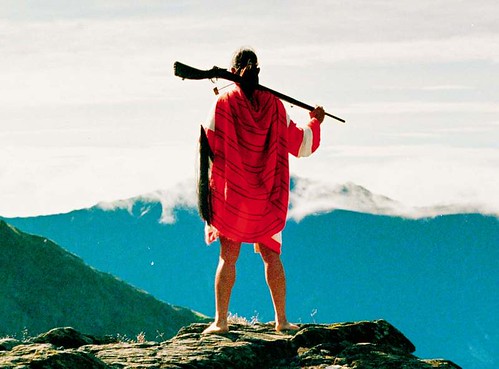
Taiwanese filmmaker Wei Te-sheng (魏德聖) is planning on making the “first Taiwanese epic,” about an Aborigine uprising against the Japanese which took place over 75 years ago. The film is tentatively titled Seediq Bale (賽德克巴萊). It seems they are still attempting to raise the money necessary to shoot the film on such a grand scale, but there is now a web site where you can download a demo preview of the film with English subtitles.
Keywords: Taiwan Independence
Of Englishmen and Mad Dogs
Seen, in today's ST, on page 12 of the Home section, an advertisement:
Prime Freehold Land
Central Bangkok
For Sale
On the instructions of the Foreign and Commonwealth Office of the Government of the United Kingdom of Great Britain and North Ireland, we are seeking preliminary expressions of interest in the acquisition of 14,000 sq.m. of Prime Freehold Land fronting Ploenchit Road Bangkok.
They decided to use the official name of the UK and still got it wrong? This notice, then, is less credible than the Engrishy Nigerian scam emails.
Filed under: Ad agency needs better editors, Bangkok property scams
Prime Freehold Land
Central Bangkok
For Sale
On the instructions of the Foreign and Commonwealth Office of the Government of the United Kingdom of Great Britain and North Ireland, we are seeking preliminary expressions of interest in the acquisition of 14,000 sq.m. of Prime Freehold Land fronting Ploenchit Road Bangkok.
They decided to use the official name of the UK and still got it wrong? This notice, then, is less credible than the Engrishy Nigerian scam emails.
Filed under: Ad agency needs better editors, Bangkok property scams
Are you sure you want to admit you did this?
An advertising agency in Singapore designed and produced a poster for the DPAS, and proudly mentions it did it pro bono at the bottom of the poster.
Out of kindness, I'm not going to name them, since the poster text read
Are you deaf to the disabled people's cry for the equalisation of opportunities?
Filed under: English police citation, advertising agency needs better editors.
Out of kindness, I'm not going to name them, since the poster text read
Are you deaf to the disabled people's cry for the equalisation of opportunities?
Filed under: English police citation, advertising agency needs better editors.
15 August 2005
The shelf life of one-party states
Soci notes that a group of people at the danieldrezner website are discussing if Singapore can continue to be a unique non-democratic, properous, capitalist state.
And so on...
The shelf life of one-party states
We used to group Hong Kong, Taiwan, South Korea, and Singapore as the 4 Asian Tigers in the 1970-80s, for their apparently resistance to the global stagflation and recession, and for the exotic charm of being non-democratic, yet economically successful regimes.
Singapore's Qin Shihuang has famously taken this happy coincidence and formulated the Confucian values theory and the Asian development theory, which inform popular perceptions of the 2 propositions in the danieldrezner dicussion:
A. Long-term economic properity requires democratic governance.
Not A. Authoritarian governance is a better guarantor of long-term economic prosperity.
Every year, Habibul Khondker of NUS looks at these two propositions in his Political Sociology class, and goes "that's interesting, but the argument is slightly inaccurate". First, none of the current Great Powers were democratic until the 1920s. The US is famous for not extending suffrage to its African-Americans until 1965. By the 1920s, all the Great Powers were already economic giants whose rise were achieved under more authoritarian or absolute forms of governance.
Similarly, Taiwan et al. cannot be held to represent of how authoritarian governments in modern times can lead to economic riches. Postcolonial countries (those achieve independence after WW2) that are authoritarian tend to perform overwhelmingly poorer.
Where are Taiwan and South Korea now?
Taiwan: KMT forces retreat to island in 1949. One-party state withers in 1988.
South Korea: Dictatorship since 1950. One-party state withers in 1987.
Mexico (Not very prosperous, but still...): PRI rules from 1929 to 2000.
Pay attention, Minilee: Sic transit gloria mundi.
Ronald Inglehart has been saying since 1977, that prolonged stretches of economic prosperity tend to lead to a liberalisation of political attitudes towards leadership and governance in a country's population. Since 1977, the European Values Survey and its successor, the World Values Survey, have proven his theory right.
Why is it so important? It's one thing to claim that people will want more political say, higher accountability, less authoritarian leadership (i.e. become more godlessly liberal) as they prosper. Your country's leaders will say, "Well, it's just a theory. As you can see, we're not going to move towards total chaos anytime soon, hahaha." But when there are more than 30 years of survey data and longtitudinal studies to prove the survey, perhaps it's time Minilee and Papalee start worrying about the inevitable.
Whenever people start talking about the interrelationships between regime type, the rule of law, economic development, and political corruption, the outlier is always Singapore.
And so on...
The shelf life of one-party states
We used to group Hong Kong, Taiwan, South Korea, and Singapore as the 4 Asian Tigers in the 1970-80s, for their apparently resistance to the global stagflation and recession, and for the exotic charm of being non-democratic, yet economically successful regimes.
Singapore's Qin Shihuang has famously taken this happy coincidence and formulated the Confucian values theory and the Asian development theory, which inform popular perceptions of the 2 propositions in the danieldrezner dicussion:
A. Long-term economic properity requires democratic governance.
Not A. Authoritarian governance is a better guarantor of long-term economic prosperity.
Every year, Habibul Khondker of NUS looks at these two propositions in his Political Sociology class, and goes "that's interesting, but the argument is slightly inaccurate". First, none of the current Great Powers were democratic until the 1920s. The US is famous for not extending suffrage to its African-Americans until 1965. By the 1920s, all the Great Powers were already economic giants whose rise were achieved under more authoritarian or absolute forms of governance.
Similarly, Taiwan et al. cannot be held to represent of how authoritarian governments in modern times can lead to economic riches. Postcolonial countries (those achieve independence after WW2) that are authoritarian tend to perform overwhelmingly poorer.
Where are Taiwan and South Korea now?
Taiwan: KMT forces retreat to island in 1949. One-party state withers in 1988.
South Korea: Dictatorship since 1950. One-party state withers in 1987.
Mexico (Not very prosperous, but still...): PRI rules from 1929 to 2000.
Pay attention, Minilee: Sic transit gloria mundi.
Ronald Inglehart has been saying since 1977, that prolonged stretches of economic prosperity tend to lead to a liberalisation of political attitudes towards leadership and governance in a country's population. Since 1977, the European Values Survey and its successor, the World Values Survey, have proven his theory right.
Why is it so important? It's one thing to claim that people will want more political say, higher accountability, less authoritarian leadership (i.e. become more godlessly liberal) as they prosper. Your country's leaders will say, "Well, it's just a theory. As you can see, we're not going to move towards total chaos anytime soon, hahaha." But when there are more than 30 years of survey data and longtitudinal studies to prove the survey, perhaps it's time Minilee and Papalee start worrying about the inevitable.
08 August 2005
Happy National Day!
The Whiskey Tango Foxtrot Edition
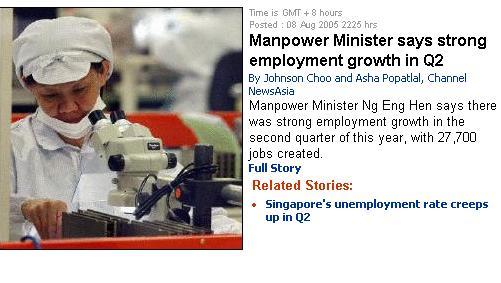
Singapore's premier news website can't make up its mind what its peasants should believe, apparently. Also, the link to the other story doesn't work (???), and only through the marvels of google can you find the original article here.
Excerpt:
Singapore's unemployment rate in the three months to June crept up slightly to 3.4 percent from a revised 3.3 percent in the previous quarter as fresh graduates joined the search for jobs, preliminary estimates released on Monday showed.
The Manpower Ministry said in its preliminary report that 27,700 jobs were created in the June quarter, an improvement from 17,800 in the previous three months and 10,900 for the same period last year.
No shit, Sherlock! To those of us who didn't skip 2004 in our Truman Show Machine, Singapore's job creation was abysmal! An improvement of this many jobs created a corresponding 0.1% in change in unemployment, yay!
Evidently job creation in Singapore is barely keeping up with the increase in labor force, and actual unemployment continues to increase.
29 July 2005
The very naughty Liberal Democratic Party
This year has seen Japan's ruling party increase its standing with its red state voters, with Prime Minister Koizumi's continued defense of his visits to the Yasukuni war shrine and the Education Ministry's non-banning of a revisionist high school History text. The country's neighbours did not seem happy even when Koizumi made suggestions that the shrine visits were in a personal, not official capacity, or that the high school text was not compulsory, but merely one out of many texts that schools could choose to teach from.
Via Frog in a Well, this should provide more grist for the mill. As part of a study on constitutional reform, an LDP commission recommended that Article 9 of the constitution be changed, to assert Japan's right to possess a "self-defense military". The original text of this famous article reads:
Well, Japan has a Self-Defense Force, but LDP's lawmakers want a Self Defense Military. Asashi Shinbun notes that "the word 'military' has never been officially used to describe the Self-Defense Forces, mainly out of consideration to Japan's neighbors." Up to now.
But there's more. Taking a leaf out of Washingtonian legislation, the LDP committee also tagged on more suggestions, among them a proposal to transform the Emperor of Japan into a mere symbolic figure to someone who would actually represent Japan in diplomatic settings.
The text reads: 自民党新憲法起草委員会(委員長・森前首相)は7日、改憲の「要綱案」を発表した。9条2項を改正し、自衛のための武力組織を「自衛軍」と名付け、軍隊であることを明確に位置づけた。また、象徴天皇制を維持することとし、天皇を「元首」とすることを見送った。委員会は今後、要綱案をもとに結党50年の今年11月に発表する党新憲法草案の条文化作業に入る。
Tak points out that the problematic word here is genshu (元首). It roughly means head of state, but it is a word that comes straight from the pre-war Great Japanese Imperial Constitution. In the old pre-war constitution, the fourth article stipulates that the emperor is the genshu of Japan. This comes right after an article that declares the emperor to be divine.
Cue ominous music?
Via Frog in a Well, this should provide more grist for the mill. As part of a study on constitutional reform, an LDP commission recommended that Article 9 of the constitution be changed, to assert Japan's right to possess a "self-defense military". The original text of this famous article reads:
Aspiring sincerely to an international peace based on justice and order, the Japanese people forever renounce war as a sovereign right of the nation and the threat or use of force as means of settling international disputes.
In order to accomplish the aim of the preceding paragraph, land, sea, and air forces, as well as other war potential, will never be maintained. The right of belligerency of the state will not be recognized.
Well, Japan has a Self-Defense Force, but LDP's lawmakers want a Self Defense Military. Asashi Shinbun notes that "the word 'military' has never been officially used to describe the Self-Defense Forces, mainly out of consideration to Japan's neighbors." Up to now.
But there's more. Taking a leaf out of Washingtonian legislation, the LDP committee also tagged on more suggestions, among them a proposal to transform the Emperor of Japan into a mere symbolic figure to someone who would actually represent Japan in diplomatic settings.
The text reads: 自民党新憲法起草委員会(委員長・森前首相)は7日、改憲の「要綱案」を発表した。9条2項を改正し、自衛のための武力組織を「自衛軍」と名付け、軍隊であることを明確に位置づけた。また、象徴天皇制を維持することとし、天皇を「元首」とすることを見送った。委員会は今後、要綱案をもとに結党50年の今年11月に発表する党新憲法草案の条文化作業に入る。
Tak points out that the problematic word here is genshu (元首). It roughly means head of state, but it is a word that comes straight from the pre-war Great Japanese Imperial Constitution. In the old pre-war constitution, the fourth article stipulates that the emperor is the genshu of Japan. This comes right after an article that declares the emperor to be divine.
Cue ominous music?
The shortest path
Microsoft released this week a compulsory patch for WinXP users. This Windows Genuine Advantage Validation locks everyone out of windowsupdate unless they install it on their pcs. It then proceeds to check that your copy of windows is legit, as well as what motherboard and hardware you own, and what other non-MS software you have installed. Why Bill Gates wants to know all that is a mystery.
Via Boingboing, a javascript workaround that only works because Microsoft's engineers left some files on their website. The workaround doesn't work anymore, sadly...
Via extended64.com, you can now use Mozilla/Firebird to access windowsupdate and bypass WGAV, with the help of certain browser plugins and scripts.
Via Pessimism Blooming, the easiest method to bypass the browser validation is to simply let windows install the validation tool, then "in Internet Explorer, go to Tools... Internet Options... Programs... Manage Add-ons... and then click on Windows Genuine Advantage and disable it. Then Windows Update works just like before."
Thank goodness IE was designed to be such a security-minded browser that add-ons like WGAV can be disabled.
Via Boingboing, a javascript workaround that only works because Microsoft's engineers left some files on their website. The workaround doesn't work anymore, sadly...
Via extended64.com, you can now use Mozilla/Firebird to access windowsupdate and bypass WGAV, with the help of certain browser plugins and scripts.
Via Pessimism Blooming, the easiest method to bypass the browser validation is to simply let windows install the validation tool, then "in Internet Explorer, go to Tools... Internet Options... Programs... Manage Add-ons... and then click on Windows Genuine Advantage and disable it. Then Windows Update works just like before."
Thank goodness IE was designed to be such a security-minded browser that add-ons like WGAV can be disabled.
28 July 2005
Burn the heretics!
Early in February, I wrote about Singapore's curious religious resurgence, where people who call themselves Christians believe
That was meant to be ironic and slightly exaggerated. It has come to my attention, however, that such nutjobs really exist in Singapore! You can even read their testimonies here.
Among other things, these "Christians" believe that God caused their property prices to increase, that their ascension to the Million-Dollar Table was divinely inspired, that because God saved a certain parishioner's father when he "rightly" did nothing (When I bo chup, God saved my dad!).
And yes, these people take the Holy Communion everwhere: in their cars, at home, some 3 times a day, and mostly without the administration of any priest.
There is one word for these people: HERETICS.
Kenny and Edward, being good Catholics and Orthodox Christians, merely have to worry about the Novus Ordo and the most sinister CLOWN MASSES. Well, if you think that liturgy is bad, keep in mind that the New Creation church people celebrate the Eucharist in cars and at home, using coca cola for wine.
Then, there is this Rev. Kong Hee, who claims "Jesus wore the modern-day equivalent of a business suit. That is why I'm dressed like this. I want to be like Jesus! Hallejulah!"
I long for the good old days where the Congregation for the Doctrine of the Faith would defrock and burn heretics like these at the stake. Okay, so the New Creation Church of Singapore and City Harvest are protestant non-denominational branches? Fine, in the good old days of the Reformation, we Protestants tortured and drowned heretics like these too.
that a particular phrase in the Bible tells us directly and authoritatively that Harry Potter books are evil... Not so much of believing that God intercedes for us, but being convinced that he is actively working on OUR SIDE when we're trying to fight our way to the train, earning our first million, protesting for a pay rise... That we almost tripped while coming down the staircase but didn't, is a miracle, an intervention from the very Hand of God...
That was meant to be ironic and slightly exaggerated. It has come to my attention, however, that such nutjobs really exist in Singapore! You can even read their testimonies here.
Among other things, these "Christians" believe that God caused their property prices to increase, that their ascension to the Million-Dollar Table was divinely inspired, that because God saved a certain parishioner's father when he "rightly" did nothing (When I bo chup, God saved my dad!).
And yes, these people take the Holy Communion everwhere: in their cars, at home, some 3 times a day, and mostly without the administration of any priest.
There is one word for these people: HERETICS.
Kenny and Edward, being good Catholics and Orthodox Christians, merely have to worry about the Novus Ordo and the most sinister CLOWN MASSES. Well, if you think that liturgy is bad, keep in mind that the New Creation church people celebrate the Eucharist in cars and at home, using coca cola for wine.
Then, there is this Rev. Kong Hee, who claims "Jesus wore the modern-day equivalent of a business suit. That is why I'm dressed like this. I want to be like Jesus! Hallejulah!"
I long for the good old days where the Congregation for the Doctrine of the Faith would defrock and burn heretics like these at the stake. Okay, so the New Creation Church of Singapore and City Harvest are protestant non-denominational branches? Fine, in the good old days of the Reformation, we Protestants tortured and drowned heretics like these too.
22 July 2005
Movie Post
Edward wants to know what I watch, given that I make short films...
Total Number of films I own on DVD/Video
Less than 10, actually. I've borrowed them from the Film Collection of the National Library or watched them at NUS's library. Not to mention, winmx and bittorrent are a good source of hard-to-find films, or stuff that aren't available in Singapore.
The Last Film I Bought
That would be Rashomon, at one of HMV's DVD clearance sales.
Five Films I Watch A Lot/Mean a Lot to Me
Ed Wood
Edward D Wood Jr might be the world's worst director, but he understands the joys of filmmaking! A better motivational film and ode to the art than Cinema Paradiso.
Dr Strangelove or: How I learned to stop worrying and love the bomb
Wild and hysterical, this is Stanley Kubrick's only comedy. Peter Sellers infuses his multiple roles with manic energy and differentiation. Kubrick pours scorn on the excesses of the military-industrial complex and explains what's so mad about MAD.
Triumph of the Will
The Nazis were pure evil, Triumph des Willens was a propaganda flick, but Leni Riefenstahl was a genius. I encourage all Singaporeans to watch this movie before the telecast of the National Day Parade, and compare how the ceremony and pomp of the Nazi state and martial music have become the template for all later nationalisms.
Koyaanisqatsi
After it appeared in 1983, advertisements began to copy its tripped-out, speeded-up images of traffic flow and people walking on streets to the point ad nauseum. Even then, Koyaanisqatsi can still be enjoyed as a visual and musical feast, preferably on a wide-screen system or in an IMAX cinema.
Mononoke Hime (もののけ姫)
Like Koyaanisqatsi, this is a movie with a strong environmentalist message and meditation on a world out of balance. Hayao Miyazaki weaves engaging tales that should not be mistaken for children's entertainment.
Tag 5 People and Have Them Put It In Their Blog
Eileen Chew (There's a suspicion her list would be more eclectic than mine)
Rachel Mercer (I bet she has very interesting films to recommend!)
RaveDave (Great taste in music... wonder what he watches)
PingandWin (They're on a roll with their blog now!)
Chris Low (As soon as his hdd resurrects)
Total Number of films I own on DVD/Video
Less than 10, actually. I've borrowed them from the Film Collection of the National Library or watched them at NUS's library. Not to mention, winmx and bittorrent are a good source of hard-to-find films, or stuff that aren't available in Singapore.
The Last Film I Bought
That would be Rashomon, at one of HMV's DVD clearance sales.
Five Films I Watch A Lot/Mean a Lot to Me
Ed Wood
Edward D Wood Jr might be the world's worst director, but he understands the joys of filmmaking! A better motivational film and ode to the art than Cinema Paradiso.
Dr Strangelove or: How I learned to stop worrying and love the bomb
Wild and hysterical, this is Stanley Kubrick's only comedy. Peter Sellers infuses his multiple roles with manic energy and differentiation. Kubrick pours scorn on the excesses of the military-industrial complex and explains what's so mad about MAD.
Triumph of the Will
The Nazis were pure evil, Triumph des Willens was a propaganda flick, but Leni Riefenstahl was a genius. I encourage all Singaporeans to watch this movie before the telecast of the National Day Parade, and compare how the ceremony and pomp of the Nazi state and martial music have become the template for all later nationalisms.
Koyaanisqatsi
After it appeared in 1983, advertisements began to copy its tripped-out, speeded-up images of traffic flow and people walking on streets to the point ad nauseum. Even then, Koyaanisqatsi can still be enjoyed as a visual and musical feast, preferably on a wide-screen system or in an IMAX cinema.
Mononoke Hime (もののけ姫)
Like Koyaanisqatsi, this is a movie with a strong environmentalist message and meditation on a world out of balance. Hayao Miyazaki weaves engaging tales that should not be mistaken for children's entertainment.
Tag 5 People and Have Them Put It In Their Blog
Eileen Chew (There's a suspicion her list would be more eclectic than mine)
Rachel Mercer (I bet she has very interesting films to recommend!)
RaveDave (Great taste in music... wonder what he watches)
PingandWin (They're on a roll with their blog now!)
Chris Low (As soon as his hdd resurrects)
21 July 2005
Take 2 and 2 together
10 June: 2004 saw a record increase in Singapore's millionaires
19 July: High joblessness dampens retail sales in Singapore
notes:
1. The rich getting richer do not create jobs for all. There is no rising tide, no trickle-down economy, even though Minilee and his predecessor, Mr Peanut, had consistently offered this argument for the past 5 years.
2. This should provide additional evidence of a deteriorating Gini coefficient in Singapore. Also, the poor have NOT gotten richer - they have gotten poorer.
19 July: High joblessness dampens retail sales in Singapore
notes:
1. The rich getting richer do not create jobs for all. There is no rising tide, no trickle-down economy, even though Minilee and his predecessor, Mr Peanut, had consistently offered this argument for the past 5 years.
2. This should provide additional evidence of a deteriorating Gini coefficient in Singapore. Also, the poor have NOT gotten richer - they have gotten poorer.
20 July 2005
The peanut that launched a thousand ships
Even more non-moralistic musings on NKF
From today's Parliament proceedings, it appears more certain that the Minister of Health, Khaw Boon Wan, regards further regulations on charities to level up their governance and disclosure as unnecessary. In the wake of NKF's failed suit against Singapore Press Holdings, Balaji, the junior minister for health, stood by NKF, calling it an efficient organisation. Just to let everyone know where the government stands, supposedly, in its ideological crusade to turn everything into a free market?
The right tool for everything?
In the free market, the maximalisation of profit or surplus is the core value and natural behaviour of every firm. It's not the corporate structure of the NKF board, the salary and 12-month bonusese of its CEO, or even the method of fundraising that is fundamentally wrong - the assumption that the NKF should behave like a free market entity and build massive surpluses that is primarily at fault and entirely inappropriate in the charity industry.
The purpose of charity organisations is to raise funds to subsidise a certain group of disprivileged people, or for a particular cause - not to accumulate operating surpluses to the tune of hundreds of millions. A surplus either means that aid is not getting through to people who need it, or an excess amount of funds has been collected, above and beyond the requirements of the charity and its cause. A surplus means that there exists a huge inefficiency in the distribution of charity funds. Worse still, these surpluses are a reward for the effectiveness of NKF's excessive fundraising, and these surpluses are the captured funds of what should've gone to other charities. Beneath the unwavering support from Minister Khaw lies a reluctant understanding of this principle: during his press conference on 14 July, Khaw admitted the possibility that "NKF reserves may be diversified into other causes" - or simply put, the surpluses will be diverted to other charities that need the funds.
The logic of charity fundraising then, is different from free markets. While free market firms should maximise profits and surpluses (although some may choose to maximise revenue or market share), charity organisations should strive for a zero surplus, zero deficit model. It's an easy goal, really. For every charitable cause, there is an identifiable and clearly-bounded population of beneficiaries whose needs are predictable and more or less stable. Calculating the total amount of funds needed wouldn't require a genius.
Singaporeans must remain vigilant
The NKF has been getting away for several years with massive surpluses, inappropriate, fraudulent, yet legal practices - with some knowledge and approval of Parliament. Minister Khaw knew about the massive reserves and defended them last year. Pricewaterhouse Coopers, the government taxman, and the the commissioner for charities have all audited the NKF's books for years and found nothing objectionable or illegal. The government's intervention now is not an admission that its strong support of NKF was wrong, but a political expedient move to quieten the tide of discontent of Singaporeans. Operationally, I expect little to change at the NKF. Legally, the Minister has already said no to urgently-needed regulation.
To the high and mighty, the amount of money involved is peanuts. Singaporeans should be aware that these people will never fight for their interests. What is in the interests of the high and mighty, though, is the continued support of Singaporeans for NKF. NKF is efficient, it has many patients that still require care and funding (presumably having 30 years' worth of surpluses isn't enough), Singaporeans are generous and kindhearted, they say.
My advice to Singaporeans is simple: let the NKF die. Whether the charity industry is a free market or not, other charities will fill in the gap. The refusal of the high and mighty to let NKF go is surprising; even in free markets, firms are always set up and shut down, and no one sheds a tear for them.
From today's Parliament proceedings, it appears more certain that the Minister of Health, Khaw Boon Wan, regards further regulations on charities to level up their governance and disclosure as unnecessary. In the wake of NKF's failed suit against Singapore Press Holdings, Balaji, the junior minister for health, stood by NKF, calling it an efficient organisation. Just to let everyone know where the government stands, supposedly, in its ideological crusade to turn everything into a free market?
The right tool for everything?
In the free market, the maximalisation of profit or surplus is the core value and natural behaviour of every firm. It's not the corporate structure of the NKF board, the salary and 12-month bonusese of its CEO, or even the method of fundraising that is fundamentally wrong - the assumption that the NKF should behave like a free market entity and build massive surpluses that is primarily at fault and entirely inappropriate in the charity industry.
The purpose of charity organisations is to raise funds to subsidise a certain group of disprivileged people, or for a particular cause - not to accumulate operating surpluses to the tune of hundreds of millions. A surplus either means that aid is not getting through to people who need it, or an excess amount of funds has been collected, above and beyond the requirements of the charity and its cause. A surplus means that there exists a huge inefficiency in the distribution of charity funds. Worse still, these surpluses are a reward for the effectiveness of NKF's excessive fundraising, and these surpluses are the captured funds of what should've gone to other charities. Beneath the unwavering support from Minister Khaw lies a reluctant understanding of this principle: during his press conference on 14 July, Khaw admitted the possibility that "NKF reserves may be diversified into other causes" - or simply put, the surpluses will be diverted to other charities that need the funds.
The logic of charity fundraising then, is different from free markets. While free market firms should maximise profits and surpluses (although some may choose to maximise revenue or market share), charity organisations should strive for a zero surplus, zero deficit model. It's an easy goal, really. For every charitable cause, there is an identifiable and clearly-bounded population of beneficiaries whose needs are predictable and more or less stable. Calculating the total amount of funds needed wouldn't require a genius.
Singaporeans must remain vigilant
The NKF has been getting away for several years with massive surpluses, inappropriate, fraudulent, yet legal practices - with some knowledge and approval of Parliament. Minister Khaw knew about the massive reserves and defended them last year. Pricewaterhouse Coopers, the government taxman, and the the commissioner for charities have all audited the NKF's books for years and found nothing objectionable or illegal. The government's intervention now is not an admission that its strong support of NKF was wrong, but a political expedient move to quieten the tide of discontent of Singaporeans. Operationally, I expect little to change at the NKF. Legally, the Minister has already said no to urgently-needed regulation.
To the high and mighty, the amount of money involved is peanuts. Singaporeans should be aware that these people will never fight for their interests. What is in the interests of the high and mighty, though, is the continued support of Singaporeans for NKF. NKF is efficient, it has many patients that still require care and funding (presumably having 30 years' worth of surpluses isn't enough), Singaporeans are generous and kindhearted, they say.
My advice to Singaporeans is simple: let the NKF die. Whether the charity industry is a free market or not, other charities will fill in the gap. The refusal of the high and mighty to let NKF go is surprising; even in free markets, firms are always set up and shut down, and no one sheds a tear for them.
16 July 2005
He who lives by the peanut...
More non-moralistic musings on NKF
The NKF prides itself as a charity run on a commercial model. "Social entrepeneurship", according to its website - that translates into heavy marketing, tv charity shows, call centres, and the provision of a fleet of company cars for its CEO and so on (?!). Its supporters in Parliament tout it as the coming of the market economy into a traditionally not-for-profit sector, a Very Good Thing. The grounds for the expulsion of TT Durai and the board of directors as well as any future criminal proceedings should necessarily stem from evaluating its behaviour against the standard of commercial companies.
Again, in shorter form: the NKF and its Parliament supporters have always insisted on its status as a commercial (decode as "more professional") entity working in a non-profit sector. If the NKF were a registered company, would its actions have been legal and typical?
1. TT Durai had an undeclared commercial relationship with a NKF board member
From the Business Times archives,
There are laws against this, of course. If the NKF was a registered company instead of a charity, this would've automatically warranted an investigation by Singapore's Commercial Affairs Department and its Corrupt Practices Investigation Bureau. Durai and Matilda Chua would be eligible for jail terms, lengthy fines, and a mandatory ban from holding any directorship or board membership of any company for a number of years.
2. Durai lied about the extent of NKF's reserves
The NKF CEO went public during the charity's drives, stating that the NKF reserves were in danger of running out in 3 years, hence securing massive donations from Singapore's public. The truth was revealed in court under the questioning of Davinder Singh: NKF has reserves of 260 million SGD, more than enough to last the organisation between 30 and 40 years, as it current spends only 7 million a year subsidising patient care.
3. The board lied about the number of NKF beneficiaries
In a letter published in ST's forum page on April 9, 2004, Dr Gerard Chuah, chairman of NKF Children's Medical Fund, stated that NKF treats 3,000 dialysis patients a year. But answers given in Parliament in May 2004 showed that NKF treated 1,512 patients in 2003. And a letter from Mr Yong on the same date (sued by NKF for the following statement, now known to be a fact) said NKF treated about 1,800 dialysis patients.
Again, from the BT archives,
The heads of CEOs have rolled for similar false statements about their accounts and reserves - Enron, Royal Dutch Shell, and so on. Some are even in jail. But what do I know? The NKF isn't a registered commercial company, it's registered as a charity. In Singapore, there aren't any laws demanding the same standards of corporate governance for charities or due disclosure and transparency of even the accounts books.
The entire NKF board, CEO, and even its patron (Mrs Peanut) may have stepped down, and the Government has been forced by public pressure to announce an investigation into the charity. During the press conference on Wednesday, Health Minister Khaw Boon Wan said certain steps will have to be taken to restore public trust: the investigation will review accounting practices, funding needs, and pricing and subsidy policies. Decode (what the Minister did not say): the investigation will most likely not look into the criminal behaviour of Durai and his board.
The good Health Minister has reason to tread thinly - it isn't clear if Durai and the Board have broken any laws. It claims to be a very corporate charity, the Parliament praises it as a model for turning Singapore's charities into a market economy, and yet the Minister is reluctant to hold NKF to the standards and legal framework of a market firm. Interesting, no?
The penalties for deception by a company's CEO, board of directors, or for false statements on a company's revnue centre on one thing only: the sanctity of a market. A free market requires perfect information from its players. Only then can investors make informed decisions to allocate their resources to the correct companies. In deceiving the entire market, a company poisons the information flow, causing misallocation of resources and non-optimal results for the industry as a whole. This is why corporate entities are subject to strict regulation and are compelled by law to disclose information on their revenues and accounts - yet this is also why any non-capitalist market needs to have equally strict regulation as well.
The NKF prides itself as a charity run on a commercial model. "Social entrepeneurship", according to its website - that translates into heavy marketing, tv charity shows, call centres, and the provision of a fleet of company cars for its CEO and so on (?!). Its supporters in Parliament tout it as the coming of the market economy into a traditionally not-for-profit sector, a Very Good Thing. The grounds for the expulsion of TT Durai and the board of directors as well as any future criminal proceedings should necessarily stem from evaluating its behaviour against the standard of commercial companies.
Again, in shorter form: the NKF and its Parliament supporters have always insisted on its status as a commercial (decode as "more professional") entity working in a non-profit sector. If the NKF were a registered company, would its actions have been legal and typical?
1. TT Durai had an undeclared commercial relationship with a NKF board member
From the Business Times archives,
Durai had a business relationship with former employee Matilda Chua when the NKF awarded a contract to an Indian call-centre company she represented. The NKF had contracted Proton Web Solutions to perform telemarketing work. Ms Chua, who is now a member of the NKF board, is the Singapore representative of Proton Web.
Mr Durai also failed to reveal that he had jointly invested with Ms Chua in another company, Global Net Relations, a company which was set up to perform call centre work and even operated out of the same premises as Proton Web at Suntec Tower. Mr Durai and Ms Chua were both directors in Global Net.
There are laws against this, of course. If the NKF was a registered company instead of a charity, this would've automatically warranted an investigation by Singapore's Commercial Affairs Department and its Corrupt Practices Investigation Bureau. Durai and Matilda Chua would be eligible for jail terms, lengthy fines, and a mandatory ban from holding any directorship or board membership of any company for a number of years.
2. Durai lied about the extent of NKF's reserves
The NKF CEO went public during the charity's drives, stating that the NKF reserves were in danger of running out in 3 years, hence securing massive donations from Singapore's public. The truth was revealed in court under the questioning of Davinder Singh: NKF has reserves of 260 million SGD, more than enough to last the organisation between 30 and 40 years, as it current spends only 7 million a year subsidising patient care.
3. The board lied about the number of NKF beneficiaries
In a letter published in ST's forum page on April 9, 2004, Dr Gerard Chuah, chairman of NKF Children's Medical Fund, stated that NKF treats 3,000 dialysis patients a year. But answers given in Parliament in May 2004 showed that NKF treated 1,512 patients in 2003. And a letter from Mr Yong on the same date (sued by NKF for the following statement, now known to be a fact) said NKF treated about 1,800 dialysis patients.
Again, from the BT archives,
"You knew it was an error. Did you correct it?" Mr Singh asked Mr Durai, referring to Dr Chuah's letter.
"No, it was not material," Mr Durai replied.
The heads of CEOs have rolled for similar false statements about their accounts and reserves - Enron, Royal Dutch Shell, and so on. Some are even in jail. But what do I know? The NKF isn't a registered commercial company, it's registered as a charity. In Singapore, there aren't any laws demanding the same standards of corporate governance for charities or due disclosure and transparency of even the accounts books.
The entire NKF board, CEO, and even its patron (Mrs Peanut) may have stepped down, and the Government has been forced by public pressure to announce an investigation into the charity. During the press conference on Wednesday, Health Minister Khaw Boon Wan said certain steps will have to be taken to restore public trust: the investigation will review accounting practices, funding needs, and pricing and subsidy policies. Decode (what the Minister did not say): the investigation will most likely not look into the criminal behaviour of Durai and his board.
The good Health Minister has reason to tread thinly - it isn't clear if Durai and the Board have broken any laws. It claims to be a very corporate charity, the Parliament praises it as a model for turning Singapore's charities into a market economy, and yet the Minister is reluctant to hold NKF to the standards and legal framework of a market firm. Interesting, no?
The penalties for deception by a company's CEO, board of directors, or for false statements on a company's revnue centre on one thing only: the sanctity of a market. A free market requires perfect information from its players. Only then can investors make informed decisions to allocate their resources to the correct companies. In deceiving the entire market, a company poisons the information flow, causing misallocation of resources and non-optimal results for the industry as a whole. This is why corporate entities are subject to strict regulation and are compelled by law to disclose information on their revenues and accounts - yet this is also why any non-capitalist market needs to have equally strict regulation as well.
14 July 2005
Get that Man a Peanut!
Non-moralistic musings on NKF
... are hard to come by these days, with everyone baying for the hide of T.T. Durai, the National Kidney Foundation charity's CEO and rainmaker. Aside from Wang Zhen's posts on the matter, actually.
Readers of my series on the casino issue will know the contempt I have for solely relying on morality to win any argument. This post will similarly identify a non-moral grounds for action against the NKF, among other things.
He who lives by the sword...
Durai's successes in the 90s transformed the NKF from a typical small charity into a multimillion foundation, by forming an alliance wiht Mediacorp to produce frequent charity shows, a kind of circus performance by the country's television stars. While detractors believed the gimmick would soon tire out, Durai proved that the lure of cash, automobile and condo prizes, celebrity power, easy phone pledging, and the option to donate monthly through bank accounts would attract enough donations to make the charity shows a quarterly event.
It didn't take Singapore's ministers much time to honour the entrepeneur with national awards and trumpeting the arrival of a new paradigm for charities. Instead of begging or relying for goodwill, charities should conduct themselves as voluntary welfare organisations operating in a free market system. It doesn't take a genius to decode that into:
1. If every charity were run like a business, as NKF does, the government wouldn't need to partially fund 80% of Singapore's charities.
2. Well, tough luck if NKF happens to take away your donation dollar. It's a free market and you didn't compete hard enough.
3. It's your fault if you can't get enough people to donate to your cause. Don't come crying to the government (see statement 1).
And so on.
NKF has been the poster child for Singapore's unique "free market charities" model. He who lives by the sword shall die by the sword, and since Durai and NKF's board of directors have proudly forced their charity model on us for almost a decade, any condemnation should centre on how well they conducted themselves as a typical member of any really-existing "free market".
... are hard to come by these days, with everyone baying for the hide of T.T. Durai, the National Kidney Foundation charity's CEO and rainmaker. Aside from Wang Zhen's posts on the matter, actually.
Readers of my series on the casino issue will know the contempt I have for solely relying on morality to win any argument. This post will similarly identify a non-moral grounds for action against the NKF, among other things.
He who lives by the sword...
Durai's successes in the 90s transformed the NKF from a typical small charity into a multimillion foundation, by forming an alliance wiht Mediacorp to produce frequent charity shows, a kind of circus performance by the country's television stars. While detractors believed the gimmick would soon tire out, Durai proved that the lure of cash, automobile and condo prizes, celebrity power, easy phone pledging, and the option to donate monthly through bank accounts would attract enough donations to make the charity shows a quarterly event.
It didn't take Singapore's ministers much time to honour the entrepeneur with national awards and trumpeting the arrival of a new paradigm for charities. Instead of begging or relying for goodwill, charities should conduct themselves as voluntary welfare organisations operating in a free market system. It doesn't take a genius to decode that into:
1. If every charity were run like a business, as NKF does, the government wouldn't need to partially fund 80% of Singapore's charities.
2. Well, tough luck if NKF happens to take away your donation dollar. It's a free market and you didn't compete hard enough.
3. It's your fault if you can't get enough people to donate to your cause. Don't come crying to the government (see statement 1).
And so on.
NKF has been the poster child for Singapore's unique "free market charities" model. He who lives by the sword shall die by the sword, and since Durai and NKF's board of directors have proudly forced their charity model on us for almost a decade, any condemnation should centre on how well they conducted themselves as a typical member of any really-existing "free market".
12 July 2005
Boy finds snake in breakfast cereal
Edward draws my attention to an article in London:
My thoughts: Thank goodness this isn't an American tabloid! Imagine, if you will, an American version of this article. We'll have the same introduction, but instead of that "it's kind of lucky the snake wasn't venomous at all" ending, we'd have:
1. Terrorist plan suspected
2. Face of pope observed in pattern of cereal flakes in the milk
3. The non-venomous snake proves that the face of pope thing is a double miracle, hallelujah!
A two-foot snake found its way into a packet of breakfast cereal, it emerged today.
Five-year-old Jordan Willett, from Dawley, Shropshire, discovered the live reptile inside his box of Golden Puffs on Bank Holiday Monday.
His mother Theresa, who was having breakfast with her son at the time, said she initially thought it was a free gift for children.
My thoughts: Thank goodness this isn't an American tabloid! Imagine, if you will, an American version of this article. We'll have the same introduction, but instead of that "it's kind of lucky the snake wasn't venomous at all" ending, we'd have:
1. Terrorist plan suspected
2. Face of pope observed in pattern of cereal flakes in the milk
3. The non-venomous snake proves that the face of pope thing is a double miracle, hallelujah!
11 July 2005
Functional Illiteracy (now in triplicate!)
The ST doesn't get it edition
(aside: Yes, there was a hiatus lasting 3 weeks. A very bad throat infection, then a near-death experience of my pc. Oh well.)
"What's ASEAN? Most teens don't know", decries our national propaganda machine.
There are a few things going on in the rest of the article, each feeding into one another and forming a greater mythology of the Uninformed Singaporean Teenager:
1. "Everyone" knows what Asean is.
2. Asean is an integral tool of Singapore's regional diplomacy and means of keeping itself safe from its potentially troublesome neighbours.
3. It is hence inconceivable, shocking, and disgraceful that our teenagers know nothing about Asean.
It is popularly 'known' that Singaporean students are notorious for producing straight-A results academically while remaining ignorant of current affairs and history, because they don't seem to read widely enough beyond their textbooks - if at all. I am not interested in the truth value of that claim, but I do contend that this ST survey serves no purpose except to further the mythology. In fact, it has no scientific or informational value due to its horrendous survey design and methodology. Instead of highlighting the functional illiteracy of the average Singaporean teenager, it brings the investigative function of the ST into disrepute.
What are some things a proper survey requires in order to generalise results to a larger population?
1. A large enough sample.
In statistics, you need to know the size of the population you want to study (In this case: how many Singaporean teenagers are there?) You also need to know how accurate you want your survey to be, or how representative of the population your sample could be, i.e the Confidence interval (In this case: if we want the survey to be 95% accurate, i.e. 95% probability that the sample we just chosen is representative of the total population of Singaporean youths, how large should the sample be, given the total population?)
2. Either a representative or a truly random sample
Sampling is a delicate science. In general, you want to choose a sample that isn't biased at all. Are the youths you find on Orchard Rd on Saturday afternoon representative of the general teenage population?
This survey fails on both counts, and then some more.
Note ST doesn't bother to say how accurate its survey is. If it did, those of us armed with calculators and a copy of the census would point out its 'survey' or 'straw poll' has a sample size far insufficient to generate a generalisation. Note also ST doesn't actually say its survey is meant to generalise about Singaporean youths, aside from its headline "Most teens don't know". That's a little dishonest and waffling.
In every survey, you need to record the number of people who refused to do the questionnaire. Only 3 out of 24 teenagers could give the correct answer to the ST survey, but how many uncounted teenagers refused to participate? A very low response rate marks any survey as useless.
The Singapore education system doesn't get it edition
History is taught to Singapore's students from the age of 10 to 18, as Social Studies in primary school and History or Combined Humanities in secondary school. There is no way, short of not reading the book, for the possibility that a majority of Singaporean students on weekend break from studies could not know what Asean is. There is a possibility, though, that most Singaporean students tend to ignore what is taught in Social Studies and History once lessons end.
I've seen the different History, Social Studies, and Combined Humanities (chiefly geography and history) syllabuses over the years. Come to think of it, if I were a student, I would tend to ignore the stuff taught in those textbooks, when it comes to national and regional history, for the simple reason that most of it is sheer national propaganda, and worse still, stupid, wrong, and uncritical propaganda.
Why, of all things, in a discussion of Venice and the Italian Renaissance, bring in SINGAPORE and remark in passing - without any collaboration or examination of facts, that the reason Venice declined was due to the complacency of its leaders, and Singapore avoids this because of its meritocratic system and emphasis on constant innovation? This is not history, this is National Education; not education, but pious hectoring and political moralisation.
Why are Singaporeans, especially the young, not interested in history or current affairs? Because the most common venues of this knowledge here make assses of them. If I were a Singaporean teenager faced with a History syllabus hell-bent on brainwashing me into pious patriotism/parrotism, I'd rather throw away the knowledge and learn history on my own, when I'm an adult. School isn't the only avenue for learning, the last I heard.
The common sense edition
As far as I know, the knowledge of humans - beyond eating, shitting, and fucking - are a result of enculturation. Our knowledge comes from learning, not instinct. The young are simply that: young and less well-read than older people, and that is something we all know without the ST reminding us. Give them time to learn.
If the ST wanted to make a meaningful survey or even non-representative study, it could've done better by comparing
1. how much more ignorant our youths are, compared to teenagers from elsewhere, or
2. how much more ignorant our youths are, compared to teenagers 10, 20, 30, and 40 years ago (but it doesn't have the resources to do so...)
(aside: Yes, there was a hiatus lasting 3 weeks. A very bad throat infection, then a near-death experience of my pc. Oh well.)
"What's ASEAN? Most teens don't know", decries our national propaganda machine.
Only three out of 24 Singapore [sic] teenagers The Straits Times approached on Orchard Rd on Saturday knew what the acronym Asean stands for and could name the countries in the grouping.
The rest, including two students from a top junior college, were stumped.
There are a few things going on in the rest of the article, each feeding into one another and forming a greater mythology of the Uninformed Singaporean Teenager:
1. "Everyone" knows what Asean is.
2. Asean is an integral tool of Singapore's regional diplomacy and means of keeping itself safe from its potentially troublesome neighbours.
3. It is hence inconceivable, shocking, and disgraceful that our teenagers know nothing about Asean.
It is popularly 'known' that Singaporean students are notorious for producing straight-A results academically while remaining ignorant of current affairs and history, because they don't seem to read widely enough beyond their textbooks - if at all. I am not interested in the truth value of that claim, but I do contend that this ST survey serves no purpose except to further the mythology. In fact, it has no scientific or informational value due to its horrendous survey design and methodology. Instead of highlighting the functional illiteracy of the average Singaporean teenager, it brings the investigative function of the ST into disrepute.
What are some things a proper survey requires in order to generalise results to a larger population?
1. A large enough sample.
In statistics, you need to know the size of the population you want to study (In this case: how many Singaporean teenagers are there?) You also need to know how accurate you want your survey to be, or how representative of the population your sample could be, i.e the Confidence interval (In this case: if we want the survey to be 95% accurate, i.e. 95% probability that the sample we just chosen is representative of the total population of Singaporean youths, how large should the sample be, given the total population?)
2. Either a representative or a truly random sample
Sampling is a delicate science. In general, you want to choose a sample that isn't biased at all. Are the youths you find on Orchard Rd on Saturday afternoon representative of the general teenage population?
This survey fails on both counts, and then some more.
Note ST doesn't bother to say how accurate its survey is. If it did, those of us armed with calculators and a copy of the census would point out its 'survey' or 'straw poll' has a sample size far insufficient to generate a generalisation. Note also ST doesn't actually say its survey is meant to generalise about Singaporean youths, aside from its headline "Most teens don't know". That's a little dishonest and waffling.
In every survey, you need to record the number of people who refused to do the questionnaire. Only 3 out of 24 teenagers could give the correct answer to the ST survey, but how many uncounted teenagers refused to participate? A very low response rate marks any survey as useless.
The Singapore education system doesn't get it edition
History is taught to Singapore's students from the age of 10 to 18, as Social Studies in primary school and History or Combined Humanities in secondary school. There is no way, short of not reading the book, for the possibility that a majority of Singaporean students on weekend break from studies could not know what Asean is. There is a possibility, though, that most Singaporean students tend to ignore what is taught in Social Studies and History once lessons end.
I've seen the different History, Social Studies, and Combined Humanities (chiefly geography and history) syllabuses over the years. Come to think of it, if I were a student, I would tend to ignore the stuff taught in those textbooks, when it comes to national and regional history, for the simple reason that most of it is sheer national propaganda, and worse still, stupid, wrong, and uncritical propaganda.
Why, of all things, in a discussion of Venice and the Italian Renaissance, bring in SINGAPORE and remark in passing - without any collaboration or examination of facts, that the reason Venice declined was due to the complacency of its leaders, and Singapore avoids this because of its meritocratic system and emphasis on constant innovation? This is not history, this is National Education; not education, but pious hectoring and political moralisation.
Why are Singaporeans, especially the young, not interested in history or current affairs? Because the most common venues of this knowledge here make assses of them. If I were a Singaporean teenager faced with a History syllabus hell-bent on brainwashing me into pious patriotism/parrotism, I'd rather throw away the knowledge and learn history on my own, when I'm an adult. School isn't the only avenue for learning, the last I heard.
The common sense edition
As far as I know, the knowledge of humans - beyond eating, shitting, and fucking - are a result of enculturation. Our knowledge comes from learning, not instinct. The young are simply that: young and less well-read than older people, and that is something we all know without the ST reminding us. Give them time to learn.
If the ST wanted to make a meaningful survey or even non-representative study, it could've done better by comparing
1. how much more ignorant our youths are, compared to teenagers from elsewhere, or
2. how much more ignorant our youths are, compared to teenagers 10, 20, 30, and 40 years ago (but it doesn't have the resources to do so...)
08 July 2005
Retrospective
13 September, 2001
I was crying earlier this morning, with all the details pouring in from the cab driver's radio.
Terrorism is not just about bombing buildings, killing civilians. True terrorism aims to destroy entire ways of life, to make people live in perpetual terror. Which is why to revoke the right of privacy and personal civil liberties in the face of an emergency, is to play right into the hands of the terrorists. Your society becomes no better, no freer, no more secure than theirs.
The only proper response is to refuse to repudiate the very way of life, the ideals of democracy and liberty, which terrorists seek to destroy.
--- <@a...> wrote:
> I am deeply shocked by yesterday's events. There is a lot of soul
> searching that will be done in the coming days however as a gay person
> one thought has become very clear to me. There was more than
> skyscapers destroyed by those attacks.
>
> Personal civil liberties have taken a major blow. The concept of
> a right to privacy has to have been completely destroyed. How can I
> ask for a right of privacy when preservation of this right can lead to
> such a major loss of human life? I can't ask for it and I don't even
> know if I want it. Do I want privacy or to feel that my friends and
> family are safe? Intellectual freedom means little if you are dead.
>
> But obviously, with this right destroyed, it is not only the
> terrorists who will be vulnerable. Security forces new right to pry
> will be misused and we will all be threatened.
>
> But is there an argument against this? I don't have one.
>
> Anne
I was crying earlier this morning, with all the details pouring in from the cab driver's radio.
Terrorism is not just about bombing buildings, killing civilians. True terrorism aims to destroy entire ways of life, to make people live in perpetual terror. Which is why to revoke the right of privacy and personal civil liberties in the face of an emergency, is to play right into the hands of the terrorists. Your society becomes no better, no freer, no more secure than theirs.
The only proper response is to refuse to repudiate the very way of life, the ideals of democracy and liberty, which terrorists seek to destroy.
--- <@a...> wrote:
> I am deeply shocked by yesterday's events. There is a lot of soul
> searching that will be done in the coming days however as a gay person
> one thought has become very clear to me. There was more than
> skyscapers destroyed by those attacks.
>
> Personal civil liberties have taken a major blow. The concept of
> a right to privacy has to have been completely destroyed. How can I
> ask for a right of privacy when preservation of this right can lead to
> such a major loss of human life? I can't ask for it and I don't even
> know if I want it. Do I want privacy or to feel that my friends and
> family are safe? Intellectual freedom means little if you are dead.
>
> But obviously, with this right destroyed, it is not only the
> terrorists who will be vulnerable. Security forces new right to pry
> will be misused and we will all be threatened.
>
> But is there an argument against this? I don't have one.
>
> Anne
23 June 2005
Migration to blogger underway
I was going to write a follow-up to a very old post on my other site, but xanga doesn't allow searching of posts, and I just HATE sifting through potentially all 3 years of blogging.
And so it begins.
And so it begins.
I've been mostly down (as in literally flat on my back) with the flu, cough and sore throat for the past 2 weeks. The hiatus will continue since I can't write properly about the weighty stuff while in this condition.
So I'm reduced to blogging sporadically about the strange and weird for the time being - it takes much less effort.
Adventures of Obviousman!
Obviousman is a recurring character on the Non Sequitur comic strip. The logo on his Superman-style costume is a crossed-out DUH...
Evidently the BBC has been reading Obviousman too much. It reports in a thrilling expose that "18+ ratings on video games attract rather than deter children". DUH.
Food Blogging
Edward Yong links to Reuters, which reports that South Korea's baseball players have been banned from putting frozen cabbage leaves under their caps to beat the summer heat.
"I'm sensitive to the heat and my wife recommended I put frozen cabbage leaves under my cap to cool my head," said the most recent offending player. Here's a picture of the frozen cabbage leaf and cap falling off as he makes a pitch.

Now, is it just me, or is Park Myung-hwan's wife is a secret fan of Bisuke-tan, the unofficial fan mascot for KFC Japan?

Bisuke-tan cosplayer. When KFC replaces the Colonel with her as their official mascot they'll bomb the Golden Arches flat.

Pretty, no?

In case you're wondering, Bisuke-tan (or ビスケたん) wears on her head a biscuit dripping with maple honey, a staple desert order in KFC Japan.
So I'm reduced to blogging sporadically about the strange and weird for the time being - it takes much less effort.
Adventures of Obviousman!
Obviousman is a recurring character on the Non Sequitur comic strip. The logo on his Superman-style costume is a crossed-out DUH...
Evidently the BBC has been reading Obviousman too much. It reports in a thrilling expose that "18+ ratings on video games attract rather than deter children". DUH.
Food Blogging
Edward Yong links to Reuters, which reports that South Korea's baseball players have been banned from putting frozen cabbage leaves under their caps to beat the summer heat.
"I'm sensitive to the heat and my wife recommended I put frozen cabbage leaves under my cap to cool my head," said the most recent offending player. Here's a picture of the frozen cabbage leaf and cap falling off as he makes a pitch.
Now, is it just me, or is Park Myung-hwan's wife is a secret fan of Bisuke-tan, the unofficial fan mascot for KFC Japan?
Bisuke-tan cosplayer. When KFC replaces the Colonel with her as their official mascot they'll bomb the Golden Arches flat.
Pretty, no?
In case you're wondering, Bisuke-tan (or ビスケたん) wears on her head a biscuit dripping with maple honey, a staple desert order in KFC Japan.
17 June 2005

15 June 2005
Beyond the Great Internet Firewall of China lies its greatest secret - the Reality Distortion Field.
From the Globe and Mail,
In China, cigarettes are a kind of miracle drug
If you believe the official website of the tobacco monopoly, cigarettes are a kind of miracle drug...
From the Globe and Mail,
In China, cigarettes are a kind of miracle drug
Here's some exciting medical news from the Chinese government: Smoking is great for your health.
Cigarettes, according to China's tobacco authorities, are an excellent way to prevent ulcers.
They also reduce the risk of Parkinson's disease, relieve schizophrenia, boost your brain cells, speed up your thinking, improve your reactions and increase your working efficiency.
And all those warnings about lung cancer? Nonsense.
If you believe the official website of the tobacco monopoly, cigarettes are a kind of miracle drug...
08 June 2005
Reality parodies itself, humourists now irrelevant
Via Articulary Loop and Boingboing, a poster from the MARC train service between Baltimore and DC:

And we thought Singapore was a nanny state.
Music lovers and geeks
The BBC to release live recordings of all 9 Beethoven symphonies as mp3 files on its website. They have up to Symphony 5 online now...
In fact, most of the programmes on Radio 3 can be downloaded or streamed for easy listening. The BBC is probably one of the few broadcasters with an enlightened attitude towards the digital distribution.
And we thought Singapore was a nanny state.
Music lovers and geeks
The BBC to release live recordings of all 9 Beethoven symphonies as mp3 files on its website. They have up to Symphony 5 online now...
In fact, most of the programmes on Radio 3 can be downloaded or streamed for easy listening. The BBC is probably one of the few broadcasters with an enlightened attitude towards the digital distribution.
07 June 2005

04 June 2005
Elected Presidency Sweepstakes
A ST Still Doesn't Get It Edition
M Nirmala of the Straits Times writes more convincingly and professionally than her colleagues at the paper. However in her article "Why so few takers for this job?", she misses the entire point of the weakness of the Elected Presidency. She mistakes the man for the office, procedural legitimacy for credibility, the symptom for the problem. The issue is not whether the next Elected President, most likely be unopposed, will be seen as illegitimate; the issue is whether the office of the elected president will be seen as a discredited institution.
Recall that the Elected President has, since 1993, the power to veto spending of national reserves and key public appointments, and powers to override ministers who try to cover up graft investigations. As the received wisdom goes, previously the presidency was a ceremonial post, but now there is real power - the power as a watchdog and rapper of heads of irresponsible and profligate governments.
Ong Teng Cheong tested if he could indeed exercise his powers, by asking for a list of the national reserves. He did not say he wanted to veto anything or to investigate graft, but you do need to know what the reserves are. We know from history that then-PM Goh Chok Tong's government stonewalled the President, then rewrote the constitution to curb his powers. And so on.
In their roundup and summary of SR Nathan's following presidency, the ST (Singapore's Xinhua News Agency) applauded his "non-activist" style, his studied avoidance of conflict with the government, and most interestingly did not bother to elaborate that this avoidance could only come about by not exercising his constitutional duties as a guardian of the reserves. No, the genial gentleman is remembered more for attending charity concerts and cutting ribbons. And refusing to pardon a former Singaporean athlete from his death sentence. But genial and jovial overall. This reversion to a ceremonial presidency by Singapore's first unelected elected president (Nathan stood unopposed in 1999) does not diminish Nathan's legitimacy, it does however diminish the credibility of the office.
The lack of contenders, according to M Nirmala, may lead to a key weakness of the institution. That is slightly incorrect: the institution of the elected presidency, with its strange rules that seem to limit contenders to only high-level senior civil servants and businessmen, is weak because there is no interest in it. If you (say, Ngiam Tong Dow) were a top-level senior civil servant in charge of national policy before your retirement, and were still interested in commenting on civil service reform, the Elected Presidency will be your ideal platformtomb. If President Ong (alledgedly) got into trouble for trying to do his job seriously, imagine what will happen if the next President decides to influence public debate and foster reform? Why, that would be an abrogation of MiniLee's domain?!
So, our leaders have created a post that expected a smart and independent brain, but demand its holder to act pretty. Very few people (top civil servants? elite businessmen?) would want to jump for this sinecure, unless they're very unmotivated and undriven.
After almost 50 years of Presidents of Singapore, Lee has finally found his machinations foiled: Singapore has run out of top civil servants in their sunset years, cabinet ministers will treat an "invitation" to run for president to be a convenient way of being kicked upstairs, and businessmen are more ambitious than accept the intellectual death the presidency implies.
M Nirmala of the Straits Times writes more convincingly and professionally than her colleagues at the paper. However in her article "Why so few takers for this job?", she misses the entire point of the weakness of the Elected Presidency. She mistakes the man for the office, procedural legitimacy for credibility, the symptom for the problem. The issue is not whether the next Elected President, most likely be unopposed, will be seen as illegitimate; the issue is whether the office of the elected president will be seen as a discredited institution.
Recall that the Elected President has, since 1993, the power to veto spending of national reserves and key public appointments, and powers to override ministers who try to cover up graft investigations. As the received wisdom goes, previously the presidency was a ceremonial post, but now there is real power - the power as a watchdog and rapper of heads of irresponsible and profligate governments.
Ong Teng Cheong tested if he could indeed exercise his powers, by asking for a list of the national reserves. He did not say he wanted to veto anything or to investigate graft, but you do need to know what the reserves are. We know from history that then-PM Goh Chok Tong's government stonewalled the President, then rewrote the constitution to curb his powers. And so on.
In their roundup and summary of SR Nathan's following presidency, the ST (Singapore's Xinhua News Agency) applauded his "non-activist" style, his studied avoidance of conflict with the government, and most interestingly did not bother to elaborate that this avoidance could only come about by not exercising his constitutional duties as a guardian of the reserves. No, the genial gentleman is remembered more for attending charity concerts and cutting ribbons. And refusing to pardon a former Singaporean athlete from his death sentence. But genial and jovial overall. This reversion to a ceremonial presidency by Singapore's first unelected elected president (Nathan stood unopposed in 1999) does not diminish Nathan's legitimacy, it does however diminish the credibility of the office.
The lack of contenders, according to M Nirmala, may lead to a key weakness of the institution. That is slightly incorrect: the institution of the elected presidency, with its strange rules that seem to limit contenders to only high-level senior civil servants and businessmen, is weak because there is no interest in it. If you (say, Ngiam Tong Dow) were a top-level senior civil servant in charge of national policy before your retirement, and were still interested in commenting on civil service reform, the Elected Presidency will be your ideal platform
So, our leaders have created a post that expected a smart and independent brain, but demand its holder to act pretty. Very few people (top civil servants? elite businessmen?) would want to jump for this sinecure, unless they're very unmotivated and undriven.
After almost 50 years of Presidents of Singapore, Lee has finally found his machinations foiled: Singapore has run out of top civil servants in their sunset years, cabinet ministers will treat an "invitation" to run for president to be a convenient way of being kicked upstairs, and businessmen are more ambitious than accept the intellectual death the presidency implies.
31 May 2005
The Good President
The month of May opened with the death of former President Wee Kim Wee and the media extravaganza of his state funeral. Eileen Chew remarked that "on camera, everyone kept emphasising his goodness but I see only a handful shed tears at his passing." Johnny Malkavian goes one-up on her: on camera, in front of the entire nation, MiniLee was smiling as he commented on Dr Wee’s passing. Malkavian rants, "Nathan cried, and for goodness sake, even his (i.e. MiniLee's) father wept."
But I digress. The media extravaganza was reminiscent of St Reagan the Good's funeral last year. In both cases, party hacks from the press and the broadcast media invented the mythology of the People's President, to be repeated ad nauseum to the public until they relent and agree. For Wee Kim Wee though, the script was less credible and even more transparent - in short, insincere.
ST readers would've noticed, in the coverage of the lying-in-state (yes, we were bombarded with the coverage of the People's President for a whole week), an unironic piece on how a primary school pupil was made to attend the funeral by their teacher, so as to better understand the greatness and good nature of the man. That, despite the fact that the kid wasn't even born when Dr Wee retired from his post.
I mean, NO ONE called President Wee a People's President during his term in office from 1985 to 1993. Think about that for a moment. Not only do we have party hacks in the ST, they apparently are also staffed with revisionist historians.
Good President, Bad President
It does make rational sense (as much as malevolence is rational), if we consider what ST thinks are the needs of the nation.
1. The nation must be reminded that Devan Nair is a Bad President. There is no better way than to contrast him with the Good President Wee.
2. The Bad President Devan Nair is like Snowball; the threat he represents must be engraved in the minds of all Singaporeans without the need to invoke his name.
3. President Wee is a People's President. President Wee has always been the People's President.
4. President Ong Teng Cheong was a Bad President. As the first Elected President to hold the powers of guardianship over the national reserves, President Ong erred in applying his job description to his own political party and masters, who held 77 out of 81 seats in Parliament. No, you see, the Elected President is expected to function aa a figurehead, like the old President post. It's only in the case of an upset victory by the opposition that the EP is expected to function as the guardian.
By taking his office seriously and challenging Goh Chok Tong's government on the issue of the reserves, President Ong had become an obstructionist. This is why he wasn't given a state funeral or the idolising media treatment upon his death in 2002. He is the only one out of the nation's 4 dead Presidents who has not had a state funeral.
In fact, the incumbent (or should I say outgoing?) President SR Nathan knows what is expected of a Good President. In the words of Devan Nair, who thought it was the silliest job in the world, all you need to do is cut ribbons and attend charity concerts.
But I digress. The media extravaganza was reminiscent of St Reagan the Good's funeral last year. In both cases, party hacks from the press and the broadcast media invented the mythology of the People's President, to be repeated ad nauseum to the public until they relent and agree. For Wee Kim Wee though, the script was less credible and even more transparent - in short, insincere.
ST readers would've noticed, in the coverage of the lying-in-state (yes, we were bombarded with the coverage of the People's President for a whole week), an unironic piece on how a primary school pupil was made to attend the funeral by their teacher, so as to better understand the greatness and good nature of the man. That, despite the fact that the kid wasn't even born when Dr Wee retired from his post.
I mean, NO ONE called President Wee a People's President during his term in office from 1985 to 1993. Think about that for a moment. Not only do we have party hacks in the ST, they apparently are also staffed with revisionist historians.
Good President, Bad President
It does make rational sense (as much as malevolence is rational), if we consider what ST thinks are the needs of the nation.
1. The nation must be reminded that Devan Nair is a Bad President. There is no better way than to contrast him with the Good President Wee.
2. The Bad President Devan Nair is like Snowball; the threat he represents must be engraved in the minds of all Singaporeans without the need to invoke his name.
3. President Wee is a People's President. President Wee has always been the People's President.
4. President Ong Teng Cheong was a Bad President. As the first Elected President to hold the powers of guardianship over the national reserves, President Ong erred in applying his job description to his own political party and masters, who held 77 out of 81 seats in Parliament. No, you see, the Elected President is expected to function aa a figurehead, like the old President post. It's only in the case of an upset victory by the opposition that the EP is expected to function as the guardian.
By taking his office seriously and challenging Goh Chok Tong's government on the issue of the reserves, President Ong had become an obstructionist. This is why he wasn't given a state funeral or the idolising media treatment upon his death in 2002. He is the only one out of the nation's 4 dead Presidents who has not had a state funeral.
In fact, the incumbent (or should I say outgoing?) President SR Nathan knows what is expected of a Good President. In the words of Devan Nair, who thought it was the silliest job in the world, all you need to do is cut ribbons and attend charity concerts.
26 May 2005
The Coming Battle for Mastery of Southeast Asia
Ruminations from the Greater East Asia Co-Prosperity Sphere
They say a great idea never dies; it is merely adopted by others. In Europe, the Third Reich, Hitler's dream of a unified Europe was resurrected by the victorious Allies as the European Common Market, then the European Commission, and then the European Union. In Asia, since the 1960s, Japan, spurred on by America, resurrected its Greater East Asia Co-Prosperity Sphere, to the benefit of the economies and citizens of Southeast Asian countries.
With the stagnation of Japan's economic juggernaut and the expected ascendence of China, a battle for the mastery and the shape of the Greater East Asia Co-Prosperity Sphere has begun. The old US-Japan axis treated Southeast Asia in the beginning as a source of raw materials for Japan's industry, but very swiftly decided to industrialise the region in order to provide cheap manufactured goods for export to the axis. On the whole, Southeast Asia has little to complain about this arrangement as it was a real beneficiary, along with its new middle classes.
China's rise, on the other hand, does not augur well for Southeast Asian economies. Leveraging on cheaper land, cheaper labour, cheaper cost of manufacturing, the region bleeds blue collar, white collar and factories to China as it begins to integrate with the global economy. The problem is de-industrialisation and loss of skilled employment due to outsourcing to China - when both ends of employment cannot 'compete', when can Southeast Asians do better, cheaper than the Chinese? What does China need from Southeast Asia? It produces cheaper than them. Its workers, high or low-skilled, are cheaper than theirs.
The worry is Southeast Asia will serve no more than a source of cheap raw materials for its new master in the North. De-industrialisation. A roll-back, if not closure, of the knowledge economies of Singapore and Malaysia. An unwanted return to the bad old days of 19th century industrialisation, where central powers devastated the existing economies of occupied countries ("colonies") in their periphery into mere sources of raw materials for their hungry factories and their own middle classes.
They say a great idea never dies; it is merely adopted by others. In Europe, the Third Reich, Hitler's dream of a unified Europe was resurrected by the victorious Allies as the European Common Market, then the European Commission, and then the European Union. In Asia, since the 1960s, Japan, spurred on by America, resurrected its Greater East Asia Co-Prosperity Sphere, to the benefit of the economies and citizens of Southeast Asian countries.
With the stagnation of Japan's economic juggernaut and the expected ascendence of China, a battle for the mastery and the shape of the Greater East Asia Co-Prosperity Sphere has begun. The old US-Japan axis treated Southeast Asia in the beginning as a source of raw materials for Japan's industry, but very swiftly decided to industrialise the region in order to provide cheap manufactured goods for export to the axis. On the whole, Southeast Asia has little to complain about this arrangement as it was a real beneficiary, along with its new middle classes.
China's rise, on the other hand, does not augur well for Southeast Asian economies. Leveraging on cheaper land, cheaper labour, cheaper cost of manufacturing, the region bleeds blue collar, white collar and factories to China as it begins to integrate with the global economy. The problem is de-industrialisation and loss of skilled employment due to outsourcing to China - when both ends of employment cannot 'compete', when can Southeast Asians do better, cheaper than the Chinese? What does China need from Southeast Asia? It produces cheaper than them. Its workers, high or low-skilled, are cheaper than theirs.
The worry is Southeast Asia will serve no more than a source of cheap raw materials for its new master in the North. De-industrialisation. A roll-back, if not closure, of the knowledge economies of Singapore and Malaysia. An unwanted return to the bad old days of 19th century industrialisation, where central powers devastated the existing economies of occupied countries ("colonies") in their periphery into mere sources of raw materials for their hungry factories and their own middle classes.
24 May 2005
Why Singapore supports Japan's UN Security Council Bid
Ruminations from the Greater East Asia Co-prosperity Sphere
Southeast Asia was under Japanese occupation as brutal as that suffered by China and South Korea during WW2. Yet almost 60 years after the end of the conflict, ASEAN nations share little of China or both Koreas' lingering and pungent resentment of Japan.
Whereas the recent incident of the textbooks drew howls of protest and stage-approved demonstrations attended largely by young adults whose grandparents had suffered under Japanese occupation, Southeast Asian leaders said nothing, aside from quiet platitudes about the need for Japan to give a clear indication to the world that it isn't trying to deny any Nanking Massacre.
Singapore and other countries in this region will support Japan's bid for the UN Security Council seat, unlike the opposition of the Chinese and the two Koreas. Why?
The Pentagon Papers provide the answer. By 1949, the Department of Defense recognised that Japan's factories and economy needed Asian food, raw materials, and markets to continue their rapid ascent. US planners realised the "potential of Communist China as a source of raw materials vital to Japan and a market for its goods", and therefore encouraged "a considerable increase in Southeast Asiatic food and raw materials exports to avoid preponderant dependence on Chinese sources".
By the 1950s, Japan was pressured to break trade relations with China, and access to Southeast Asia was explicitly offered as an inducement.
By the 1960s, the wave of independence in the region was stabilised by Japanese imports and subsidies of industrial machinery, seeding the region's own industrialisation. Southeast Asia had become integrated into Japan's region of the "Free World" economy. The disastrous Great Leap Forward was no foolhardy or crazy scheme, it was China's only alternative, now that it was isolated from the very investments it needed for successful industrialisation - which would not be achieved until Deng.
This is why the wounds of war have healed far better here than in Northeast Asia.
Southeast Asia was under Japanese occupation as brutal as that suffered by China and South Korea during WW2. Yet almost 60 years after the end of the conflict, ASEAN nations share little of China or both Koreas' lingering and pungent resentment of Japan.
Whereas the recent incident of the textbooks drew howls of protest and stage-approved demonstrations attended largely by young adults whose grandparents had suffered under Japanese occupation, Southeast Asian leaders said nothing, aside from quiet platitudes about the need for Japan to give a clear indication to the world that it isn't trying to deny any Nanking Massacre.
Singapore and other countries in this region will support Japan's bid for the UN Security Council seat, unlike the opposition of the Chinese and the two Koreas. Why?
The Pentagon Papers provide the answer. By 1949, the Department of Defense recognised that Japan's factories and economy needed Asian food, raw materials, and markets to continue their rapid ascent. US planners realised the "potential of Communist China as a source of raw materials vital to Japan and a market for its goods", and therefore encouraged "a considerable increase in Southeast Asiatic food and raw materials exports to avoid preponderant dependence on Chinese sources".
By the 1950s, Japan was pressured to break trade relations with China, and access to Southeast Asia was explicitly offered as an inducement.
By the 1960s, the wave of independence in the region was stabilised by Japanese imports and subsidies of industrial machinery, seeding the region's own industrialisation. Southeast Asia had become integrated into Japan's region of the "Free World" economy. The disastrous Great Leap Forward was no foolhardy or crazy scheme, it was China's only alternative, now that it was isolated from the very investments it needed for successful industrialisation - which would not be achieved until Deng.
This is why the wounds of war have healed far better here than in Northeast Asia.
23 May 2005
Funding Scholarships
Readers from our fair isle will do well to note the similarities from elsewhere.
Old news from 5 years ago:
Mafia Scholarships?
Taiwan's gangs are paying the tuition of some university students in exchange for service as accountants or other skilled professionals after graduation...
Gang fronts operating as finance companies will pay school fees and monthly stipends of $900 to $1,200 for needy students...
Students then hand over school transcripts and identification and sign a "contract" agreeing to work for the gangs for an unspecified number of years...
Some very recent news from the US a few days ago:
In the new Intelligence Community Scholars Program (ICSP), "unnamed intelligence agencies" will enter into contractual agreements with individual students. The funding could amount to as much as $160,000 over a four year period.
Here's the kicker:
If ICSP recipients decline to work for their sponsoring intelligence agency upon completing of their education, then the student "shall be liable to the United States for an amount equal to the total amount of the scholarships received [and] the interest on the amounts of such awards which would be payable if at the time the awards were received they were loans bearing interest at the maximum legal prevailing rate, as determined by the Treasurer of the United States, multiplied by three.
(Via Savage Minds)
ST headline tomorrow: Singapore exports government scholarship policies to US (and Taiwan)?
Serve your Taiwanese gangland/US intelligence/Singapore scholarship bond, or have a lousy credit rating for the rest of your life.
Glad to know great minds think alike, really.
Old news from 5 years ago:
Mafia Scholarships?
Taiwan's gangs are paying the tuition of some university students in exchange for service as accountants or other skilled professionals after graduation...
Gang fronts operating as finance companies will pay school fees and monthly stipends of $900 to $1,200 for needy students...
Students then hand over school transcripts and identification and sign a "contract" agreeing to work for the gangs for an unspecified number of years...
Some very recent news from the US a few days ago:
In the new Intelligence Community Scholars Program (ICSP), "unnamed intelligence agencies" will enter into contractual agreements with individual students. The funding could amount to as much as $160,000 over a four year period.
Here's the kicker:
If ICSP recipients decline to work for their sponsoring intelligence agency upon completing of their education, then the student "shall be liable to the United States for an amount equal to the total amount of the scholarships received [and] the interest on the amounts of such awards which would be payable if at the time the awards were received they were loans bearing interest at the maximum legal prevailing rate, as determined by the Treasurer of the United States, multiplied by three.
(Via Savage Minds)
ST headline tomorrow: Singapore exports government scholarship policies to US (and Taiwan)?
Serve your Taiwanese gangland/US intelligence/Singapore scholarship bond, or have a lousy credit rating for the rest of your life.
Glad to know great minds think alike, really.
21 May 2005
Subvert the Dominant Link Hierarchy!
Because some people won't even recognise "dominant" or "hierarchy" even when the boots are on their faces, StDLH will not take hold in this part of the world...
Brad Delong and Clay Shirkey pose these questions, and fall off the edges of the dark precipice, into the bottomless depths of shrill unholy madness:
Are the best websites - the most interesting, the most informative, the most authoritative - the easiest to find?
Is there a danger that we are drifting toward a web of celebrity rather than of information - one in which well-known sites are well-known and prominent because of their well-knownness rather than their quality?
A persistent theme among people writing about the social aspects of weblogging is to note (and usually lament) the rise of an A-list, a small set of webloggers who account for a majority of the traffic in the weblog world...
A new social system starts, and seems delightfully free of the elitism and cliquishness of the existing systems. Then, as the new system grows, problems of scale set in. Not everyone can participate in every conversation. Not everyone gets to be heard. Some core group seems more connected than the rest of us, and so on.
We in the Great, Bountiful and Benevolent Empire of Singapore look on in horror as the internet becomes a sham meritocratic system.
It has to do with human behaviour (darn, some people do need some reeducation and thought-retraining!) - we tend to visit sites that are linked in the blogroll of other sites we've visited. People tend to link overwhelmingly to show either a preference for solidarity, or a solidarity for marketing (I link to X because X seems to be linked by everyone).
Delong takes the view that search engines exacerbate this trend. But readers from the Great, Bountiful and Benevolent Empire of Singapore might say "Search engines are meritocratic!"
Err, right... Each time someone arrives via Google, there's a chance they'll add a link. Sites with lots of links get high PageRanks. Sites with high PageRanks get lots of links. Will the system converge to fundamentals, or will it spiral out of control? Will positive feedback takes hold and in the end create many popular sites that are popular primarily because of their popularity?
And so it begins. Nicholas of Buttermilk has checked into the Hospice That Must Not Be Named, muttering nothing else but "I've been trying very hard not to say anything about tomorrow". Yes, the Order of the Shrill has claimed yet another adherent, this time through the mendacity, incompetence, malevolence, and sheer disconnection from reality of the editors at this virtual Potemkin village.
Nicholas wonders, as do Delong, Shirkey and myself among others, if the blogosphere and even groupblogs have become a web of celebrity and banality instead of information.
Brad Delong and Clay Shirkey pose these questions, and fall off the edges of the dark precipice, into the bottomless depths of shrill unholy madness:
Are the best websites - the most interesting, the most informative, the most authoritative - the easiest to find?
Is there a danger that we are drifting toward a web of celebrity rather than of information - one in which well-known sites are well-known and prominent because of their well-knownness rather than their quality?
A persistent theme among people writing about the social aspects of weblogging is to note (and usually lament) the rise of an A-list, a small set of webloggers who account for a majority of the traffic in the weblog world...
A new social system starts, and seems delightfully free of the elitism and cliquishness of the existing systems. Then, as the new system grows, problems of scale set in. Not everyone can participate in every conversation. Not everyone gets to be heard. Some core group seems more connected than the rest of us, and so on.
We in the Great, Bountiful and Benevolent Empire of Singapore look on in horror as the internet becomes a sham meritocratic system.
It has to do with human behaviour (darn, some people do need some reeducation and thought-retraining!) - we tend to visit sites that are linked in the blogroll of other sites we've visited. People tend to link overwhelmingly to show either a preference for solidarity, or a solidarity for marketing (I link to X because X seems to be linked by everyone).
Delong takes the view that search engines exacerbate this trend. But readers from the Great, Bountiful and Benevolent Empire of Singapore might say "Search engines are meritocratic!"
Err, right... Each time someone arrives via Google, there's a chance they'll add a link. Sites with lots of links get high PageRanks. Sites with high PageRanks get lots of links. Will the system converge to fundamentals, or will it spiral out of control? Will positive feedback takes hold and in the end create many popular sites that are popular primarily because of their popularity?
And so it begins. Nicholas of Buttermilk has checked into the Hospice That Must Not Be Named, muttering nothing else but "I've been trying very hard not to say anything about tomorrow". Yes, the Order of the Shrill has claimed yet another adherent, this time through the mendacity, incompetence, malevolence, and sheer disconnection from reality of the editors at this virtual Potemkin village.
Nicholas wonders, as do Delong, Shirkey and myself among others, if the blogosphere and even groupblogs have become a web of celebrity and banality instead of information.
20 May 2005

18 May 2005
Law and Process
A Great Singapore Purge Now On! Edition
Martyn See was interviewed in the middle of the night by the Police yesterday.
The highlight of his post:
More importantly, I was finally informed of the reason for this police investigation.
ASP Chan said: "I'm informing you that the MDA (Media Development Authority) has on April 11 lodged a police report alleging that Singapore Rebel is a party political film. Do you have anyhing to say to that?"
The mind boggles. Under Sec. 23 of the Film Act, the police are indeed authorised to conduct interviews, launch a search without a warrant, etc. to investigate if a film has not been submitted to the Film Board for classification.
The police are not empowered to investigate if a film is, as alleged by members of the public, a political film. The MDA is in charge of the Film Board, and it should know that it has to first classify Mr See's documentary as a political film in order for the Film Act to be thrown at him. (Of course, this is not the only way the Film Act can be thrown, as I will show shortly after.)
Why then has the MDA lodged a complaint to the police that Mr See has made a political film? Is the police supposed to classify the film for the Film Board? Why is the Film Board not the one lodging a complaint that Singapore Rebel has not been submitted for censorship, as required under sec. 12 (1)?
The police has asked several questions which are appear irrelevant to sec. 12 (1), which Mr See has undeniably violated. They asked instead, "Is Dr Chee a personal friend of yours? Are you a member of any political party in Singapore?" and "Who conceptualised it? Who produced it? Who shot it? Who edited it? Who funded it? How much was spent? What was the objective of the film?"
Once again, I repeat: the police are NOT empowered under the Film Act to decide whether a film is a political film. Perhaps these questions would be more "appropriate" coming from the Film Board.
Films made in Singapore to be deposited in approved warehouse
If Mr See is guilty of any crime, it is this: he has not submitted his documentary to the Film Board for classification.
Sec. 12 states
(1) The owner of any film made in Singapore shall, within 7 days after the making of the film, deposit the film in a warehouse approved for this purpose [Aki: i.e. licensing and classification] by the Board.
(2) Any person who fails to deposit the film in accordance with subsection (1) shall be guilty of an offence and shall be liable on conviction to a fine not exceeding $5,000.
And to make it perfectly clear, sec. 2 says a film is:
(a) any cinematograph film;
(b) any video recording, including a video recording that is designed for use wholly or principally as a game;
(c) any other material record or thing on which is recorded or stored for immediate or future retrieval any information that, by the use of any computer or electronic device, is capable of being reproduced or displayed as wholly or partly visual moving pictures,
and includes any part of a film, and any copy or part of a copy of the whole or any part of a film;
Yes. Technically speaking, anything you shoot with a camcorder and have not submitted to the Film Board for classification violates the law. Baby video. Wedding video. Birthday video. EVERYTHING.
Any clip you shot with a cameraphone and videophone comes under the purview of the Film Act.
In case you don't get the point of it all, refer to sec. 78A (3) of the Parliamentary Elections Act:
During the elections period, ANYONE WHO:
(a) provides any programme on the World Wide Web through what is commonly known as the internet under a class licence; and
(b) is required under the conditions of the class licence to register with the Media Development Authority of Singapore on account of that person or group of persons engaging in or providing any programme for the propagation, promotion or discussion of political issues relating to Singapore.
Presumably, this unironic, wide-ranging, vaguely-phrased law was crafted to prevent political parties from using non-official websites to campaign for them during an election period.
Let's see if the police haul up all bloggers during the next election period for not registering with the MDA. Or if the MDA lodges a police report that some blogger has opened a political site.
Why oh why are we ruled by these fools?
Martyn See was interviewed in the middle of the night by the Police yesterday.
The highlight of his post:
More importantly, I was finally informed of the reason for this police investigation.
ASP Chan said: "I'm informing you that the MDA (Media Development Authority) has on April 11 lodged a police report alleging that Singapore Rebel is a party political film. Do you have anyhing to say to that?"
The mind boggles. Under Sec. 23 of the Film Act, the police are indeed authorised to conduct interviews, launch a search without a warrant, etc. to investigate if a film has not been submitted to the Film Board for classification.
The police are not empowered to investigate if a film is, as alleged by members of the public, a political film. The MDA is in charge of the Film Board, and it should know that it has to first classify Mr See's documentary as a political film in order for the Film Act to be thrown at him. (Of course, this is not the only way the Film Act can be thrown, as I will show shortly after.)
Why then has the MDA lodged a complaint to the police that Mr See has made a political film? Is the police supposed to classify the film for the Film Board? Why is the Film Board not the one lodging a complaint that Singapore Rebel has not been submitted for censorship, as required under sec. 12 (1)?
The police has asked several questions which are appear irrelevant to sec. 12 (1), which Mr See has undeniably violated. They asked instead, "Is Dr Chee a personal friend of yours? Are you a member of any political party in Singapore?" and "Who conceptualised it? Who produced it? Who shot it? Who edited it? Who funded it? How much was spent? What was the objective of the film?"
Once again, I repeat: the police are NOT empowered under the Film Act to decide whether a film is a political film. Perhaps these questions would be more "appropriate" coming from the Film Board.
Films made in Singapore to be deposited in approved warehouse
If Mr See is guilty of any crime, it is this: he has not submitted his documentary to the Film Board for classification.
Sec. 12 states
(1) The owner of any film made in Singapore shall, within 7 days after the making of the film, deposit the film in a warehouse approved for this purpose [Aki: i.e. licensing and classification] by the Board.
(2) Any person who fails to deposit the film in accordance with subsection (1) shall be guilty of an offence and shall be liable on conviction to a fine not exceeding $5,000.
And to make it perfectly clear, sec. 2 says a film is:
(a) any cinematograph film;
(b) any video recording, including a video recording that is designed for use wholly or principally as a game;
(c) any other material record or thing on which is recorded or stored for immediate or future retrieval any information that, by the use of any computer or electronic device, is capable of being reproduced or displayed as wholly or partly visual moving pictures,
and includes any part of a film, and any copy or part of a copy of the whole or any part of a film;
Yes. Technically speaking, anything you shoot with a camcorder and have not submitted to the Film Board for classification violates the law. Baby video. Wedding video. Birthday video. EVERYTHING.
Any clip you shot with a cameraphone and videophone comes under the purview of the Film Act.
In case you don't get the point of it all, refer to sec. 78A (3) of the Parliamentary Elections Act:
During the elections period, ANYONE WHO:
(a) provides any programme on the World Wide Web through what is commonly known as the internet under a class licence; and
(b) is required under the conditions of the class licence to register with the Media Development Authority of Singapore on account of that person or group of persons engaging in or providing any programme for the propagation, promotion or discussion of political issues relating to Singapore.
Presumably, this unironic, wide-ranging, vaguely-phrased law was crafted to prevent political parties from using non-official websites to campaign for them during an election period.
Let's see if the police haul up all bloggers during the next election period for not registering with the MDA. Or if the MDA lodges a police report that some blogger has opened a political site.
Why oh why are we ruled by these fools?
17 May 2005
Singapore's Digital Bantustan
Another Great Singapore Purge Now On! Edition
Etymology
Bantustan. Any one of the sham independent states, "ethnic homelands", set up by the apartheid government for Black South Africans. The boundaries of these native reserves were drawn to exclude all economically-viable land, often discontiguous, and an overwhelming citizens of these homelands had to find employment anyway in South Africa.
Bantustan. Yasser Arafat complains the Israeli concessions in the peace negotiations (i.e. the non-concessions of the settlements, the non-concessions of the Great Wall) have always tended to partition the Palestinians into an economically unviable state.
The Singaporean blogosphere.
(And I will personally kick the heel of the next person who speaks of it as the "Singapore blogosphere". That's more of the bad grammar that begat such atrocities like "Uniquely Singapore" and "Singapore Idol". The adjectival form of "Singapore" is "Singaporean".)
Bantustan, or the Singaporean blogosphere
The Straits Times devotes one page a week to showcase examples great blogs, mostly written by Singaporeans, Singaporeans abroad, and the occasional expat or ex-expat.
Safe, "interesting" reads, nothing offensive. Whimsical, lightweight, entertaining. Ergo, a good way to show the world that Singapore is a hip and modern city. Ergo, an exhortation for would-be bloggers to focus on these responsible issues.
At the same time, there has a recruitment of bloggers by the republic's newspapers - all operated by just 2 publishing companies, both owned by the State. The papers elevate and confer veteran status on these bloggers, who were previously merely popular in certain parts of the blogosphere.
By and large, these approved veteran bloggers (Mr Brown operates a column in Today, Xiaxue appears to be an intern with a tabloid) are hip, entertaining, and ultimately, lightweight. Safe and responsible online writing (and yes, Xiaxue is a responsibly irresponsible blogger, as opposed to the irresponsibly irresponsible AcidFlask. Now I shall shoot myself for channeling the spirit of Rumsfeld.).
There are bad, evil, liberal bloggers out there. Attention must be brought on them to accentuate the difference between responsible and irresponsible blogging. So a suitable blogger was threatened with a defamation suit by the head of a statutory board. Statements were taken from veteran bloggers on this affair, and twisted out of context and even misquoted, in order to promote the approved newspapers' reminder of the need for responsible blogging.
And to assure observers that there is no purge of Singapore's bloggers, measures are in place to publicize efforts by employees of the Internet Development Authority to set up groupblogs, presumably run by bloggers, for bloggers with no state interference save the initial 'seeding'. While tomorrow.sg is one such virtual Potemkin village, there is also the lesser-known Singapore Speaks (with the tag line: "Listen to what Singaporeans have to say! We demand to be heard!"), which, given the timidity and insignificance of its 'articles', ought to be called Singapore Whimpers.
What is the Bantustanization of the Singaporean blogosphere, then?
It is the cordoning off of legitimate discourse of bloggers into the ethnic homelands of Browntown, xiaxuecity, and other safe and trivial territory. It is the redrawing of the boundaries, to limit bloggers into a state of non-credible viability. The Great Singapore Purge marches on, claiming the scalp of the self-proclaimed new media.
Etymology
Bantustan. Any one of the sham independent states, "ethnic homelands", set up by the apartheid government for Black South Africans. The boundaries of these native reserves were drawn to exclude all economically-viable land, often discontiguous, and an overwhelming citizens of these homelands had to find employment anyway in South Africa.
Bantustan. Yasser Arafat complains the Israeli concessions in the peace negotiations (i.e. the non-concessions of the settlements, the non-concessions of the Great Wall) have always tended to partition the Palestinians into an economically unviable state.
The Singaporean blogosphere.
(And I will personally kick the heel of the next person who speaks of it as the "Singapore blogosphere". That's more of the bad grammar that begat such atrocities like "Uniquely Singapore" and "Singapore Idol". The adjectival form of "Singapore" is "Singaporean".)
Bantustan, or the Singaporean blogosphere
The Straits Times devotes one page a week to showcase examples great blogs, mostly written by Singaporeans, Singaporeans abroad, and the occasional expat or ex-expat.
Safe, "interesting" reads, nothing offensive. Whimsical, lightweight, entertaining. Ergo, a good way to show the world that Singapore is a hip and modern city. Ergo, an exhortation for would-be bloggers to focus on these responsible issues.
At the same time, there has a recruitment of bloggers by the republic's newspapers - all operated by just 2 publishing companies, both owned by the State. The papers elevate and confer veteran status on these bloggers, who were previously merely popular in certain parts of the blogosphere.
By and large, these approved veteran bloggers (Mr Brown operates a column in Today, Xiaxue appears to be an intern with a tabloid) are hip, entertaining, and ultimately, lightweight. Safe and responsible online writing (and yes, Xiaxue is a responsibly irresponsible blogger, as opposed to the irresponsibly irresponsible AcidFlask. Now I shall shoot myself for channeling the spirit of Rumsfeld.).
There are bad, evil, liberal bloggers out there. Attention must be brought on them to accentuate the difference between responsible and irresponsible blogging. So a suitable blogger was threatened with a defamation suit by the head of a statutory board. Statements were taken from veteran bloggers on this affair, and twisted out of context and even misquoted, in order to promote the approved newspapers' reminder of the need for responsible blogging.
And to assure observers that there is no purge of Singapore's bloggers, measures are in place to publicize efforts by employees of the Internet Development Authority to set up groupblogs, presumably run by bloggers, for bloggers with no state interference save the initial 'seeding'. While tomorrow.sg is one such virtual Potemkin village, there is also the lesser-known Singapore Speaks (with the tag line: "Listen to what Singaporeans have to say! We demand to be heard!"), which, given the timidity and insignificance of its 'articles', ought to be called Singapore Whimpers.
What is the Bantustanization of the Singaporean blogosphere, then?
It is the cordoning off of legitimate discourse of bloggers into the ethnic homelands of Browntown, xiaxuecity, and other safe and trivial territory. It is the redrawing of the boundaries, to limit bloggers into a state of non-credible viability. The Great Singapore Purge marches on, claiming the scalp of the self-proclaimed new media.
16 May 2005
Singapore bans US activist for political interference
Great Singapore Purge Now on!
SINGAPORE (AFX) - A US democracy activist has been banned from entering Singapore indefinitely for interfering in the nation's domestic politics, the government said.
Yeshua Moser-Puangsuwan, the Southeast Asian coordinator for the group Nonviolence International, was turned away from Changi Airport and sent back to Thailand when he tried to enter Singapore on Friday.
Opposition politician and Singapore Democratic Party secretary general Chee Soon Juan told Agence France-Presse (AFP) that Moser-Puangsuwan had been invited to Singapore to give a lecture at a weekend training workshop on non-violent political action.
The Home Affairs Ministry said in an e-mailed statement sent to AFP: 'Foreigners like Yeshua with no stake in the future of Singapore and of Singaporeans will not be allowed to interfere in Singapore's domestic politics, much less to instigate, agitate and promote civil disobedience among targeted segments of society, against the laws of the country.'
The statement concluded: 'The government has therefore decided to bar Yeshua Moser-Puangsuwan from entering Singapore indefinitely.'
The Nonviolence International website says Moser-Puangsuwan, a US citizen, is the organization's 'main facilitator of training programs in movement strategy and political struggle' in Southeast Asia.
SINGAPORE (AFX) - A US democracy activist has been banned from entering Singapore indefinitely for interfering in the nation's domestic politics, the government said.
Yeshua Moser-Puangsuwan, the Southeast Asian coordinator for the group Nonviolence International, was turned away from Changi Airport and sent back to Thailand when he tried to enter Singapore on Friday.
Opposition politician and Singapore Democratic Party secretary general Chee Soon Juan told Agence France-Presse (AFP) that Moser-Puangsuwan had been invited to Singapore to give a lecture at a weekend training workshop on non-violent political action.
The Home Affairs Ministry said in an e-mailed statement sent to AFP: 'Foreigners like Yeshua with no stake in the future of Singapore and of Singaporeans will not be allowed to interfere in Singapore's domestic politics, much less to instigate, agitate and promote civil disobedience among targeted segments of society, against the laws of the country.'
The statement concluded: 'The government has therefore decided to bar Yeshua Moser-Puangsuwan from entering Singapore indefinitely.'
The Nonviolence International website says Moser-Puangsuwan, a US citizen, is the organization's 'main facilitator of training programs in movement strategy and political struggle' in Southeast Asia.
15 May 2005
A Party Political Broadcast on Behalf of the Liberal Party (Part 3)
Because all good trilogies have 3 parts in them =P
Today I bring you the analysis. How is Singapore society configured, what does this state tick, in order for a piece of "legislation" like the 1998 Film Act to come into being? Disclaimer: This is not a legal analysis. It is a sociological analysis.
Self-perception of the Government
From sec. 40, the Government sees itself as being capable (in abilities and in due probability) of making a party political film. It may sponsor or pay for a party political film, and yet be above the very law it crafted.
Ergo, the Government is above the law. (Because I did watch the Matrix Reloaded)
Ergo, the Government is really a political party, i.e. the (ironically named) People's Action Party, which masquerades as "THE GOVERNMENT", by virtue of its control of 81 seats in an 83-seat Parliament.
Ergo, the PAP is above the law (when it dons its Government hat).
This paragraph confirms what critics (academics, foreign crusaders) and regular people in Singapore's coffeeshops and rowdy forums already know instinctively. This Chapter gives voice, form, and flesh to the shadows of their doubts.
It's already unsettling that Singaporeans often confuse the Government, the State, the Cabinet, and the People's Action Party for one and the same thing. It's highly disturbing this confusion has been codified into an actual piece of legislation by Singapore's parliamentarians, who should know better.
The Media
All the party political films chapters of the Film Act presuppose a certain model of the media in Singapore. Sec. 2 (3) decoded, reads:
"The boundaries between an innoucous current affairs programme and a propaganda broadcast on behalf of the Government/PAP are exceedingly thin. Therefore we excuse all current affairs programmes broadcast on the state media from this law."
As the maker of Singapore Rebel points out, both his film and the Up Close series on Channelnewsasia let viewers get up close with political figures (the opposition figure in Mr See's film, and PAP cabinet ministers in the TV series). Both humanise their subject politicians, both seek to find out what motivates them.
Ergo, the media is used by the State-Party as its personal political broadcaster.
The ST has attempted to brush this aside by revealing that the PAP party leaders decided not to make a film to commemorate their 50th anniversary. So what? The PAP doesn't need to make a blatantly political film on its own. It shouldn't be too obviously flouting the law.
Ergo, the media is used... oh wait. I said that already.
Prosecution is a procedure of the State, not a procedure of the Judiciary
"The Minister may..." crops up so often, you'd think he makes all the decisions about whether to ban or not to ban a film, and not say, a judge.
You may appeal the film board or the minister's decision should you feel wronged, but the appealing authority is appointed by the minister.
In fact, the police need not seek the permission of a judge to issue a warrant for an investigation for a contravention of the Film Act. Nosiree. They have wideranging and unlimited power, given the complete vagueness of sec. 23 (2) and sec. 34 (1), (2).
In fact, by the time an offender is charged with the Films Act and brought to court, there is nothing for the judge to deliberate. The Minister says it's a dangerous film. The Police have investigated and said so. And the appeals board says yes, it is a political film. So the judge needs to do nothing but assent.
I'm not saying Singapore's judiciary is compliant. However, for the process of prosecution itself to be written into the legislation in this manner, it can be argued that all this presupposes on an already-existing mode of the judiciary here - that of non-interpretation of the law, but mere execution of the interpretations of the ministers.
In other news...
Steven McDermott reports he has found, through an internet forum, a bittorrent link for Singapore Rebel. I urge my readers NOT to download it.
Bittorrent may be an efficient p2p and distribution tool, but Brahm Cohen didn't design it to be a secure tool for underground distribution.
What this means is anyone who downloads that torrent file can, with the right version/client of bittorrent or its modifications, obtain the IP addresses of all other downloaders.
Needless to say, given how our laws are crafted (vaguely) and interpreted (creatively), Singaporean IP addresses would probably be under probe at some point, and possibly charged with sec. 33 of the Act.
Don't think it's too difficult for the police to liaise with Singapore's 3 or so ISPs, since we've already established the police don't even need a warrant for that.
Do NOT be roped into this.
Today I bring you the analysis. How is Singapore society configured, what does this state tick, in order for a piece of "legislation" like the 1998 Film Act to come into being? Disclaimer: This is not a legal analysis. It is a sociological analysis.
Self-perception of the Government
From sec. 40, the Government sees itself as being capable (in abilities and in due probability) of making a party political film. It may sponsor or pay for a party political film, and yet be above the very law it crafted.
Ergo, the Government is above the law. (Because I did watch the Matrix Reloaded)
Ergo, the Government is really a political party, i.e. the (ironically named) People's Action Party, which masquerades as "THE GOVERNMENT", by virtue of its control of 81 seats in an 83-seat Parliament.
Ergo, the PAP is above the law (when it dons its Government hat).
This paragraph confirms what critics (academics, foreign crusaders) and regular people in Singapore's coffeeshops and rowdy forums already know instinctively. This Chapter gives voice, form, and flesh to the shadows of their doubts.
It's already unsettling that Singaporeans often confuse the Government, the State, the Cabinet, and the People's Action Party for one and the same thing. It's highly disturbing this confusion has been codified into an actual piece of legislation by Singapore's parliamentarians, who should know better.
The Media
All the party political films chapters of the Film Act presuppose a certain model of the media in Singapore. Sec. 2 (3) decoded, reads:
"The boundaries between an innoucous current affairs programme and a propaganda broadcast on behalf of the Government/PAP are exceedingly thin. Therefore we excuse all current affairs programmes broadcast on the state media from this law."
As the maker of Singapore Rebel points out, both his film and the Up Close series on Channelnewsasia let viewers get up close with political figures (the opposition figure in Mr See's film, and PAP cabinet ministers in the TV series). Both humanise their subject politicians, both seek to find out what motivates them.
Ergo, the media is used by the State-Party as its personal political broadcaster.
The ST has attempted to brush this aside by revealing that the PAP party leaders decided not to make a film to commemorate their 50th anniversary. So what? The PAP doesn't need to make a blatantly political film on its own. It shouldn't be too obviously flouting the law.
Ergo, the media is used... oh wait. I said that already.
Prosecution is a procedure of the State, not a procedure of the Judiciary
"The Minister may..." crops up so often, you'd think he makes all the decisions about whether to ban or not to ban a film, and not say, a judge.
You may appeal the film board or the minister's decision should you feel wronged, but the appealing authority is appointed by the minister.
In fact, the police need not seek the permission of a judge to issue a warrant for an investigation for a contravention of the Film Act. Nosiree. They have wideranging and unlimited power, given the complete vagueness of sec. 23 (2) and sec. 34 (1), (2).
In fact, by the time an offender is charged with the Films Act and brought to court, there is nothing for the judge to deliberate. The Minister says it's a dangerous film. The Police have investigated and said so. And the appeals board says yes, it is a political film. So the judge needs to do nothing but assent.
I'm not saying Singapore's judiciary is compliant. However, for the process of prosecution itself to be written into the legislation in this manner, it can be argued that all this presupposes on an already-existing mode of the judiciary here - that of non-interpretation of the law, but mere execution of the interpretations of the ministers.
In other news...
Steven McDermott reports he has found, through an internet forum, a bittorrent link for Singapore Rebel. I urge my readers NOT to download it.
Bittorrent may be an efficient p2p and distribution tool, but Brahm Cohen didn't design it to be a secure tool for underground distribution.
What this means is anyone who downloads that torrent file can, with the right version/client of bittorrent or its modifications, obtain the IP addresses of all other downloaders.
Needless to say, given how our laws are crafted (vaguely) and interpreted (creatively), Singaporean IP addresses would probably be under probe at some point, and possibly charged with sec. 33 of the Act.
Don't think it's too difficult for the police to liaise with Singapore's 3 or so ISPs, since we've already established the police don't even need a warrant for that.
Do NOT be roped into this.
14 May 2005
A Party Broadcast on Behalf of the Liberal Party (Part 2)
Elsewhere, others have offered a textual-legal reading of the Film Act. I will not attempt to cross the same grounds here. Instead of the Film Act as the subject of study, we focus on the Film Act (and only its 1998 revisions) as an artefact - a manifestation or symptom, if you will - of the modes of production and subsequent relations of power inherent in Singapore.
What are the pre-existing conditions of Singapore society that facilitate the specific measures and proposals within the 1998 Film Act? In order to answer this, we first have to marshall our evidence.
The Evidence
Sec. 2 (2) appears to offer a straightforward definition of a political film, but the preceding chapter gives away the true intention of the legislators:
A political film is a film or media broadcast...
1(b) which is made by any person and directed towards any political end in Singapore;
Sec. 2 (3) is either uniquely Singaporean, or crafted by unironic legislators with a poor grasp of grammar:
For the avoidance of doubt, any film which is made solely for the purpose of
(a) reporting of current events; or
(b) informing or educating persons on the procedures and polling times for any election or national referendum in Singapore,
is not a party political film.
It seems to say "Yes, you can do all of the above evil things, if you're reporting on current events, or informing people that there is this election".
In case you didn't get the nudge, nudge, wink wink message, here's sec. 40:
1) This Act shall not apply to
(a) any film sponsored by the Government;
...
(c) any film reproduced from local television programmes and is not intended for distribution or public exhibition.
[10/98]
(2) The Minister may, subject to such conditions as he thinks fit, exempt any person or class of persons or any film or class of films from all or any of the provisions of this Act.
"The Government" may make political films that blatantly or subtly influence elections, mould public opinion of its candidates, broadcast them on national propaganda tv. It is exempt to this Film Act, and it is empowered to exempt others (as it sees fit) from this Act.
Under sec. 23 (2); sec. 34 (1-2), the Act gives unlimited power to the police to engage in search without warrants and use of force to investigate violations of the Act. (All these are 1998 provisions) Note that the police authorities do NOT need the opinion of the censorship board to classify a film as violating the Act, in order to launch an investigation. They are also allowed to confiscate all suspected filmmaking material, storage material, etc. (Your cameras, film footage, other film stock for unrelated projects, your computer...)
You can appeal to a committee if you feel your film has been wrongly classified. The 1998 revision adds that the appeals committee will consist of people appointed by the Minister (for the Arts/Communication), under sec. 25 (1).
Even in the original Act itself, the Minister has the power to call for an inspection of any film by the censorship board, and also call for any film that does not contravene the Act (i.e. escaped through some loopholes) to be banned.
The Analysis will come tomorrow... this post is long enough.
What are the pre-existing conditions of Singapore society that facilitate the specific measures and proposals within the 1998 Film Act? In order to answer this, we first have to marshall our evidence.
The Evidence
Sec. 2 (2) appears to offer a straightforward definition of a political film, but the preceding chapter gives away the true intention of the legislators:
A political film is a film or media broadcast...
1(b) which is made by any person and directed towards any political end in Singapore;
Sec. 2 (3) is either uniquely Singaporean, or crafted by unironic legislators with a poor grasp of grammar:
For the avoidance of doubt, any film which is made solely for the purpose of
(a) reporting of current events; or
(b) informing or educating persons on the procedures and polling times for any election or national referendum in Singapore,
is not a party political film.
It seems to say "Yes, you can do all of the above evil things, if you're reporting on current events, or informing people that there is this election".
In case you didn't get the nudge, nudge, wink wink message, here's sec. 40:
1) This Act shall not apply to
(a) any film sponsored by the Government;
...
(c) any film reproduced from local television programmes and is not intended for distribution or public exhibition.
[10/98]
(2) The Minister may, subject to such conditions as he thinks fit, exempt any person or class of persons or any film or class of films from all or any of the provisions of this Act.
"The Government" may make political films that blatantly or subtly influence elections, mould public opinion of its candidates, broadcast them on national propaganda tv. It is exempt to this Film Act, and it is empowered to exempt others (as it sees fit) from this Act.
Under sec. 23 (2); sec. 34 (1-2), the Act gives unlimited power to the police to engage in search without warrants and use of force to investigate violations of the Act. (All these are 1998 provisions) Note that the police authorities do NOT need the opinion of the censorship board to classify a film as violating the Act, in order to launch an investigation. They are also allowed to confiscate all suspected filmmaking material, storage material, etc. (Your cameras, film footage, other film stock for unrelated projects, your computer...)
You can appeal to a committee if you feel your film has been wrongly classified. The 1998 revision adds that the appeals committee will consist of people appointed by the Minister (for the Arts/Communication), under sec. 25 (1).
Even in the original Act itself, the Minister has the power to call for an inspection of any film by the censorship board, and also call for any film that does not contravene the Act (i.e. escaped through some loopholes) to be banned.
The Analysis will come tomorrow... this post is long enough.
12 May 2005
A Party Political Broadcast on Behalf of the Liberal Party (Part I)
Under the Film Act of Singapore (1998), this episode from season 4 of Monty Python's Flying Circus cannot be shown on local tv.
And now for the non-funny bits of today's blog (since yesterday's was all funny)...
The revision of the Film Act in 1998 by Singapore's parliamentarians turned an anti-obscenity and anti-porn film law into a piece of legislation empowering the police and the film censorship board to monitor and prosecute the makers and distributors of "party political films".
Since then, no one has been prosecuted under this act, so there is no climate of fear and repression in Singapore. In 2002, 4 lecturers from the film school in Ngee Ann Polytechnic (the equivalent of a US community college) submitted to the Singapore International Film Festival (SIFF), a documentary on the opposition politician J.B. Jeyaratnam. The four withdrew their film immediately when told by the festival organisors and the censorship board that it was a political film.
This year, filmmaker Martyn See is under the spotlight for submitting a documentary chronicling the political and civil disobedience career of another opposition politician Dr Chee Soon Juan, to the SIFF and was told by the festival's director that he may be jailed and fined if the censorship board feels the film contravened the Films Act. The film was dutifully withdrawn. Unlike the lecturers in 2002, Mr See submitted his documentary to the Amnesty International Film Festival and the New Zealand Human Rights Film Festival, and trailers for the documentary have appeared online.
The filmmaker has recently received polite calls up by police authorities here for an unspecified investigation on his political film.
It will be noted that:
1. The censorship board did not receive the documentary or political film for classification as Mr See withdrew it from the SIFF on the advice of its director, before they were required to submit it to the censors.
2. The film was withdrawn from the SIFF; it was not banned. Neither the censorship board or the SIFF have issued any comments on the film.
3. In the absence of any official announcement from the censorship board to classify the documentary, it is puzzling to see thestate machinery police apparently taking the matter into their own hands conducting an interview with the filmmaker.
4. In the likely event that the documentary will be retroactively pronounced by the censorship authorities as a political film, it is puzzling why the machinery of the state have moved, even though the Film Act does not prohibit the same "party political films" to be distributed and shown outside of Singapore. (Nudge, nudge, wink, wink. There should be another ammendment soon, to close this loophole!)
(Updated)
5. As the filmmaker has no intention of releasing the documentary in Singapore, he is not legally obliged to seek a classification from the censorship board or the police.
(end of update)
Now, all this has happened barely 3 months since cabinet minister Tharman Shanmugaratnam spoke to more than 1,000 students in a youth and media conference, assuring them that nothing will happen even if one breaches an OB marker (like disagreeing with certain national policies and critiquing them).
The manager of the statepropaganda machine broadcast company said the key to engaging youths lies in the packaging of political content. He pointed to how wacky political websites and show business figures such as film-maker Michael Moore led the way in encouraging turnout among young voters during last year's US presidential elections.
So much for that... Michael Moore's Fahrenheit 9/11 would've been classified as a political film and banned here, if he were a Singaporean.
And now for the non-funny bits of today's blog (since yesterday's was all funny)...
The revision of the Film Act in 1998 by Singapore's parliamentarians turned an anti-obscenity and anti-porn film law into a piece of legislation empowering the police and the film censorship board to monitor and prosecute the makers and distributors of "party political films".
Since then, no one has been prosecuted under this act
This year, filmmaker Martyn See is under the spotlight for submitting a documentary chronicling the political and civil disobedience career of another opposition politician Dr Chee Soon Juan, to the SIFF and was told by the festival's director that he may be jailed and fined if the censorship board feels the film contravened the Films Act. The film was dutifully withdrawn. Unlike the lecturers in 2002, Mr See submitted his documentary to the Amnesty International Film Festival and the New Zealand Human Rights Film Festival, and trailers for the documentary have appeared online.
The filmmaker has recently received polite calls up by police authorities here for an unspecified investigation on his political film.
It will be noted that:
1. The censorship board did not receive the documentary or political film for classification as Mr See withdrew it from the SIFF on the advice of its director, before they were required to submit it to the censors.
2. The film was withdrawn from the SIFF; it was not banned. Neither the censorship board or the SIFF have issued any comments on the film.
3. In the absence of any official announcement from the censorship board to classify the documentary, it is puzzling to see the
4. In the likely event that the documentary will be retroactively pronounced by the censorship authorities as a political film, it is puzzling why the machinery of the state have moved, even though the Film Act does not prohibit the same "party political films" to be distributed and shown outside of Singapore. (Nudge, nudge, wink, wink. There should be another ammendment soon, to close this loophole!)
(Updated)
5. As the filmmaker has no intention of releasing the documentary in Singapore, he is not legally obliged to seek a classification from the censorship board or the police.
(end of update)
Now, all this has happened barely 3 months since cabinet minister Tharman Shanmugaratnam spoke to more than 1,000 students in a youth and media conference, assuring them that nothing will happen even if one breaches an OB marker (like disagreeing with certain national policies and critiquing them).
The manager of the state
So much for that... Michael Moore's Fahrenheit 9/11 would've been classified as a political film and banned here, if he were a Singaporean.
11 May 2005
Why Oh Why Are We Ruled by These Public Figures?
Yet Another Government-linked Edition
We in the Great, Bountiful and Benevolent Empire of Singapore look on in horror at the sham legal systems in lesser nations.
Under current understanding of defamation law in the US for example,
In order for a public official to recover damages for a defamatory falsehood relating to his official conduct, he must prove that the statement was made with actual malice; that is, with knowledge that it was false or with reckless disregard of whether or not it was false.
Yes, you need to prove malice. Apparently in the lawless West, people are allowed to offer balanced and fair criticisms of their leaders' policies. Shocking! Scandalous! You're going to make the whole economy go down, talent will leave, investments will not come - and the US will be sunk!
The US Supreme Court further defined the meaning of actual malice by stating: "And since '... erroneous statement is inevitable in free debate, and ... it must be protected if the freedoms of expression are to have the "breathing space" that they "need ... to survive" ...,'376 U.S., at 271-272, only those false statements made with the high degree of awareness of their probable falsity ...may be the subject of either civil or criminal sanctions. The test which we laid down in New York Times is not keyed to ordinary care; defeasance of the privilege is conditioned, not on mere negligence, but on reckless disregard for the truth."
Free debate is allowed? Criticism is not defamatory? The horrors! In the words of Sheng-ji Yang, "you must surely realize that Democracy is a menace to right-thinking people everywhere. Common citizens cannot be allowed to question the decisions of their rulers! I urge you to impose strict police control at once!"
An essential element of defamation by libel slander is that the statement published was false. Consequently, if the statement was, in fact true, there can be no defamation, regardless of defendant's motivation. Truth is an absolute defense to a claim of libel.
Further, it is even more difficult for a public figure to launch a defamation suit if say, they have been on record for making a series of controversial or inflammatory statements. In simple English, if you are a good and uncomplicated public figure, it's easier to sue people than opposed to if you were a politician with a motor mouth.
Now, someone like "Singapore's John Bolton", who is on public record for making remarks like these would never be able to launch any defamation suit, ever, in the lawless and decadent West:
"A basic science degree qualifies you to wash test tubes. A master's makes you an advanced washer. And a PhD makes you an ordinary worker."
And it is noted that much of pioneering research is done between a professor and their basic degree or even masters students.
"I don't want whining Singapore boys. They are not mature even though they have national service and are over 22 years old when they take up undergraduate studies. They give me so much trouble and waste our precious time."
Actually they give you trouble only when they are offered postgrad studies and premier research posts by their universities, and have to choose between being compelled to give up these postgrad studies because they aren't allowed to postpone their bonds, or to just simply break the bond in favor of their academic careers.
"That's not my job. My job is to create more jobs. Publishing scientific papers and Nobel Prizes do not create jobs."
And mind you, the "R" in A★★ stands for "Research" - which in common understanding implies scientific papers and Nobel Prizes, not "jobs".
Moral of the story: the world needs to import Singapore's legal system, where even a ham sandwhich can be sued for defamation.
We in the Great, Bountiful and Benevolent Empire of Singapore look on in horror at the sham legal systems in lesser nations.
Under current understanding of defamation law in the US for example,
In order for a public official to recover damages for a defamatory falsehood relating to his official conduct, he must prove that the statement was made with actual malice; that is, with knowledge that it was false or with reckless disregard of whether or not it was false.
Yes, you need to prove malice. Apparently in the lawless West, people are allowed to offer balanced and fair criticisms of their leaders' policies. Shocking! Scandalous! You're going to make the whole economy go down, talent will leave, investments will not come - and the US will be sunk!
The US Supreme Court further defined the meaning of actual malice by stating: "And since '... erroneous statement is inevitable in free debate, and ... it must be protected if the freedoms of expression are to have the "breathing space" that they "need ... to survive" ...,'376 U.S., at 271-272, only those false statements made with the high degree of awareness of their probable falsity ...may be the subject of either civil or criminal sanctions. The test which we laid down in New York Times is not keyed to ordinary care; defeasance of the privilege is conditioned, not on mere negligence, but on reckless disregard for the truth."
Free debate is allowed? Criticism is not defamatory? The horrors! In the words of Sheng-ji Yang, "you must surely realize that Democracy is a menace to right-thinking people everywhere. Common citizens cannot be allowed to question the decisions of their rulers! I urge you to impose strict police control at once!"
An essential element of defamation by libel slander is that the statement published was false. Consequently, if the statement was, in fact true, there can be no defamation, regardless of defendant's motivation. Truth is an absolute defense to a claim of libel.
Further, it is even more difficult for a public figure to launch a defamation suit if say, they have been on record for making a series of controversial or inflammatory statements. In simple English, if you are a good and uncomplicated public figure, it's easier to sue people than opposed to if you were a politician with a motor mouth.
Now, someone like "Singapore's John Bolton", who is on public record for making remarks like these would never be able to launch any defamation suit, ever, in the lawless and decadent West:
"A basic science degree qualifies you to wash test tubes. A master's makes you an advanced washer. And a PhD makes you an ordinary worker."
And it is noted that much of pioneering research is done between a professor and their basic degree or even masters students.
"I don't want whining Singapore boys. They are not mature even though they have national service and are over 22 years old when they take up undergraduate studies. They give me so much trouble and waste our precious time."
Actually they give you trouble only when they are offered postgrad studies and premier research posts by their universities, and have to choose between being compelled to give up these postgrad studies because they aren't allowed to postpone their bonds, or to just simply break the bond in favor of their academic careers.
"That's not my job. My job is to create more jobs. Publishing scientific papers and Nobel Prizes do not create jobs."
And mind you, the "R" in A★★ stands for "Research" - which in common understanding implies scientific papers and Nobel Prizes, not "jobs".
Moral of the story: the world needs to import Singapore's legal system, where even a ham sandwhich can be sued for defamation.
The A★★ Clown Show Continues
Via Reuters,
SINGAPORE (Reuters) - A Singapore student said on Monday he has shut down his blog and apologised unreservedly after a government agency threatened to sue for defamation. Chen Jiahao, a 23-year-old graduate student in the United States, told Reuters he closed down his personal Web site after A*STAR, a Singapore government agency focusing on science and research, threatened legal action for what the agency said were untrue and serious accusations.
International freedom of speech and media advocates have criticised the agency's methods.
The U.S.-based Committee to Protect Journalists said last week it was alarmed that the threat of defamation lawsuits was being used to inhibit criticism of the government in cyberspace, much as it has in Singapore's traditional media.
Chen said he had removed all material from his site and posted an apology on April 26 after receiving e-mails from the agency's chief. He added that the agency told him last week his apology was insincere and that they wanted a new apology.
On Sunday he posted the new apology on his "Caustic Soda" blog, saying "I unreservedly apologise to A*STAR, its Chairman Mr. Philip Yeo, and its executive officers for the distress and embarrassment caused to them."
"They sent me an e-mail with these words," Chen told Reuters on Monday by telephone from the United States, where he studies chemical physics at the University of Illinois at Urbana-Champaign.
A*STAR's Yeo said in a statement on Monday he accepted Chen's apology and considered the matter closed. "We wish him well. My invitation to Mr. Chen to meet for tea in the fall still remains," Yeo said.
Paris-based Reporters without Borders said the case highlighted the lack of free expression in Singapore, which is among the 20 lowest-scoring countries in the organisation's worldwide press freedom index.
"Chen criticised some of A*Star's policies but there was nothing defamatory in what he wrote," Julien Pain, head of Reporters without Borders' Internet freedom desk, told Reuters.
A*STAR said in a statement that it recognised the value of a diversity of views and welcomed that in all media. "But the particular public blog had statements which went way beyond fair comment." It did not elaborate.
Bloggers are generally not journalists, but some of the thousands of private online blogs -- short for Web logs -- on the Internet have gained political relevance. The campaign for the May 5 election in Britain saw an explosion of blogs, much like in last year's U.S. presidential election.
"We are troubled that the (Singapore) government has raised the spectre of costly legal action to chill commentary on the Internet," Ann Cooper, Executive Director of the Committee to Protect Journalists, was quoted on a CPJ Web site as saying.
Singapore-based politicians as well as international media organisations have paid large amounts of damages in libel cases brought by senior government figures.
Singapore leaders have defended their use of defamation lawsuits, saying that such actions are necessary to safeguard their reputation.
SINGAPORE (Reuters) - A Singapore student said on Monday he has shut down his blog and apologised unreservedly after a government agency threatened to sue for defamation. Chen Jiahao, a 23-year-old graduate student in the United States, told Reuters he closed down his personal Web site after A*STAR, a Singapore government agency focusing on science and research, threatened legal action for what the agency said were untrue and serious accusations.
International freedom of speech and media advocates have criticised the agency's methods.
The U.S.-based Committee to Protect Journalists said last week it was alarmed that the threat of defamation lawsuits was being used to inhibit criticism of the government in cyberspace, much as it has in Singapore's traditional media.
Chen said he had removed all material from his site and posted an apology on April 26 after receiving e-mails from the agency's chief. He added that the agency told him last week his apology was insincere and that they wanted a new apology.
On Sunday he posted the new apology on his "Caustic Soda" blog, saying "I unreservedly apologise to A*STAR, its Chairman Mr. Philip Yeo, and its executive officers for the distress and embarrassment caused to them."
"They sent me an e-mail with these words," Chen told Reuters on Monday by telephone from the United States, where he studies chemical physics at the University of Illinois at Urbana-Champaign.
A*STAR's Yeo said in a statement on Monday he accepted Chen's apology and considered the matter closed. "We wish him well. My invitation to Mr. Chen to meet for tea in the fall still remains," Yeo said.
Paris-based Reporters without Borders said the case highlighted the lack of free expression in Singapore, which is among the 20 lowest-scoring countries in the organisation's worldwide press freedom index.
"Chen criticised some of A*Star's policies but there was nothing defamatory in what he wrote," Julien Pain, head of Reporters without Borders' Internet freedom desk, told Reuters.
A*STAR said in a statement that it recognised the value of a diversity of views and welcomed that in all media. "But the particular public blog had statements which went way beyond fair comment." It did not elaborate.
Bloggers are generally not journalists, but some of the thousands of private online blogs -- short for Web logs -- on the Internet have gained political relevance. The campaign for the May 5 election in Britain saw an explosion of blogs, much like in last year's U.S. presidential election.
"We are troubled that the (Singapore) government has raised the spectre of costly legal action to chill commentary on the Internet," Ann Cooper, Executive Director of the Committee to Protect Journalists, was quoted on a CPJ Web site as saying.
Singapore-based politicians as well as international media organisations have paid large amounts of damages in libel cases brought by senior government figures.
Singapore leaders have defended their use of defamation lawsuits, saying that such actions are necessary to safeguard their reputation.
09 May 2005
Our Very Own...
Seen and heard on the Australian, via SDFonline:
ST headline tomorrow: Singapore has global culture?
There's the founding father of Singapore, the island republic's most prominent (and *still* not retiring) statesman. He might be Singapore's Qin Shi Huang, except the founding father of unified China didn't have the luck of getting an army of foreign geneticists and biopharmaceuticals to work on his immortality potion.
There's MiniLee, the island republic's most prominent son. He might be Singapore's Baby Doc Duvalier, except the son of Papa Doc didn't have a Newspeak tutor.
There's that controversial Philip Yeo, minister and head of a statutory board. He might be Singapore's John Bolton, except the nominee for ambassador to the United Nations didn't actually threaten to sue bloggers for unspecified defamation, or publicly blacklist ex-civil servants in the national propaganda press because they broke their scholarship bonds by pursuing higher degrees and research positions overseas.
There's Chua Lee Hoong, the ST's most prominent political columnist. She might be Singapore's Maureen Dowd, except the New York Times's Dowd didn't work with the secret police for nine years.
ST headline tomorrow: Singapore has global culture?
There's the founding father of Singapore, the island republic's most prominent (and *still* not retiring) statesman. He might be Singapore's Qin Shi Huang, except the founding father of unified China didn't have the luck of getting an army of foreign geneticists and biopharmaceuticals to work on his immortality potion.
There's MiniLee, the island republic's most prominent son. He might be Singapore's Baby Doc Duvalier, except the son of Papa Doc didn't have a Newspeak tutor.
There's that controversial Philip Yeo, minister and head of a statutory board. He might be Singapore's John Bolton, except the nominee for ambassador to the United Nations didn't actually threaten to sue bloggers for unspecified defamation, or publicly blacklist ex-civil servants in the national propaganda press because they broke their scholarship bonds by pursuing higher degrees and research positions overseas.
06 May 2005
How did Singapore celebrate May Day?
This international holiday commemorates and celebrates the achievements of the historical labour movement, such as unionisation, a standardised work day, annual leave, and the minimum wage and unemployment insurance in some countries.
To celebrate May Day, MiniLee gave a speech on restructuring the Singapore economy and improving workers' lives. The government will help vulnerable workers cope with the changes, he declared, but he rejected going "down the welfare route by subsidising those who cannot find jobs".
Declared MiniLee: people will get lazy, and "eventually you're going to make the whole economy go down, talent will leave, investments will not come - and we will be sunk."
Yes, Singapore is as fragile as a Jenga tower.

Do anything (liberalise, have a multi-party democracy, legalise gay rights, let single mothers buy public housing) and everything will go down, we will be sunk, etc.
Bollocks.
We are "not" a welfare state and we do not intend to be a welfare state, but we have ridiculously huge and comprehensive subsidies on public housing, education (subsidising even foreign students), transport, and health care.
I repeat: we heavily subsidise all these things, sometimes even to the point of economic unviability (Singapore produces more university graduates than it needs) but we are not a welfare state? HAH!
To celebrate May Day, MiniLee gave a speech on restructuring the Singapore economy and improving workers' lives. The government will help vulnerable workers cope with the changes, he declared, but he rejected going "down the welfare route by subsidising those who cannot find jobs".
Declared MiniLee: people will get lazy, and "eventually you're going to make the whole economy go down, talent will leave, investments will not come - and we will be sunk."
Yes, Singapore is as fragile as a Jenga tower.
Do anything (liberalise, have a multi-party democracy, legalise gay rights, let single mothers buy public housing) and everything will go down, we will be sunk, etc.
Bollocks.
We are "not" a welfare state and we do not intend to be a welfare state, but we have ridiculously huge and comprehensive subsidies on public housing, education (subsidising even foreign students), transport, and health care.
I repeat: we heavily subsidise all these things, sometimes even to the point of economic unviability (Singapore produces more university graduates than it needs) but we are not a welfare state? HAH!
01 May 2005
The GLC Clown Show Continues
At every train station, there are huge LCD screens scattered near the waiting bays, stating how much time left till your train arrives.
It seems the schedule system broke down recently.
They've replaced these auto-updating messages on the LCDs at the Northeast line with a static message: "Trains arrive every x minutes."
Well, thank you for that useless piece of information. Unless you tell me when the previous train arrived, I won't have a clue about how much longer I have to wait for the next one.
It seems the schedule system broke down recently.
They've replaced these auto-updating messages on the LCDs at the Northeast line with a static message: "Trains arrive every x minutes."
Well, thank you for that useless piece of information. Unless you tell me when the previous train arrived, I won't have a clue about how much longer I have to wait for the next one.
Subscribe to:
Posts (Atom)